بازگشت به مهندسی مدرن و کار با هوش مصنوعی · فصل صفر — جای خودت را در مسیر پیدا کن · 5
How Should You Personalize Your Programming Learning Path?
Select Foundation, Repair, or Experienced/Fast Path from evidence while keeping the same mastery and evidence bar. میتواند بین مسیر پایه، repair و fast path انتخاب کند و بداند همه به یک evidence bar میرسند.
چطور مسیر یادگیری برنامهنویسی را بر اساس سطح خودمان شخصی کنیم؟ — fa-IR
Lesson summary
Select Foundation, Repair, or Experienced/Fast Path from evidence while keeping the same mastery and evidence bar.
میتواند بین مسیر پایه، repair و fast path انتخاب کند و بداند همه به یک evidence bar میرسند.
This lesson produces
میتواند بین مسیر پایه، repair و fast path انتخاب کند و بداند همه به یک evidence bar میرسند.
Who it is for
Foundation
Explicit vocabulary + worked case + guided artifact.
Repair
Target the diagnosed misconception; do not replay mastered material.
Experienced
Compress explanation; increase ambiguity, contrast and transfer demand.
Prerequisites
Two learners open the same programming lesson. One recognizes the vocabulary but stalls as soon as the step-by-step guide disappears. The other has built several projects and moves quickly through familiar work, yet the current evidence for one specific part of the skill is still fragile. Calling the first person a “beginner” and the second “experienced” is not enough to route either learner well.
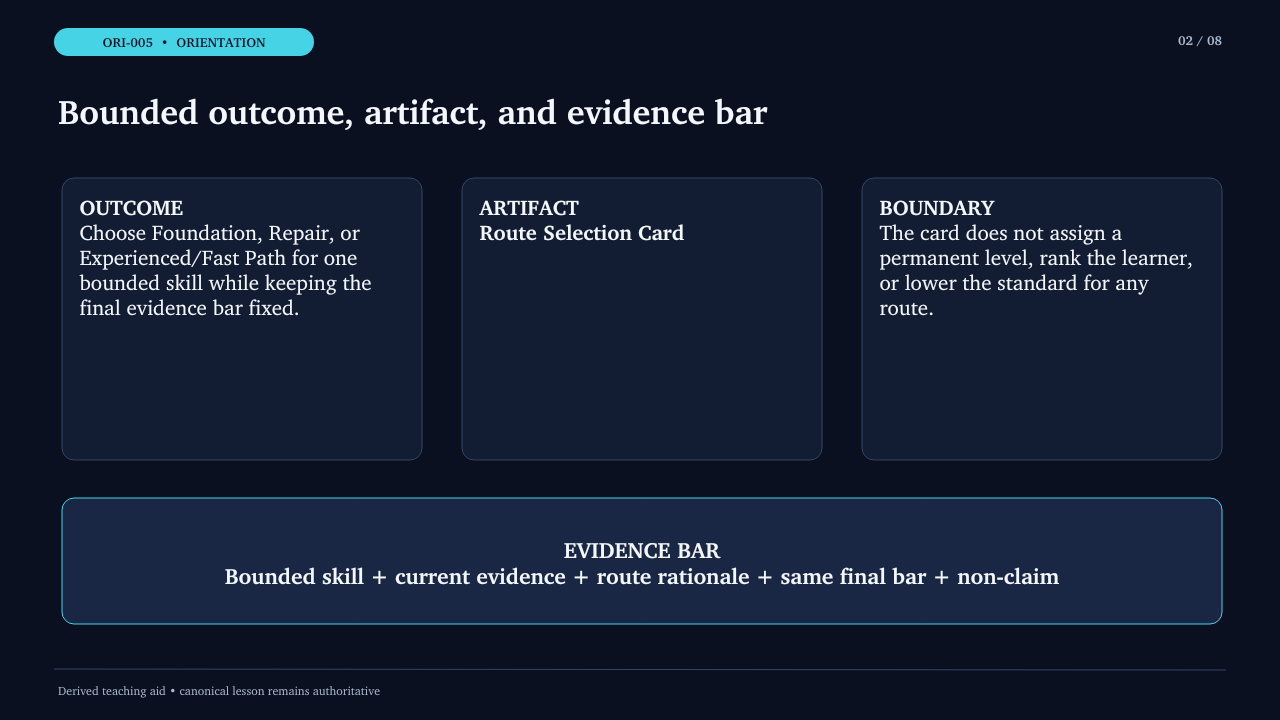
This lesson does not rank you. It teaches you to choose support for one bounded skill or outcome using inspectable evidence. The available routes are Foundation, Repair, and Experienced/Fast Path. The amount and shape of support may change; the final evidence bar does not.
Your deliverable is a Route Selection Card. It records what you are trying to prove, the evidence you already have, what is still fragile, the route you select, what would make you change that route, and what your decision does not prove.
This lesson does not establish technical programming mastery, job readiness, or a single global level for you. It only develops evidence-based routing for a bounded learning decision.
The central distinction: route is not the standard
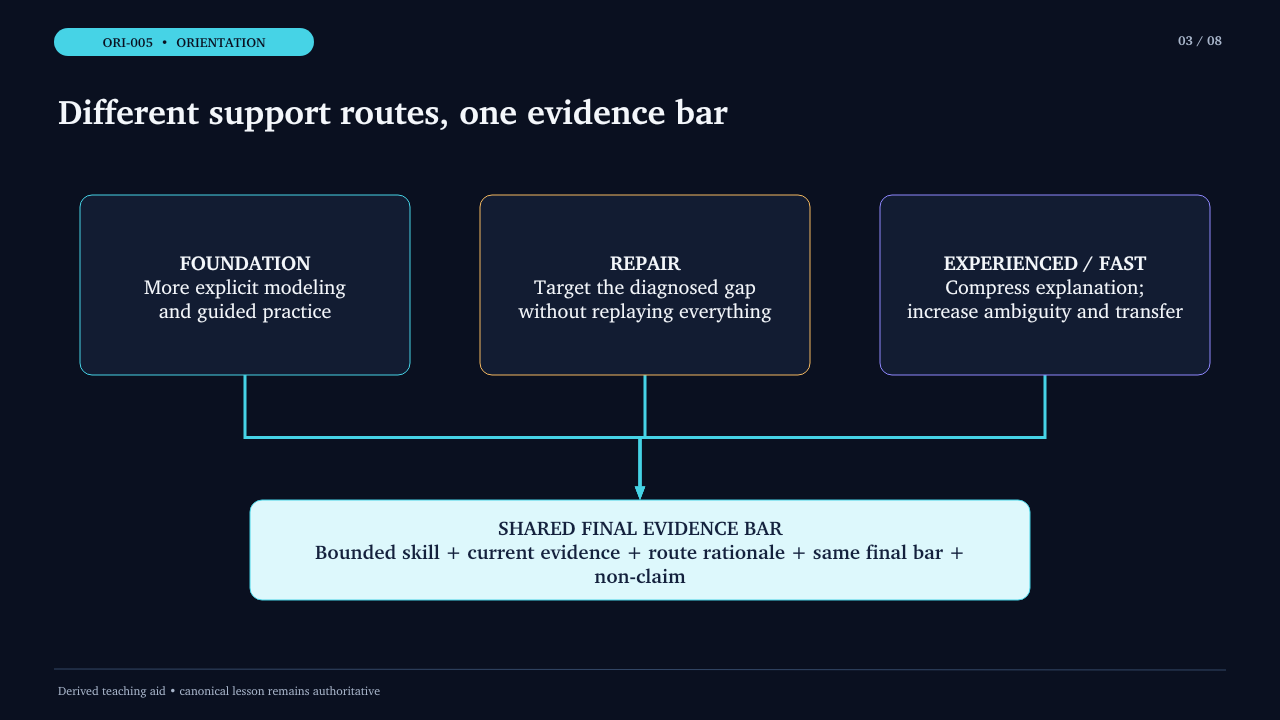
Think of the three routes as different amounts of scaffolding toward the same destination.
- Foundation fits when the evidence for independent performance is missing or fragile. You get explicit vocabulary, a worked case, and more guided practice before support fades.
- Repair fits when most of the outcome is already stable but a specific misconception or gap keeps causing failure. The intervention should target that gap instead of replaying everything.
- Experienced/Fast Path fits when current evidence is strong for the bounded outcome. Explanations can be compressed and the work can move earlier to ambiguity, trade-offs, and transfer. Evidence is still required.
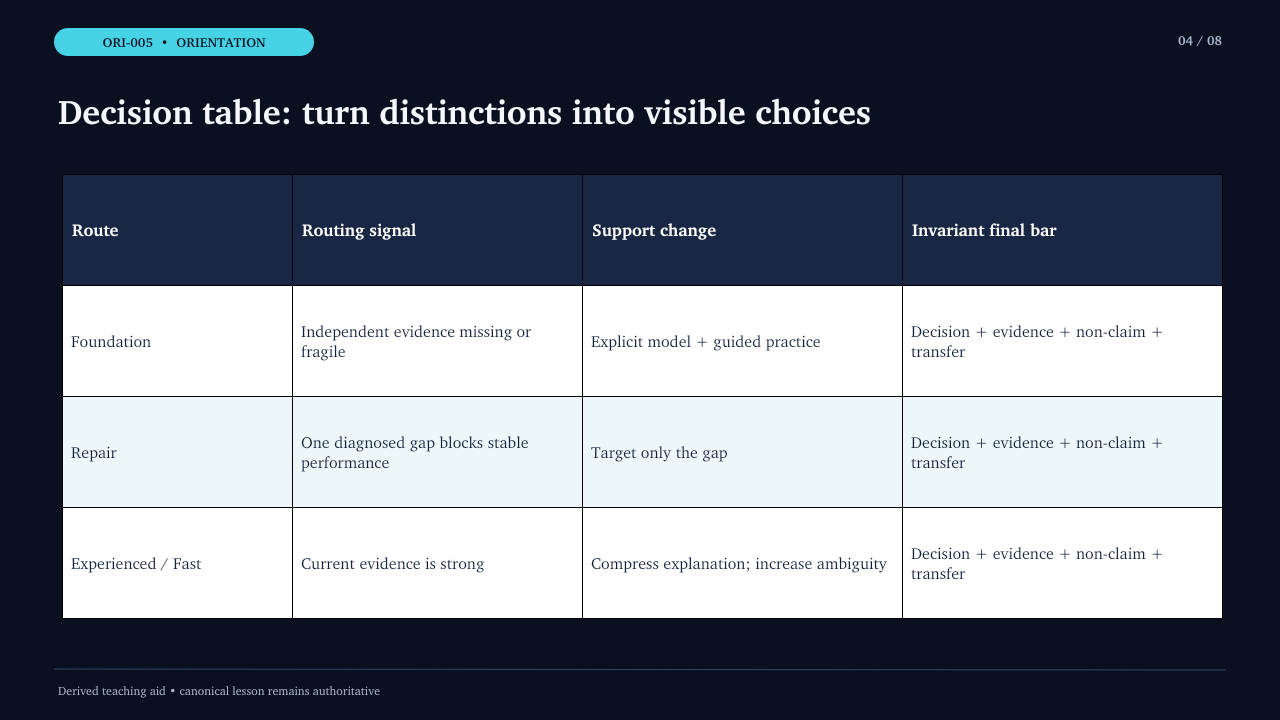
| Route | What changes | What stays fixed |
|---|---|---|
| Foundation | More explicit modeling and guided practice | The bounded outcome and final evidence bar |
| Repair | A narrow intervention on a diagnosed gap | The bounded outcome and final evidence bar |
| Experienced/Fast Path | Less explanation, more ambiguity and transfer | The bounded outcome and final evidence bar |
A different route never means that one learner is allowed to meet a weaker standard. It means the support is better matched to the evidence state.
Replace “What level am I?” with a better question
A weak routing question is:
“What level am I?”
A more useful question is:
“For this specific skill, what evidence do I have now, where is it fragile, and what support will get me to the same evidence bar without wasting effort?”
That wording prevents a global label from hiding local differences. You might be fast in one programming skill and still need a targeted repair in another. Routing should follow the skill evidence, not your identity story.
Check prerequisite evidence before routing
A prior orientation idea matters here: a learning claim should connect to something you can inspect or do, not to course order alone. Reaching this lesson, recognizing a topic, or remembering an earlier explanation is not enough to close that prerequisite.
Run this short probe before you close a route decision:
- Name one bounded programming outcome you would learn through a project or inspectable output.
- Point to one current artifact, decision, or independent performance that shows what you can do for that outcome now.
- State one limitation or fragility in that evidence.
For this routing decision, the prerequisite is sufficiently supported when you can connect the bounded outcome to concrete current evidence and name a limitation. Treat it as fragile when the only support is lesson order, familiarity, years of experience, or an unsupported AI judgment.
If it is fragile, use a targeted bridge instead of assuming a route: choose a small project-sized outcome, inspect one worked artifact or decision, then produce or examine one equivalent current artifact for the same outcome and rerun the probe. Equivalent current evidence can close the prerequisite without replaying an earlier lesson. If the evidence is still too thin to defend a route, use bounded defer.
Absolute-beginner readiness gate — before the first coding lab
Foundation means more support for the same bounded skill; it does not, by itself, guarantee that you already know programming syntax from zero. If you have never read, run, and changed a tiny program, use this probe before finalizing your route. It is not a ranking test. It only detects whether you need a short bridge before the first executable lab.
Read this code; you do not need to have memorized the syntax:
def open_tasks(tasks):
    result = []
    for task in tasks:
        if task["completed"] is False:
            result.append(task)
    return result
Five readiness questions:
- Can you explain that
tasksis the function input andresultis a local name used to collect the answer? - Can you predict that
completed is Falsekeeps only records that are not completed? - Can you state, in one sentence, the difference between a source-code file, a data file, and a value that exists in memory while a program runs?
- Can you run a provided command from the correct directory and locate a
PASS/FAILresult or traceback? - If a test says
expected [1, 3]butactual [1, 2, 3], can you identify that the observed behavior differs from the expected behavior even if you cannot repair it yet?
If 4 or 5 are clear: choose the route using evidence for the bounded skill. This gate does not block Repair or Fast Path.
If 2 or 3 are clear: Foundation is the safer support route for early coding work. Before the first independent execution, complete the bridge embedded in FND-003 and run its probe.
If 0 or 1 are clear: this is not a failure and it does not lower the final standard. Your state is Absolute-Beginner Bridge Required. When you reach FND-003, complete the “Programming Run & Read Bridge,” then re-check the five abilities above. After the bridge, the normal course evidence bar still applies.
This gate makes no claim about talent, job readiness, or your global level. It exposes one hidden prerequisite only: before an executable coding lab, you must be able to read a tiny program, run it, locate a failure, make a bounded change, and rerun evidence.
When evidence is not enough: bounded defer
Defer is not a fourth route. It is a temporary exit when the evidence needed to distinguish Foundation, Repair, and Experienced/Fast Path is missing, contradictory, or too stale to support a defensible choice.
A defensible defer records:
- exactly which evidence is missing or uncertain;
- the smallest probe, artifact, or changed-context attempt that can supply it;
- the evidence condition that will reopen and close the route decision;
- one non-claim about what the defer does not prove.
Once that evidence exists, choose one of the three routes. Defer cannot be used to skip evidence, avoid a decision indefinitely, or lower the final evidence bar.
Build a Route Selection Card
Use a separate card for each important bounded outcome:
- Skill / bounded outcome — What exactly must be done?
- Current evidence — What artifact, explanation, decision, or independent performance is available now?
- Fragility / constraint — Where is the evidence missing, stale, incomplete, or dependent on support?
- Route decision — Foundation, Repair, or Experienced/Fast Path?
- Support to use — What help is necessary, and what help would merely repeat mastered work?
- Final evidence bar — What evidence must every route eventually produce?
- What would change the route? — What new evidence would force a different decision?
- Non-claim — What does this card explicitly not prove?
Skill / bounded outcome:
Current evidence:
Fragility / constraint:
Selected route:
Support to use:
Final evidence bar:
Evidence that would change this route:
Non-claim:
Worked contrast: one outcome, three evidence states
Assume the bounded outcome is: “Produce an independent programming artifact, explain a key decision, and adapt the approach when the task changes.” This orientation lesson is not judging the technical correctness of the programming artifact; it is judging the routing logic.
State A — Foundation
Current evidence: the learner can follow a completed example but cannot organize the task independently and cannot explain why a major decision was made.
Decision: Foundation.
Why: independence is not yet supported by evidence. A visible model, one worked case, and guided practice are appropriate.
What would change the route: an independent artifact in a new case plus a defensible explanation of the major decision.
Non-claim: Foundation does not mean the learner is weak or a beginner in every programming topic.
State B — Repair
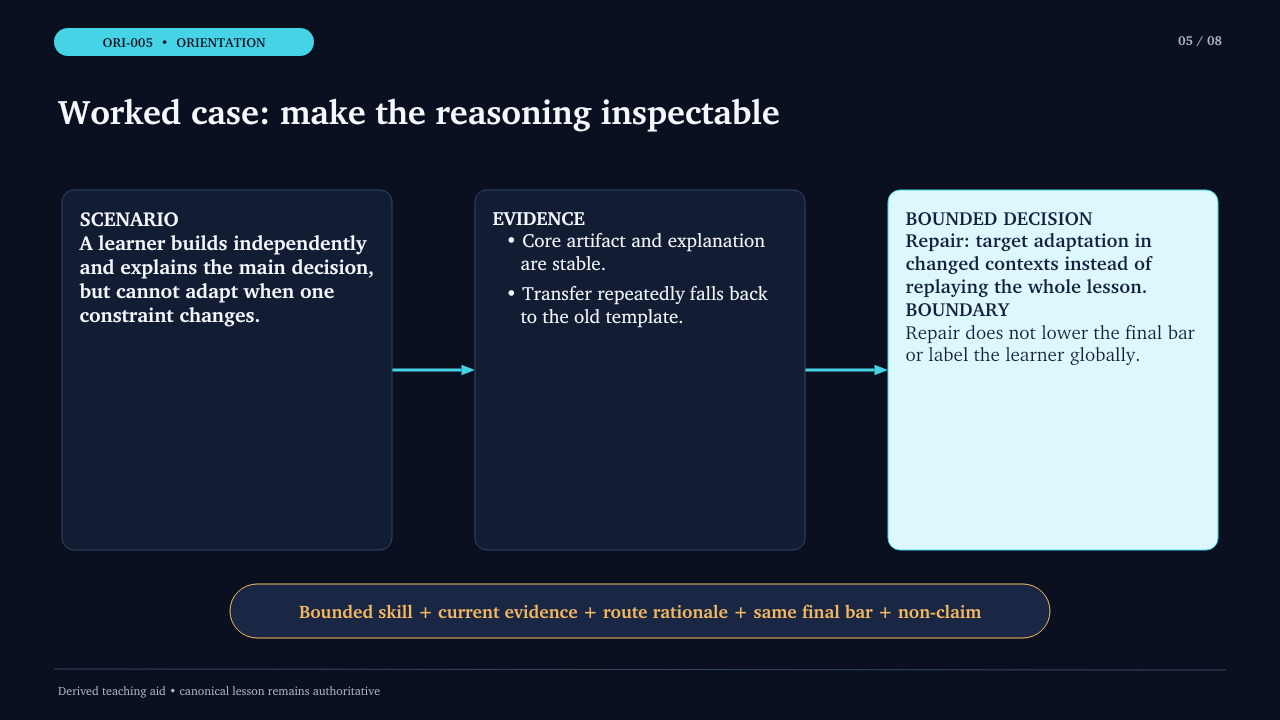
Current evidence: the learner can produce the main artifact and explain the overall approach, but the same error appears whenever one specific constraint changes. The rest of the outcome is stable.
Decision: Repair.
Why: replaying the full lesson adds little value. The evidence points to a narrow, diagnosable gap.
What would change the route: handling that constraint correctly across two different contexts with an independent explanation.
Non-claim: Repair does not lower the standard; it narrows the intervention.
State C — Experienced/Fast Path
Current evidence: the learner creates the artifact without a template, explains the key decisions, and adapts the method successfully in a changed context.
Decision: Experienced/Fast Path.
Why: introductory support is unlikely to add much. The learner should encounter harder ambiguity and transfer earlier.
What would change the route: new evidence that shows hidden dependence on a template or memorized pattern. That may justify Repair or Foundation for the affected dimension.
Non-claim: experience or one successful performance never grants a permanent exemption from the final evidence bar.
A plausible shortcut that fails
“I have programmed for three years, so I should use Fast Path everywhere.”
The problem is not the experience. The problem is that history has replaced evidence for the specific outcome. Experience can be a useful initial signal, but it cannot close the routing decision by itself.
A stronger version is:
“For this bounded outcome, I have two independent artifacts and successful transfer in a changed case. I will use Experienced/Fast Path. If the next transfer task shows that my performance depends on a template, I will route the affected gap to Repair. This decision makes no claim about my overall programming ability.”
Three misconceptions to remove
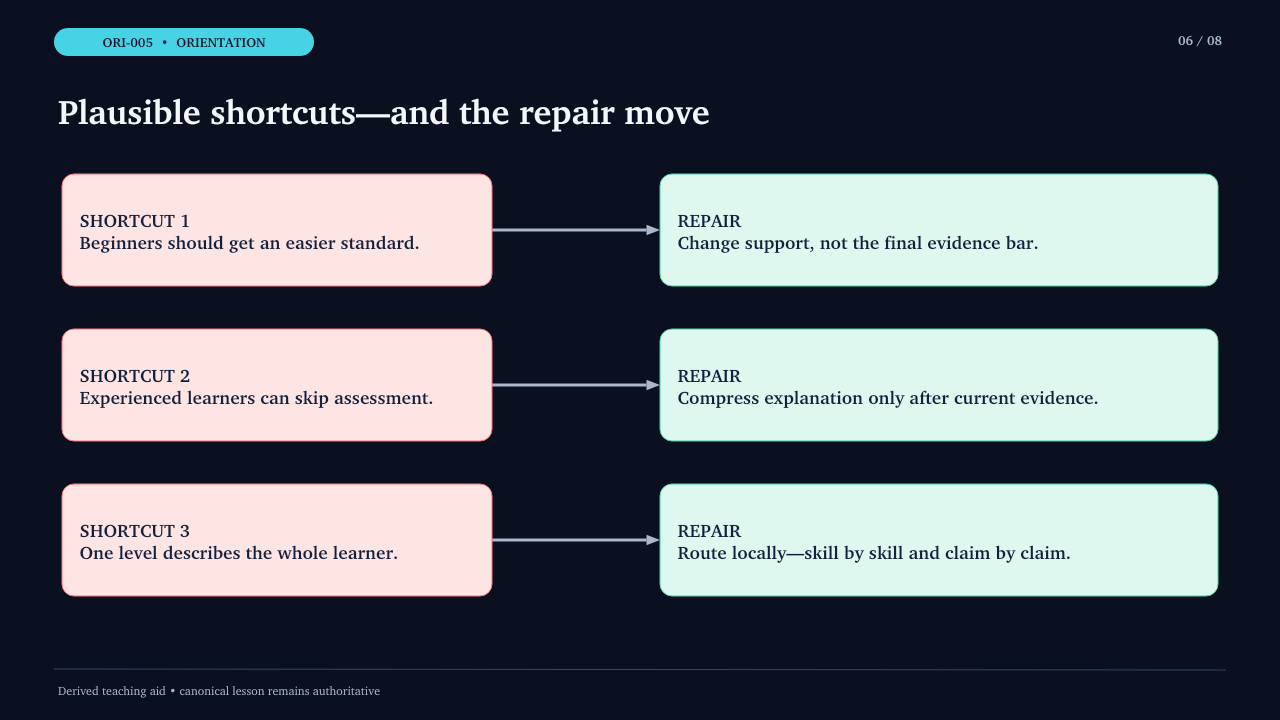
1. “Beginners should have an easier evidence standard”
No. Foundation changes scaffolding, not the destination. The learner may receive more explanation and practice, but the final evidence requirement for the bounded outcome remains fixed.
2. “Experienced learners can skip assessment”
No. Fast Path can skip redundant explanation or repetitive practice. It cannot skip the evidence that justifies the claim. Prior experience matters only when it is connected to current evidence for the outcome being routed.
3. “One level describes the whole learner”
No. Routing is local. The same person can be Experienced for one skill, in Repair for another, and in Foundation for a third. That is not inconsistency; it is a more precise model.
What counts as useful routing evidence?
Strong evidence is tied to the claim you are making. It can include:
- an artifact produced without step-by-step prompting;
- an explanation of why a decision was made;
- a short diagnostic that isolates a specific gap;
- successful use of the method in a changed context;
- a failure or constraint that reveals fragility in previous evidence.
Weak evidence for a final routing decision includes:
- “I have seen this lesson before”;
- “the title sounds familiar”;
- “I have several years of experience”;
- “an AI said my answer was correct” when there is no independent correctness check or required human judgment.
AI can assist, but it cannot own the final route decision
AI may suggest route options, surface counterexamples, summarize evidence you provide, or critique your rationale. It must not:
- make the final route decision for you;
- generate the answer and then act as the sole judge of its correctness;
- invent experience, artifacts, or evidence that you did not provide.
At least one important decision in the Route Selection Card must remain defensible without an AI choosing the answer.
Guided practice
Consider this bounded outcome:
“Produce an independent solution, explain the main decision, and adapt the method after a small change to the task.”
Suppose the evidence is:
- the original artifact was produced independently;
- the explanation is coherent;
- when the task changes, the learner falls back to the old template and does not adapt.
A defensible route is Repair. The core performance is present, but transfer is fragile. The repair should target adaptation in a changed context rather than replaying the entire lesson.
A complete answer must also state what new evidence would close the repair and what the decision does not prove.
Independent transfer: create three evidence states
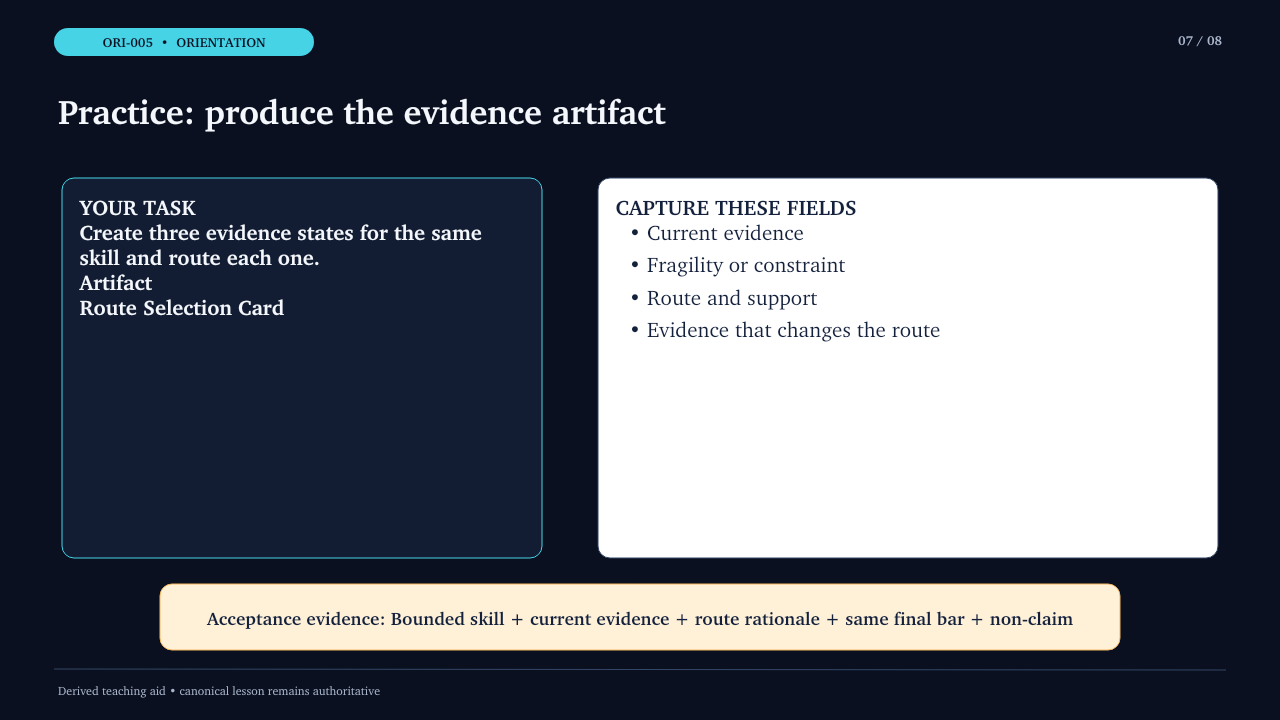
Choose one programming skill. Create three different evidence states for that same skill:
- one state that justifies Foundation;
- one state that justifies Repair;
- one state that justifies Experienced/Fast Path.
Keep the final evidence bar identical in all three. For each state, record:
- current evidence;
- route and rationale;
- evidence that would change the route;
- one non-claim.
If you only change the route labels while the evidence and thresholds remain vague, the transfer is not complete.
Pre-decision check
A Route Selection Card is stronger when you can answer all of these:
- Is the skill or outcome bounded tightly enough?
- Does the route follow evidence rather than a self-label?
- Can you name the evidence that would change the route?
- Have you kept support separate from the final evidence bar?
- Have you stated at least one limitation or non-claim?
- Can you use the same reasoning in a changed context instead of copying the worked example?
Decision summary
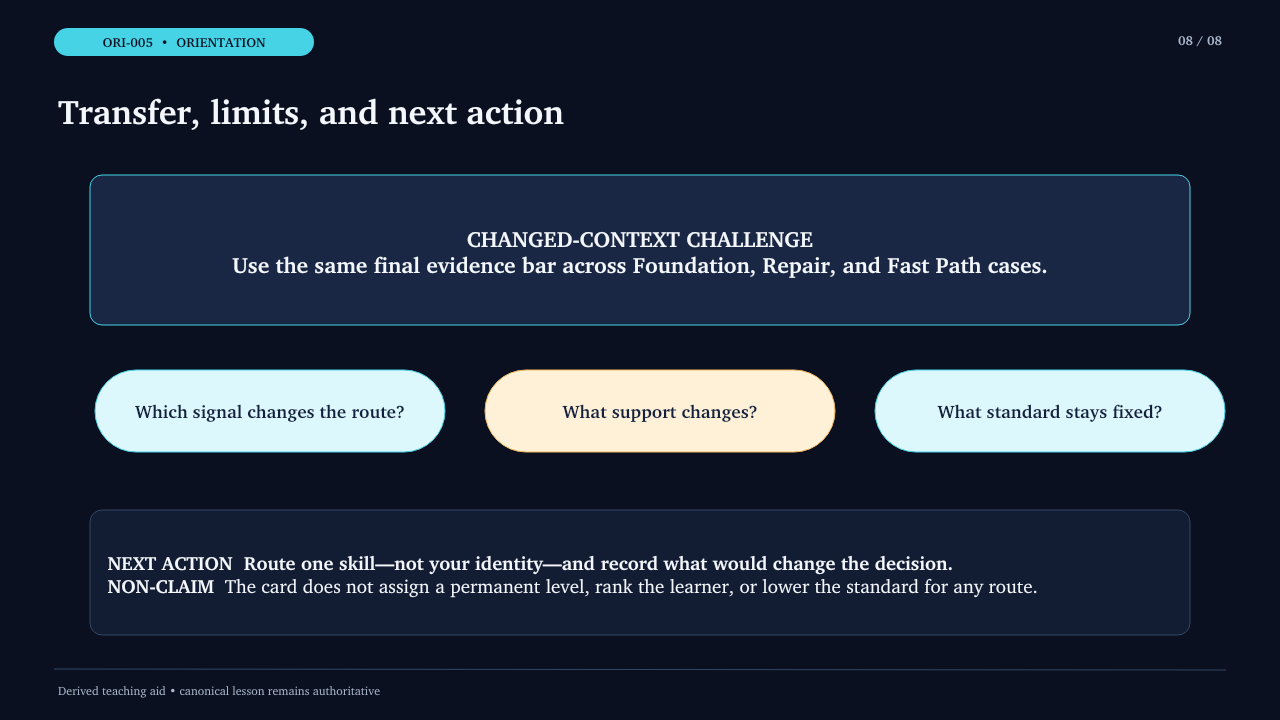
Personalization means adjusting support to the current evidence state of a bounded skill. Foundation, Repair, and Experienced/Fast Path are not three quality levels. They are three routes that converge on one evidence bar.
The required output of this lesson is a Route Selection Card that makes the decision, evidence, constraint, change condition, and non-claim inspectable. That is what allows a learning path to become faster or more supportive without weakening the standard.
Assessment
There is no answer key in this lesson pack; answer it yourself and mark honestly. "Needs review" sends the lesson to your review queue.
Q1 retrieval
Q2 application
Q3 diagnosis
Q4 decision
Q5 transfer
Assessment rubric
Critical dimensions
1. Decision/scope correctness — critical
Decision matches a bounded outcome and does not become a global learner label.
2. Evidence adequacy — critical
Evidence or constraint supporting/changing the route is explicit.
3. Non-claim honesty — critical
At least one thing the decision does not prove is explicit.
4. Transfer — critical
Method is adapted in a changed context rather than copied.
Blocking failure conditions
- decision without evidence
- global self-label replaces skill evidence
- final evidence bar changes by route
- non-claim missing
- transfer is surface-copy
- complete artifact missing support_to_use
- complete artifact missing final_evidence_bar
- defer treated as a fourth route
Human decision policy
AI may suggest options, counterexamples, or critique; it may not make the final route decision, act as the sole judge of its own answer, or invent learner evidence.
What passing does not prove
- technical programming mastery
- job readiness
- whole-program mastery
References & freshness
Case studies
Lesson media & slides
Teaching files (download)