بازگشت به مهندسی مدرن و کار با هوش مصنوعی · فصل صفر — جای خودت را در مسیر پیدا کن · 6
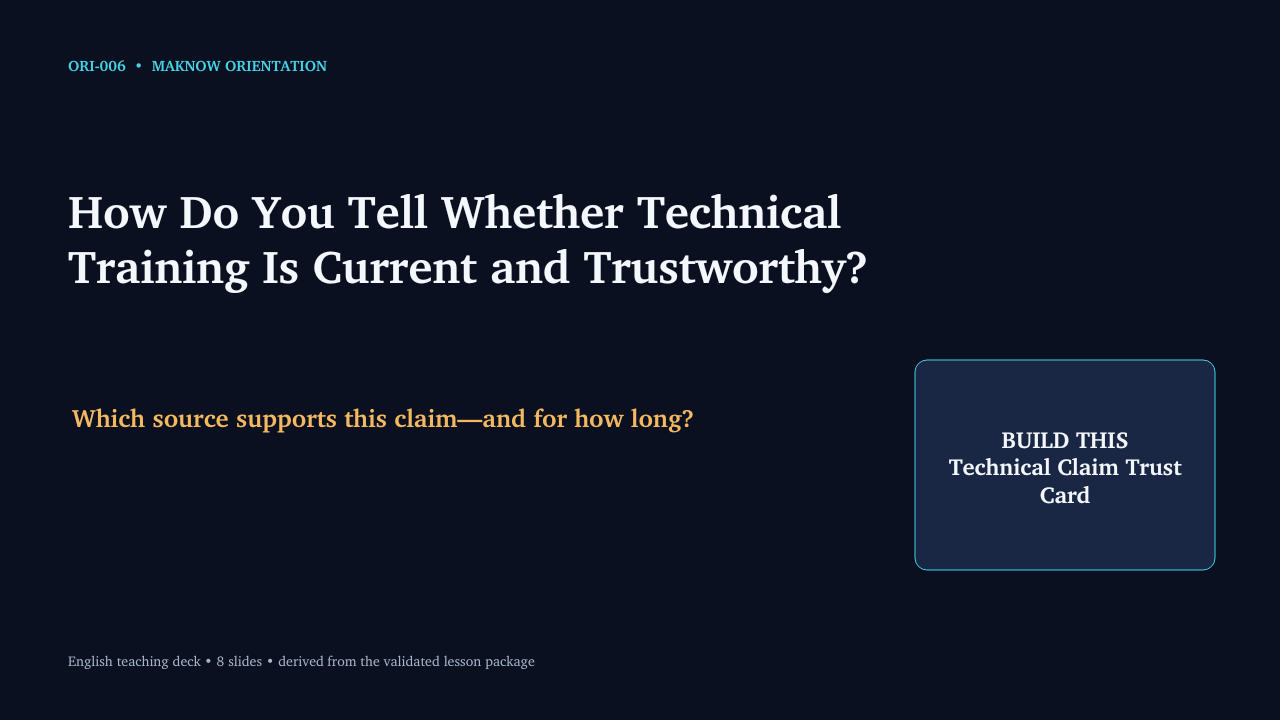
How Do You Tell Whether Technical Training Is Current and Trustworthy?
Evaluate whether a technical learning claim is trustworthy and current by checking authority, provenance, claim boundary, retrieval date, and review trigger.
Lesson summary
Evaluate whether a technical learning claim is trustworthy and current by checking authority, provenance, claim boundary, retrieval date, and review trigger.
Who it is for
Foundation
Explicit vocabulary + worked case + guided artifact.
Repair
Target the diagnosed misconception; do not replay mastered material.
Experienced
Compress explanation; increase ambiguity, contrast and transfer demand.
Prerequisites
Two technical tutorials give you conflicting advice. One was published yesterday and sounds certain. The other points to versioned official documentation but is older. Publication date, search rank, polished design, and confident language do not tell you which claim is actually supported or how long that support remains useful.
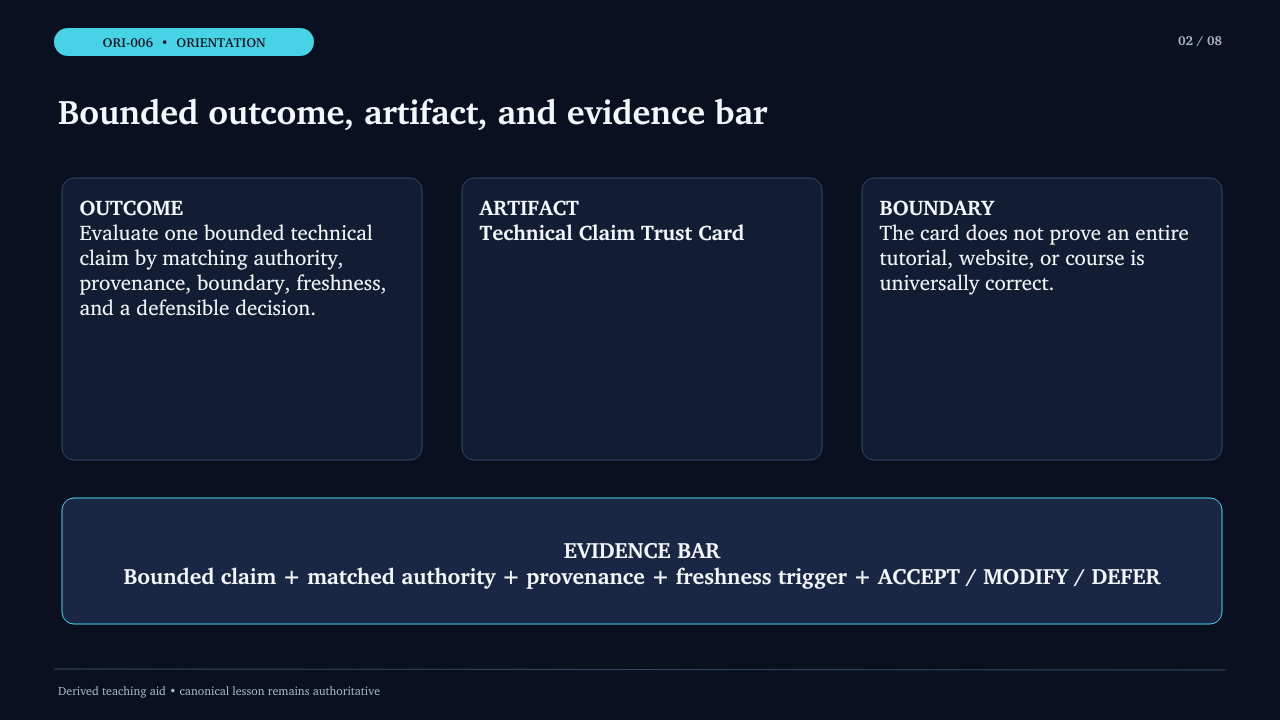
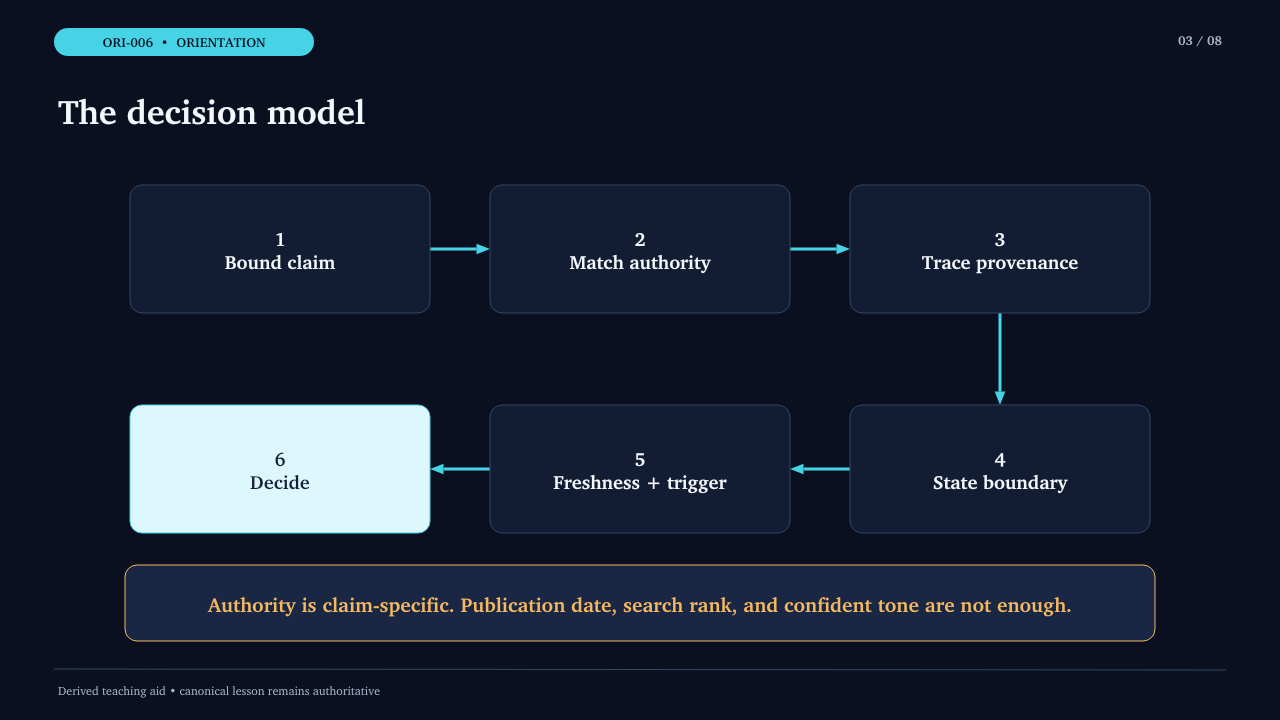
This lesson is not a list of websites that are “always trustworthy.” You will evaluate one bounded technical claim by matching it to an appropriate authority, tracing provenance, limiting the claim to what the source really supports, recording when you checked it, defining what should trigger another review, and then choosing ACCEPT, MODIFY, or DEFER.
Your output is a Technical Claim Trust Card. The card makes your reasoning inspectable instead of reducing trust to a feeling.
This lesson does not prove technical mastery, job readiness, or that every statement in a tutorial is correct. It develops bounded judgment about one claim and the evidence used for that claim.
Before you start: a short prerequisite probe
Pick any technical sentence and write two separate lines:
- Claim: What exactly is being asserted?
- Evidence/Source: What evidence or source could support that assertion?
If you cannot separate those two lines, use a short bridge first: choose a simple factual statement, separate the assertion from the reason or source offered for it, and only then continue to the trust card. The dependency is soft: fragile evidence calls for targeted repair, not silent waiver.
Choose support from your current evidence
The destination does not change: every route must end with a complete Technical Claim Trust Card and the same evidence standard. The route changes only how much support you use before that evidence.
- Foundation — use this route if authority, provenance, claim boundary, freshness, or the three decisions are still unfamiliar. Follow the central model, build the card with the template, study the worked cases, then complete the guided practice before independent transfer.
- Repair — use this route when the problem is specific. Do not replay the whole lesson. If you confuse claim with evidence, redo only the prerequisite bridge. If you choose sources by reputation or publication date, revisit authority + boundary and the shortcut example. If provenance is the weak point, revisit provenance and the AI-citation failure. If freshness/review timing is weak, revisit checks 5–6 and the source-class table. Then repair one card and continue.
- Experienced / Fast Path — if you can already separate claim from evidence and can produce all twelve card fields with a defensible boundary, skim the central model and source-class table, skip the worked cases unless a field fails, and go directly to the unresolved-source practice plus the changed-context transfer. This route removes explanation; it does not remove ambiguity or evidence requirements.
If a route stops fitting the evidence, switch support. A missed field or weak rationale can move Fast Path into targeted Repair; a successful repair can return you to independent transfer. Route choice is about the current evidence state, not about labeling the learner.
Common evidence bar for all routes: one complete card with claim-specific authority, traceable provenance, explicit boundary, freshness/retrieval handling where needed, ACCEPT/MODIFY/DEFER with rationale, decision-change evidence, non-claim, and a changed-context transfer that does not copy the worked example.
The central model: authority has a boundary
No source is the best authority for every kind of technical claim. Start by bounding the claim, then choose a source class that is close to that claim.
Examples:
- For a release-support status, the project’s release schedule or official version documentation is usually more direct than a tutorial article.
- For API behavior in a specific version, versioned documentation and release notes are closer to the claim.
- For an experimental workaround, an issue thread and a reproducible case may provide useful evidence, but the claim should stay narrower than “this always works.”
- For security guidance, the fact that old tutorial code still runs does not establish that the recommendation is still supported or safe.
So the useful question is not “Is this website trustworthy?” It is:
“For this specific claim, within this boundary, at this time, what does this source actually support?”
Seven checks before ACCEPT
1. Write the claim precisely
“Newer Node is better” is too broad. “What release status does version X have on date Y?” is narrow enough to verify against an appropriate source.
2. Match authority to the claim
Authority is claim-specific. A tutorial can be excellent for explanation while still being the wrong source for today’s support status of a runtime.
3. Trace provenance
If a tutorial says “the official docs say…,” you should be able to reach the primary source. A screenshot without a date, an unlinked quote, or an AI summary has weaker provenance.
4. State the claim boundary
A source can support only part of a sentence. If it says “version X is Current,” that does not automatically support “version X is the best production choice.”
5. Judge freshness by claim type
Claims do not age at the same rate. A stable definition may remain useful for a long time; a support status, provider capability, or security recommendation can change quickly. Use a review trigger rather than inventing one universal expiration period.
6. Record retrieved_at and a review trigger
For volatile claims, a link is not enough. Record when you checked it and what event should force another check: a new release, status change, security advisory, target-version change, or a new contradiction.
7. Close the decision: ACCEPT, MODIFY, or DEFER
- ACCEPT — current evidence supports the bounded claim within the stated boundary.
- MODIFY — the source is useful, but the claim is too broad, stale, or badly framed; narrow or update it.
- DEFER — evidence is insufficient, untraceable, or materially unresolved. Do not force certainty yet.
DEFER is not failure. It is the honest output when evidence does not justify a reliable decision.
Build a Technical Claim Trust Card
Use one card per important claim:
- Technical claim — the exact sentence you are evaluating.
- Claim type — stable, version-specific, security-sensitive, provider/tool capability, or experimental/community.
- Authority/source — which source is appropriate for this claim?
- Provenance — where is the primary source, and can it be traced?
- Claim boundary — what part of the claim does the source actually support?
- Freshness state — relatively stable or volatile?
- Retrieved at — when was the source checked?
- Review due/trigger — what date or event requires another check?
- Decision — ACCEPT / MODIFY / DEFER.
- Rationale — what evidence and constraint drive the decision?
- What would change the decision? — what new evidence would force a different result?
- Non-claim — what does this card not prove?
Technical claim:
Claim type:
Authority/source:
Provenance:
Claim boundary:
Freshness state:
Retrieved at:
Review due/trigger:
Decision: ACCEPT / MODIFY / DEFER
Rationale:
Evidence that would change the decision:
Non-claim:
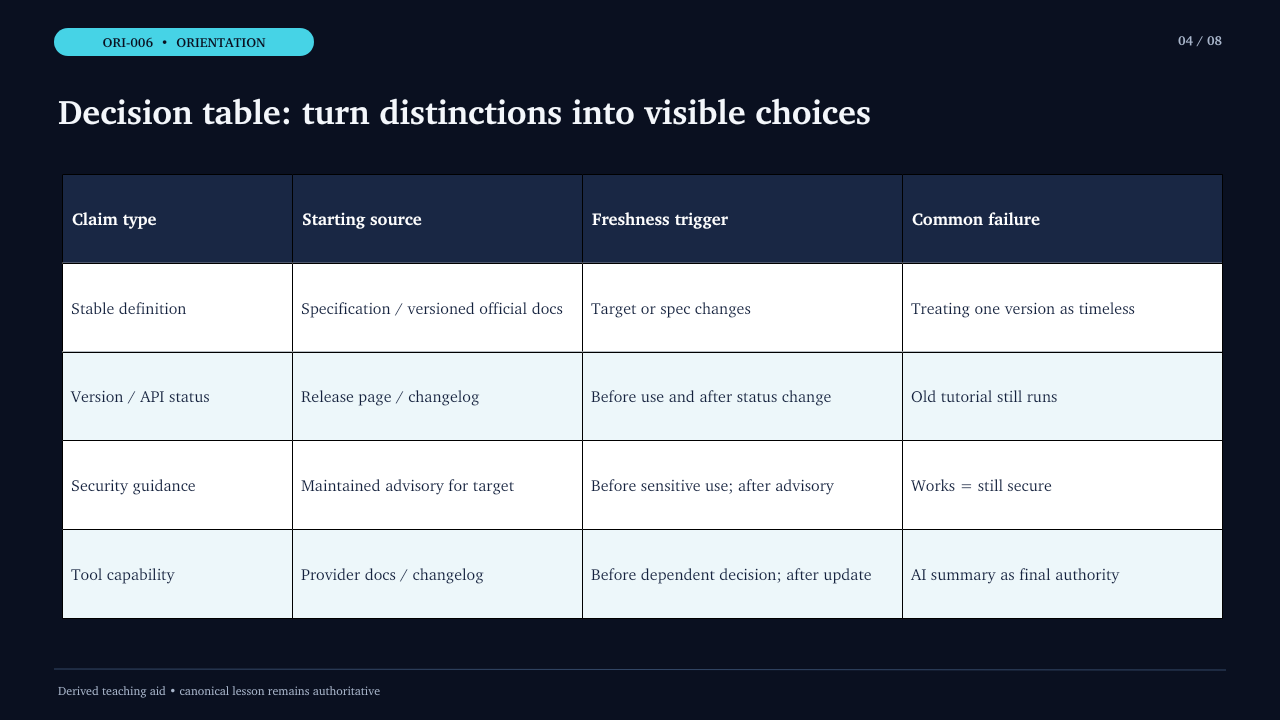
Match source class to claim type
| Claim type | Useful starting source | Freshness check | Common failure |
|---|---|---|---|
| Stable rule or definition | specification or versioned official documentation | Recheck when the target/spec changes or a credible contradiction appears | Turning one-version guidance into a timeless rule |
| Version/runtime/API status | release page, versioned docs, changelog | Record retrieved_at; recheck before consequential use and after release/status changes | Trusting an old tutorial because its code still runs |
| Security recommendation | maintained security advisory/guidance for the target product/version | Recheck before sensitive use and after relevant advisories or version changes | Treating “works” as “still secure” |
| Tool/service capability | provider documentation or changelog | Recheck before a capability-dependent decision and after product updates | Treating an AI summary or secondary post as final authority |
| Community workaround | issue/reproduction plus a more direct source where possible | Keep the boundary narrow; recheck after version changes | Generalizing one local workaround into a universal rule |
The table deliberately avoids a universal fixed cadence. Freshness follows the claim type and its change triggers.
Real case 1: “Newest means best for production”
Suppose a tutorial makes this claim:
Claim: “Node.js 26 is the best production choice because it is the newest major release.”
On 2026-09-05, the official Node.js releases page lists v26 as Current, while v24 and v22 are listed as LTS. The same page directs production applications toward Active LTS or Maintenance LTS release lines.
A defensible card would say:
- Authority/source: official Node.js release-status page.
- Provenance: primary project release page.
- Claim boundary: the source supports release status and the project’s production-support policy; it does not prove a universal “best” choice.
- Freshness: volatile.
- Retrieved at: 2026-09-05.
- Review trigger: release-status change, a new LTS transition, or the next production-runtime selection.
- Decision: MODIFY.
- Narrower claim: “On 2026-09-05, v26 is Current; production support status should be checked against the official LTS release page.”
- Non-claim: this card does not determine performance or suitability for every project.
“Newest” may be a fact, but it does not create authority for the broader recommendation.
Real case 2: code still runs, but the support claim is stale
Suppose an older tutorial says:
Claim: “Node.js 20 is a supported line for a new deployment today.”
On 2026-09-05, the project’s End-of-Life page lists Node.js 20 as EOL, last updated on 2026-03-24, and explains that EOL release lines stop receiving project updates, including security patches.
The current support claim should be MODIFY. Parts of the tutorial may still teach stable syntax or concepts, but its present-tense support recommendation must be rewritten against current evidence.
This is the key distinction: “the example still executes” is not evidence that the training is current.
Case 3: an over-broad Python claim
Suppose a tutorial says:
Claim: “This behavior exists in Python 3.”
But the behavior is version-specific. Python’s official “What’s New” documentation is organized by version and records features, deprecations, removals, and porting changes separately.
If the tutorial does not identify the target version, DEFER can be the correct decision until the version is known. Then narrow the claim to the version the source actually covers.
A plausible shortcut that fails
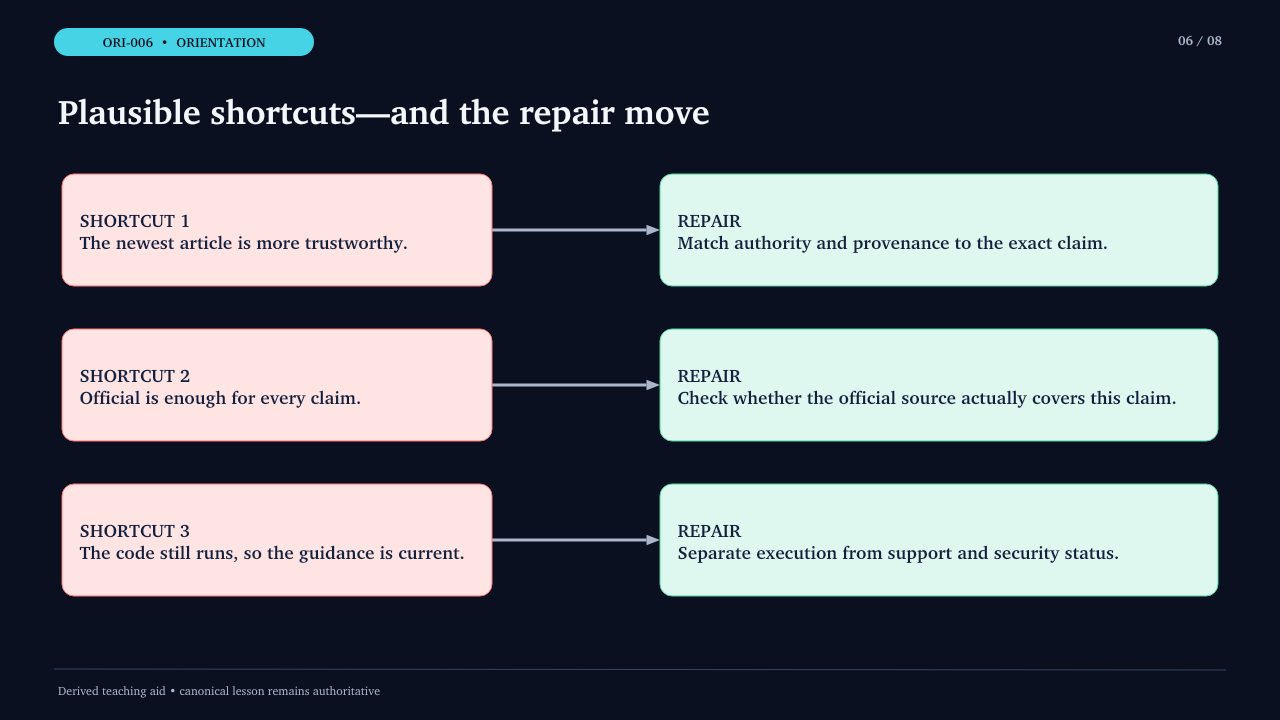
“This article was published yesterday, so it is more trustworthy than documentation from two years ago.”
The problem is that publication date has replaced authority and claim match. A new article can repeat stale material or extend a claim beyond its source. A versioned specification or documentation page may still be the direct authority for the claim you are checking.
A better method is: bound the claim, locate the direct source, record the boundary, record freshness, then decide.
Three other common mistakes
“Official is enough for every claim”
No. Official status matters, but source-to-claim fit still matters. Release notes are direct evidence for release behavior; they may not answer an independent benchmark or a project-specific trade-off.
“The AI gave me a citation, so the claim is verified”
No. AI can help locate or summarize sources, but the citation must resolve to inspectable evidence and you must compare the source boundary to the claim yourself.
“If the tutorial still works, it is current”
No. One section may remain stable while another section—especially version status or security advice—has become stale. Evaluate the claims separately.
AI can assist, but it cannot own the decision
AI may:
- suggest a narrower claim;
- surface conflicting sources;
- summarize evidence you provide;
- ask what evidence would change your decision.
AI must not:
- close ACCEPT/MODIFY/DEFER for you without your defensible rationale;
- generate the answer and then act as the sole judge of its correctness;
- invent a source, retrieval date, or experience that does not exist.
At least one important card decision must remain defensible from the source and boundary without an AI choosing the result.
Guided practice
Evaluate this claim:
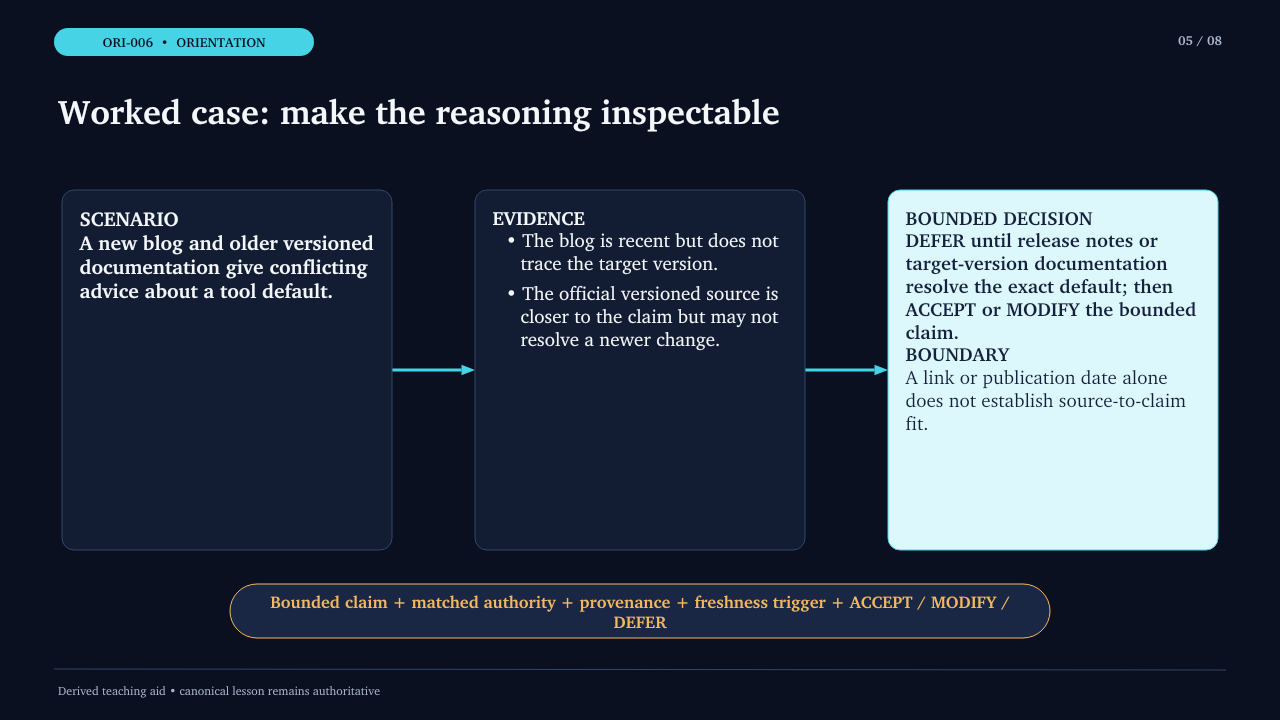
“A blog published yesterday says a particular option is now the default in the current version of a tool, but the versioned documentation you found for the target version does not show that default.”
A weak answer is: “The blog is newer, so ACCEPT.”
A stronger decision is DEFER until release notes or official documentation for the exact target version resolves whether the default changed. Record the target version, sources, retrieved_at, and the evidence that would close the decision.
Independent transfer: evaluate a real claim
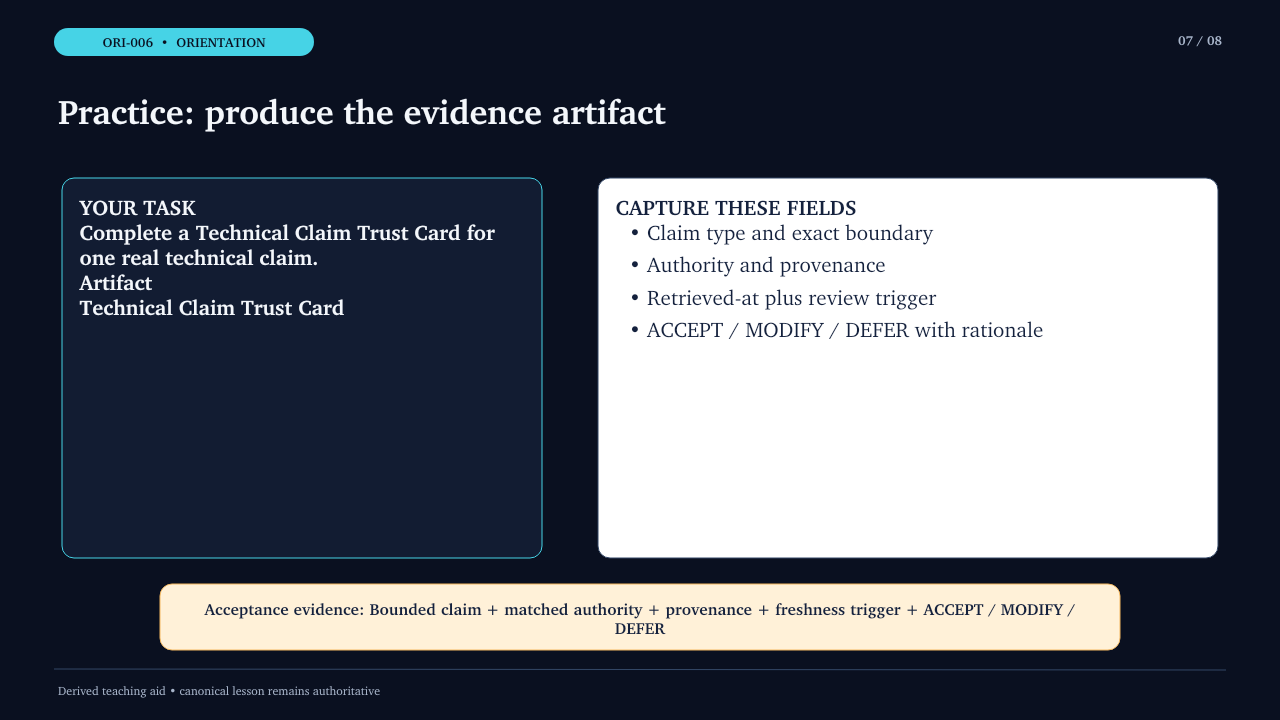
Choose one real technical claim from a tutorial, video, documentation page, forum answer, or AI response. Make it narrow enough to verify.
Complete a Technical Claim Trust Card, then:
- justify the source class;
- state the claim boundary in one sentence;
- record retrieved_at and a review trigger;
- choose ACCEPT, MODIFY, or DEFER;
- name one specific piece of evidence that could change the decision;
- state one non-claim;
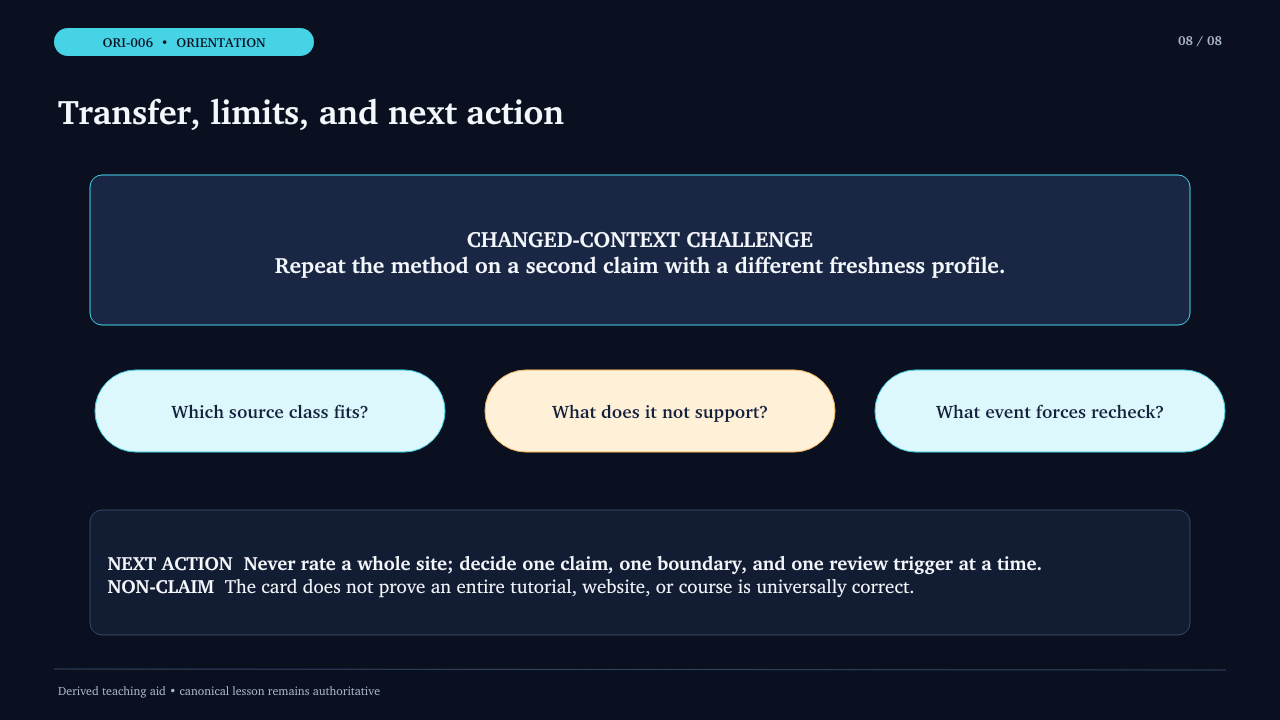
- repeat the method on a second claim in a changed context with less scaffold.
If your result is only “trustworthy/untrustworthy,” or only a link without boundary and freshness, the evidence is incomplete.
Final card check
- Is the claim precise and bounded?
- Is the source appropriate for this type of claim?
- Can you trace provenance to the primary evidence?
- Does the boundary state what the source does not support?
- Does a volatile claim have retrieved_at?
- Is the review trigger tied to a real change condition?
- Does ACCEPT/MODIFY/DEFER follow from evidence?
- Can you name evidence that would change the decision?
- Is there a non-claim?
- Can you transfer the method without copying the worked example?
Decision summary
Trustworthiness in technical training is not an absolute property of an entire website or course. Bound the claim, match it to the right authority, trace provenance, record the boundary, manage freshness with retrieved_at and a review trigger, and then choose ACCEPT/MODIFY/DEFER.
The required output is a Technical Claim Trust Card: a small artifact showing why you rely on a claim today, what remains uncertain, and what should force you to review it again.
Assessment
There is no answer key in this lesson pack; answer it yourself and mark honestly. "Needs review" sends the lesson to your review queue.
Q1 retrieval
Q2 application
Q3 diagnosis
Q4 decision
Q5 transfer
Assessment rubric
All critical dimensions must be satisfied for blocking assessment acceptance.
Decision/scope correctness
- Critical: YES
- Sufficient evidence: Decision matches one bounded technical claim and does not become a verdict on an entire website/course.
Evidence adequacy
- Critical: YES
- Sufficient evidence: Authority, provenance, boundary, freshness and constraints are inspectable enough to support/change the decision.
Non-claim honesty
- Critical: YES
- Sufficient evidence: The learner states what the card does not prove.
Transfer
- Critical: YES
- Sufficient evidence: The method is adapted to a changed claim/source context rather than copied.
Global failure conditions
- required decision without evidence
- scope inflation
- volatile claim without retrieval/review handling
- non-goal erased
- transfer is surface-copy
AI boundary
AI may suggest narrower claims, surface contradictions, summarize provided evidence, or critique. It may not choose the final ACCEPT/MODIFY/DEFER result for the learner, serve as the sole judge of its own answer, or invent sources/retrieval dates/evidence.
References & freshness
Case studies
Lesson media & slides
Teaching files (download)