بازگشت به مهندسی مدرن و کار با هوش مصنوعی · فصل صفر — جای خودت را در مسیر پیدا کن · 1
Who Is AI-Assisted Programming Learning For?
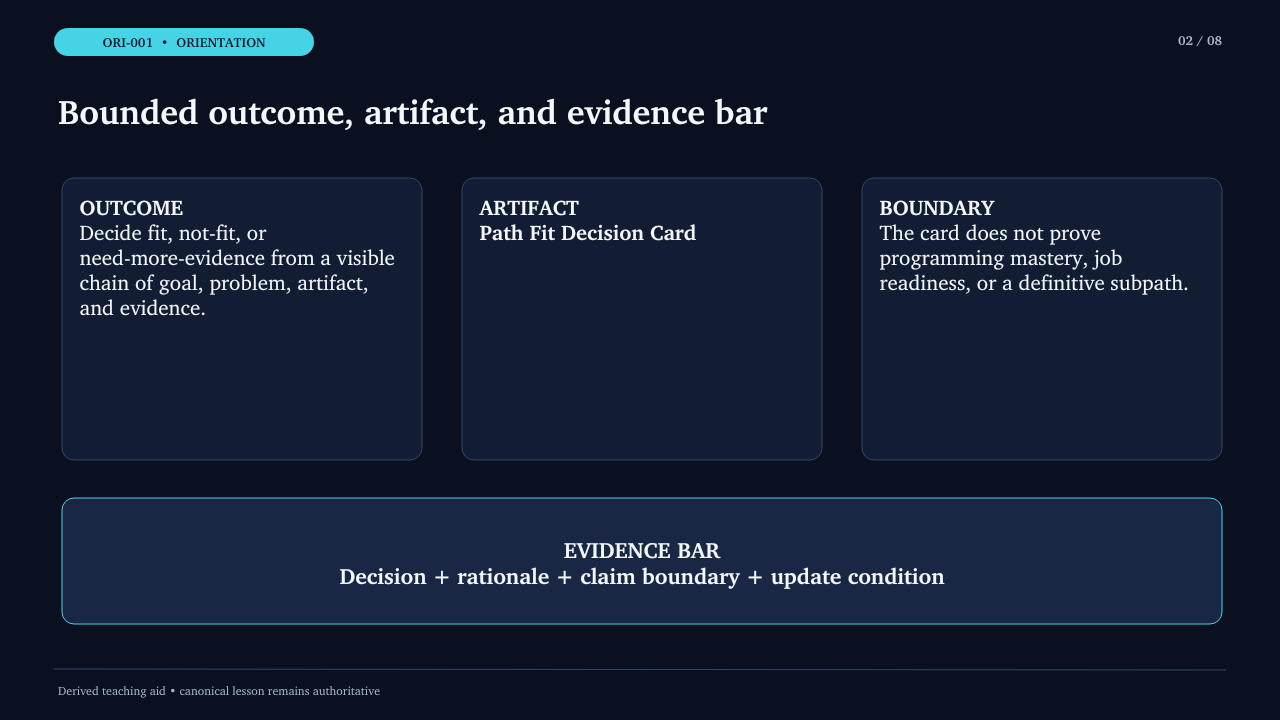
Decide whether MAKNOW's AI-assisted, evidence-based programming path fits the learner's goals, problem type, and expected responsibility.
آموزش برنامهنویسی با هوش مصنوعی برای چه کسانی مناسب است؟ — fa-IR
Lesson summary
Decide whether MAKNOW's AI-assisted, evidence-based programming path fits the learner's goals, problem type, and expected responsibility.
Who it is for
Foundation
Explicit vocabulary + worked case + guided artifact.
Repair
Target the diagnosed misconception; do not replay mastered material.
Experienced
Compress explanation; increase ambiguity, contrast and transfer demand.
Prerequisites
No prerequisites — this is a starting point.
Opening a course called “AI-assisted programming” does not answer the question that matters most. Does this learning path fit what you need right now?
MAKNOW uses AI as support, but the learner still has to understand the problem, build something inspectable, check the result, and remain accountable for the decision.
This lesson is not designed to persuade you to enroll. A defensible result may be yes, not for my current goal, or I do not have enough evidence yet. By the end, you should have more than a feeling about fit. You should have a bounded decision that another person can inspect and challenge.
Three people find the same course and need three different things
Imagine three people arriving at the phrase “learn programming with AI.”
The first is new to programming and wants to become capable of building real, small projects. AI assistance is welcome, but so are practice, mistakes, verification, and explaining why a solution was accepted. This learner is willing to show the same reasoning again when the context changes.
The second has years of technical experience but has been away from day-to-day coding. Starting from zero would waste valid prior evidence. Skipping every foundational check would be equally careless. This learner needs to separate what is still demonstrably transferable from what now needs review or fresh evidence.
The third person does not want a learning process at all. The need is a finished deliverable, immediately. Practice, verification, and later transfer are not part of the goal. That may be a legitimate need, but it is a delivery problem rather than the learning problem this path is designed to solve.
If all three are classified as a fit merely because they are interested in “programming with AI,” the decision has already been reduced to a label.
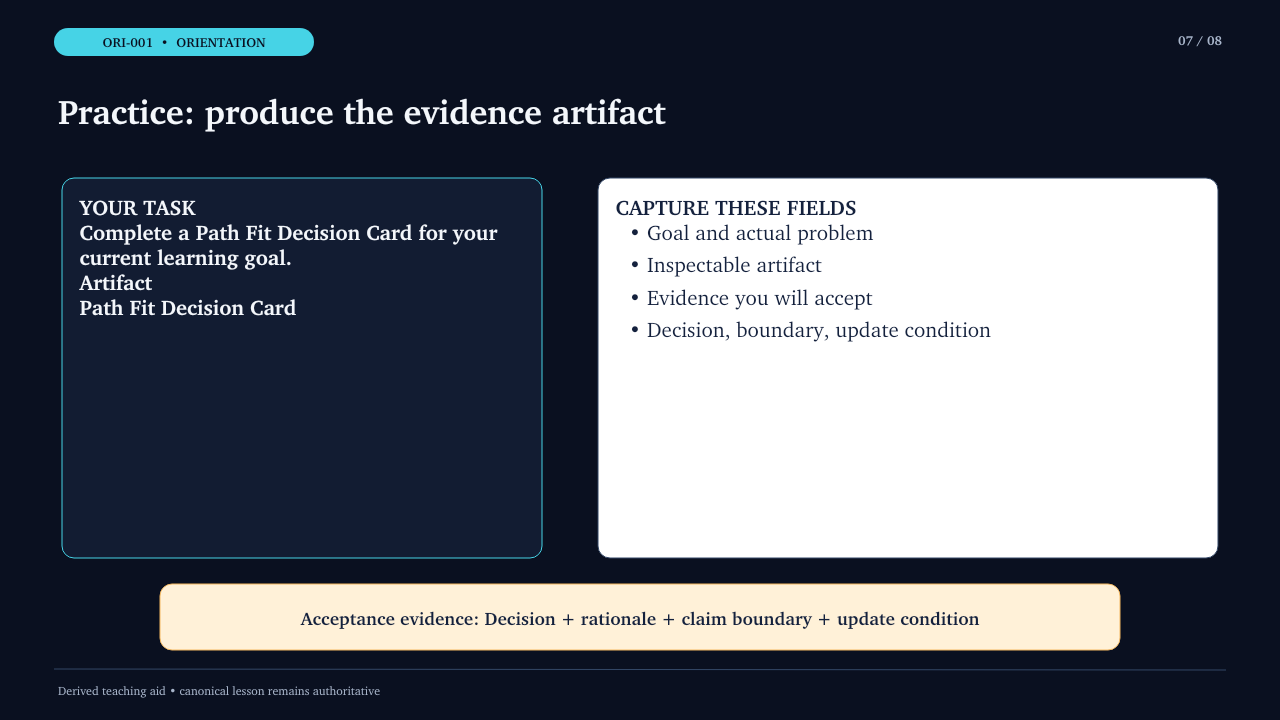
In this lesson you will build a Path Fit Decision Card. It records:
- the change you want from learning;
- the problem standing between you and that change;
- the inspectable artifact you are willing to build;
- the evidence you will accept for your own decision;
- the decision you can defend now;
- what that decision does not prove;
- and what new evidence or constraint would make you revisit it.
Before reading further, write one sentence: “Right now, I think this path is ___ for me because ___.” Keep it. You will return to the sentence at the end. The goal is not to force a different answer; it is to see whether the reasoning behind the answer becomes stronger.
Do not choose a route from a label; decide where you need support and where you can show evidence
“I'm a beginner” and “I have ten years of experience” are useful facts about context. Neither one is a complete route decision.
A new learner may need explicit vocabulary, guided examples, and more frequent practice. That suggests they may need more support at the start. It does not, by itself, justify assigning a specific subpath or prove that the whole program fits the learner's actual goal.
An experienced learner may be able to compress material that is already supported by real prior evidence. But compression should follow what can be demonstrated, not a job title or a number of years. The useful questions are narrower: What did you actually do? What artifact remains? Which decisions were yours? What part of that evidence still applies to the problem in front of you? What now needs to be checked again?
This prevents two opposite mistakes. One is making experienced learners replay material they can already defend. The other is treating experience as permission to bypass every current gap.
For now, use three questions instead of asking which identity label fits you:
- Where do I still need explanation and practice?
- Where can I show prior capability with inspectable evidence?
- Where do I not yet know enough to decide?
The third answer is allowed to be large. “I need more evidence” is a valid decision state. It is more useful than filling an empty box with confidence you cannot defend.
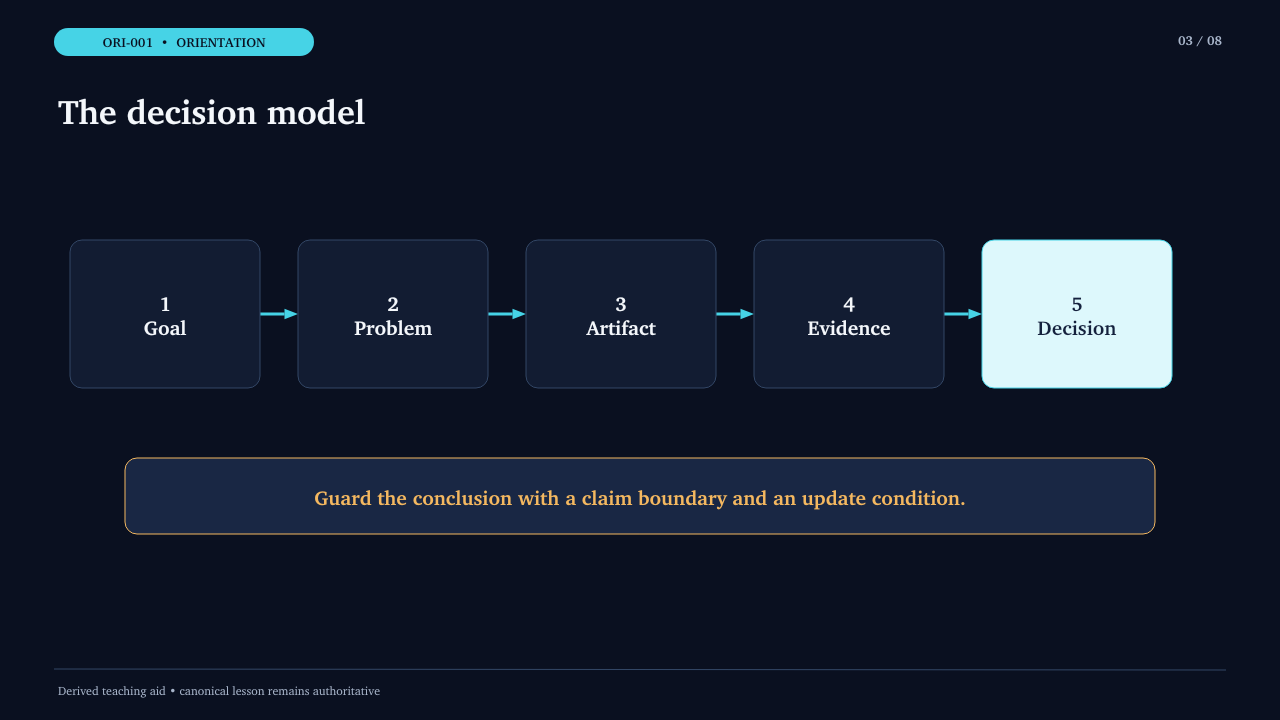
The fit model: Goal → Problem → Artifact → Evidence → Decision
Path fit in this lesson is reasoned through five links:
Goal → Problem → Artifact → Evidence → Decision
The model does not score people. It exposes the reasoning behind a decision.
1. Goal: what should be different when the learning has done its job?
“Learn programming” is a reasonable starting phrase, but it is too broad to choose a path. A more useful goal describes a change you want to demonstrate. You might take a small feature from problem to inspectable result, return to technical work after time away, or use AI assistance while keeping verification and final judgment under your control.
A different goal may be simply to get a deliverable produced. That is not an inferior goal. It is a different job to be done, so it may call for a different kind of help.
2. Problem: what is currently stopping that change?
The obstacle might be missing foundations. It might be the difficulty of returning to an engineering workflow. It might be that producing an answer feels easy while checking and defending the answer is weak. Or the obstacle may not be educational at all.
If the problem is named incorrectly, a good learning path can still be the wrong solution.
3. Artifact: what are you willing to build that someone can inspect?
An artifact is something another person can examine and ask questions about. In later lessons that may be code, tests, a design decision, or an analysis. In this lesson the artifact is the Path Fit Decision Card itself.
“Watched,” “read,” and “finished” are activity records. They are not enough to show how you reached a decision.
4. Evidence: what would make the claim more than self-description?
Evidence should match the claim being made. The claim here is deliberately small: for my current goal, I can explain why this path is a fit, not a fit, or still undecidable.
The card, its rationale, its claim boundary, and your ability to rebuild the method in another technical context are the relevant evidence for that claim. They do not establish general programming mastery.
5. Decision: what can you defend with the information available now?
A bounded decision may be:
- preliminary alignment with the path, with a likely need for more explanation and guided practice;
- preliminary alignment with the path, with prior evidence that may reduce repetition in some areas;
- not aligned with the current goal for now;
- or more evidence needed before deciding.
These are not rankings of ability or worth. The decision is only as strong as its connection to the goal, problem, artifact, and evidence that precede it. The card can clarify preliminary alignment, support needs, and a preliminary idea about what kind of route may fit, but it does not by itself select a Foundation, Repair, or Experienced subpath. A definitive subpath decision requires clear learner-facing information specific to that subpath.
Build a decision card that gives future evidence permission to disagree with you
A useful decision includes not only a reason for the current answer, but also a condition for revisiting it. If no possible evidence could change your mind, the card has become a defense brief rather than a decision tool.
Use these seven rows:
| Row | Question |
|---|---|
| Goal | What change in my current capability or situation do I actually want? |
| Problem | What obstacle is between me and that goal now? |
| Artifact | What am I willing to build and explain during this path? |
| Evidence | What would make my decision or progress inspectable rather than asserted? |
| Current decision | preliminary alignment / preliminary alignment with more support or use of prior evidence / not aligned now / need more evidence |
| Claim boundary | What does this decision not prove? |
| Update condition | What new evidence or constraint would make me reconsider? |
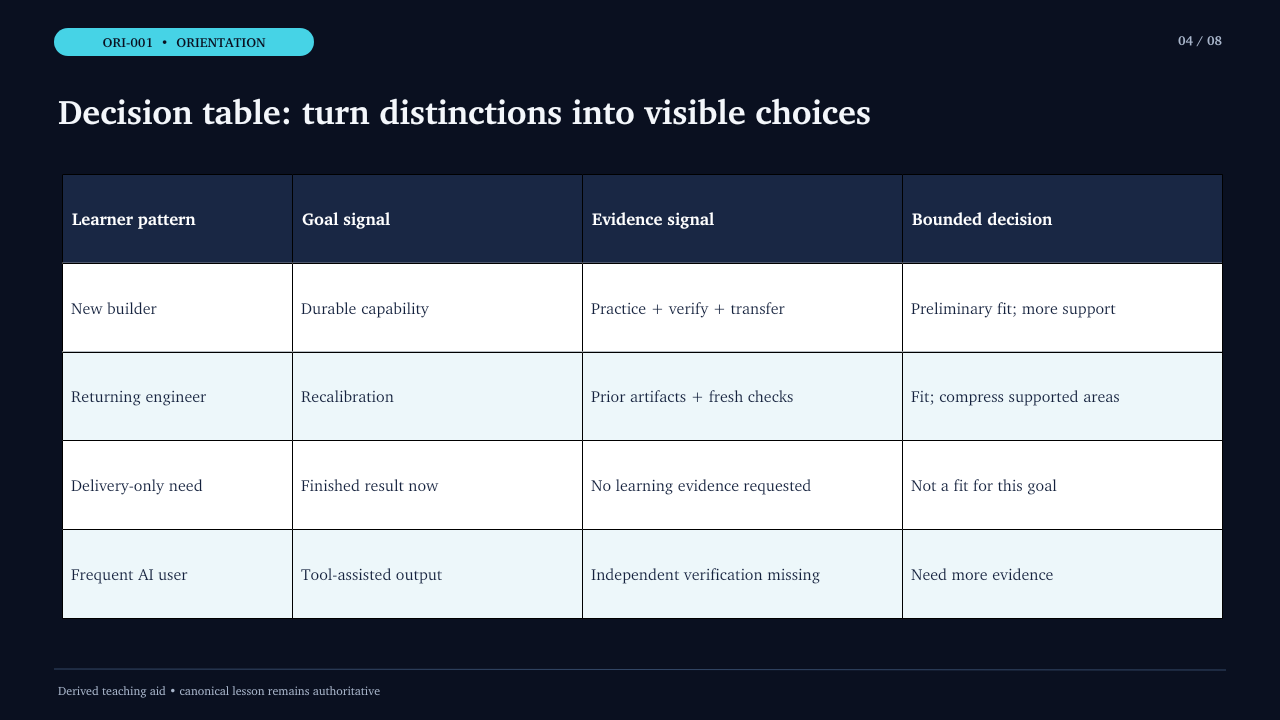
Path-fit decision patterns
Compare goals, inspectable artifacts, claim-relevant evidence, and bounded path-alignment/support signals without scoring or ranking people. The Decision Card does not by itself select a definitive subpath.
| Learner pattern | Goal signal | Artifact expectation | Evidence expectation | Preliminary path signal | Claim boundary |
|---|---|---|---|---|---|
| New learner seeking durable capability and willing to practice, verify, explain, and transfer | Capability growth | Small real project + decision/verification record | Explanation + verification + changed-context transfer | Preliminary alignment; likely need for more guided support | Does not prove job readiness, broad technical mastery, or a definitive Foundation subpath |
| Experienced learner with inspectable prior work plus current gaps that still need review | Return/recalibration without unnecessary replay | Prior inspectable artifacts for covered claims + fresh work for uncovered gaps | Prior evidence mapped to bounded claims + fresh evidence where current capability is not yet demonstrated | Preliminary alignment; prior evidence may reduce repetition; fresh checks remain for current gaps | Experience can compress supported material; claim-relevant checks still apply to unsupported or current gaps, and this card alone does not select Repair or Experienced. |
| Immediate deliverable wanted; practice, verification, and transfer are explicitly rejected | Delivery, not learning | Finished deliverable | Learning evidence is not part of the current goal | Not a fit for current goal | A delivery-oriented form of help may fit the job better |
| Frequent AI use with weak independent verification or decision evidence | Tool-assisted building with uncertain independent judgment | Generated outputs plus an inspectable decision/verification record | Independent verification, claim boundary, and evidence that could change the decision | Need more evidence/support profile; no subpath assignment from tool exposure alone | Tool exposure alone does not establish judgment supported by evidence or a definitive Foundation/Repair subpath |
The last two rows do much of the intellectual work.
Compare two statements:
“This path fits me because I like working with AI.”
and:
“My goal is to become able to build and verify small features. I am willing to practice, explain decisions, and show evidence in a changed context. Because I have little experience, I will probably need more guided explanation and practice at the start. That is evidence about the kind of support that may help me, not enough to select a specific subpath. This decision does not prove programming mastery, and I would revisit it if my real goal turned out to be immediate delivery rather than learning.”
The second statement is longer, but length is not what improves it. Each part can be inspected, and the conclusion is allowed to change.
AI can assist the reasoning without owning the decision
AI assistance is compatible with this lesson. Handing over the final path-fit decision is not.
An assistant may help you list alternatives, point out contradictions, or challenge an assumption in your card. It can ask whether the artifact you named actually supports the claim you are making. It can surface a counterexample you failed to consider.
But the final path-fit decision remains yours. The assistant cannot be its own evidence, cannot invent experience you do not have, and cannot turn a preference into proof simply by phrasing it confidently.
A practical way to preserve that boundary is to mark each material AI suggestion with one of three human actions:
- ACCEPT — I agree, and I can give my reason.
- MODIFY — part of the suggestion is useful, but the final statement is mine.
- REJECT — I do not accept it, and I can explain why.
This is not paperwork for its own sake. It keeps the decision yours rather than handing ownership to the tool that helped you explore it.
There is a second distinction worth keeping visible: AI-assisted does not mean practice-free. In this curriculum, assistance may suggest options, surface counterexamples, or critique reasoning you provide. It does not remove the need to build, verify, explain, and transfer the reasoning when those actions are part of the evidence.
Four learners, one model, four different decisions
The same five-link model should not force everyone toward the same answer.
Case 1: new to programming, serious about building capability
A learner has little programming experience and wants to become able to build small, real projects. They accept practice, verification, explaining decisions, and trying the same reasoning again on a changed problem.
The current decision can reasonably be preliminary alignment with this learning path, with a need for more guided explanation and practice. The decisive reason is not “beginner.” The goal is capability growth, the learner accepts the kind of artifact the path asks for, and the expected evidence matches that goal.
The claim boundary matters: this decision does not show job readiness or broad technical mastery. It only says that the learning method fits the current goal and participation model.
Case 2: experienced, returning, and carrying reusable evidence
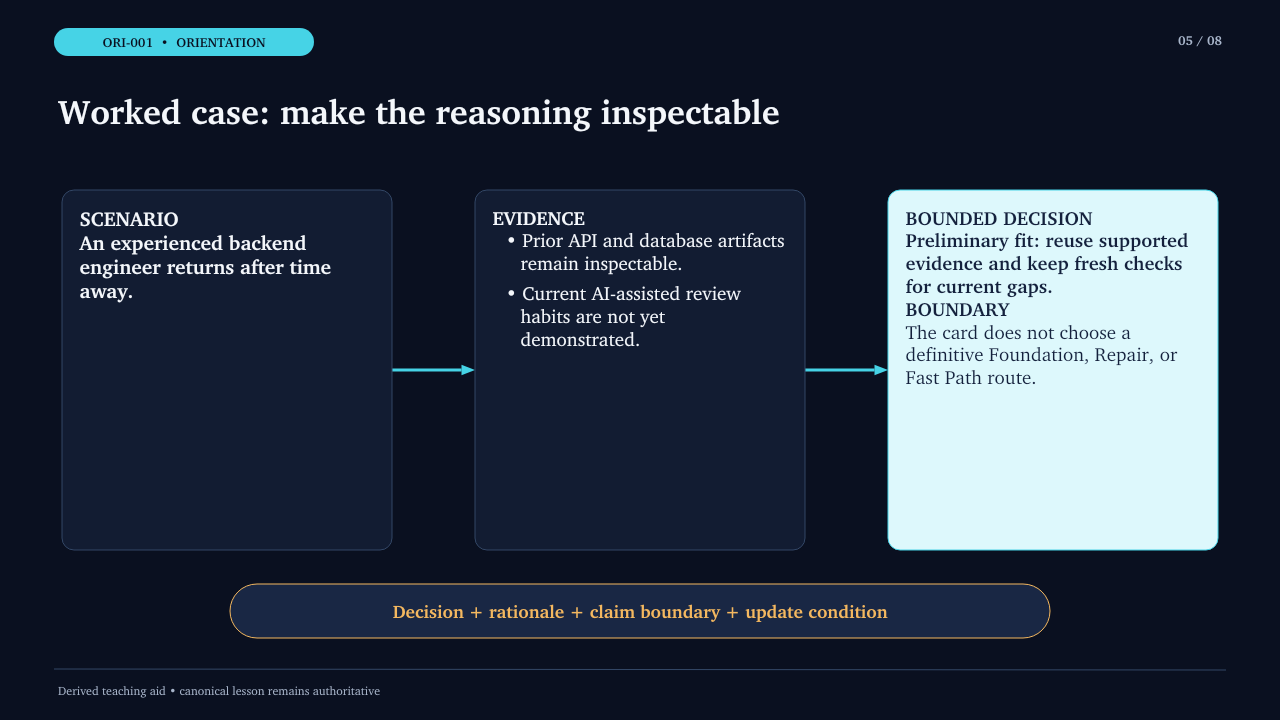
An experienced backend engineer returns after time away. There is inspectable prior work around APIs and databases, so replaying every mastered foundation would add little. At the same time, some current review habits and AI-assisted workflows have not yet been independently demonstrated.
The current decision can reasonably be preliminary alignment with this path, with prior evidence potentially reducing repetition in some areas and fresh checks remaining for current gaps. Prior evidence can compress what is genuinely covered. It cannot erase current gaps merely because the learner has worked for many years.
The update condition is straightforward: if the supposed prior evidence cannot be inspected or does not support the claim being used to skip material, that part of the route should be reconsidered.
Case 3: wants a deliverable, not a learning process
Another person needs a finished result now and explicitly rejects practice, verification, and transfer. The goal is delivery.
For that current goal, a learning program is not a fit. Forcing the person into a curriculum would quietly replace the original problem with a different one.
This is not a judgment about ability or seriousness. It is a scope decision: a service, direct project help, or another delivery-oriented option may fit the job better.
Case 4: heavy AI use, weak independent evidence
A fourth learner uses AI frequently and produces many generated outputs, but relies on AI to judge those outputs as well. When asked what evidence would falsify a decision, the answer is unclear.
High tool exposure does not resolve the route decision. The card may show a need for more evidence, a need for more support, or prior evidence that may be reusable; it does not by itself select a specific subpath. The target here is judgment you can support with evidence, not a count of prompts or generated artifacts.
The important pattern across all four cases is simple: the decision does not come from a label alone.
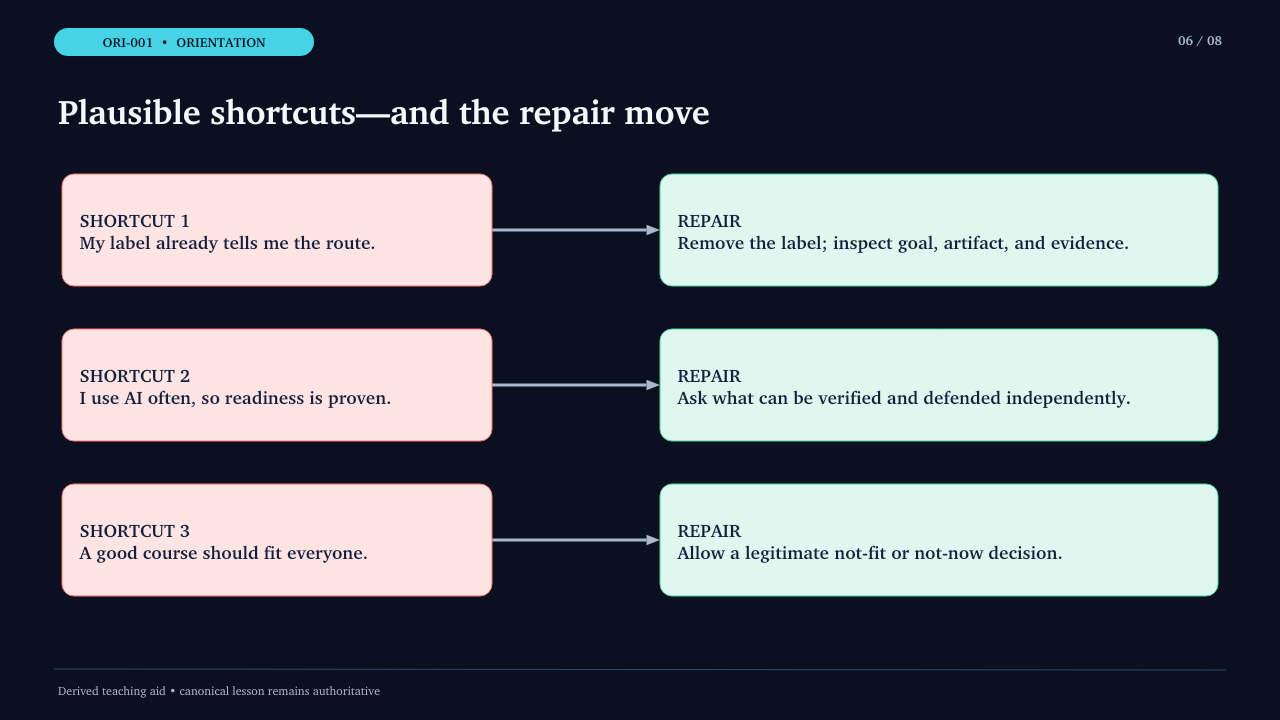
Three shortcuts that make the decision look easier than it is
Shortcut 1: “my label already tells me the route”
“I am a beginner, so Foundation must fit me.”
“I am experienced, so I should skip every foundational check.”
Both statements replace evidence with identity shorthand.
Repair them by temporarily removing the label. Ask what the goal is, what currently blocks it, what prior capability can actually be shown, and where evidence is still missing. You may end with the same route. What changes is the quality of the reason.
Shortcut 2: “I use AI a lot, so readiness is already proven”
Tool use can be part of your context. In this lesson it is not the target evidence.
Ask instead: when AI helps produce an answer, which parts of problem framing, verification, acceptance, and rejection can you still defend independently? What would make you change your mind about the output?
If those boundaries are unclear, the right next state may be “need more evidence,” not a larger claim based on usage frequency.
Shortcut 3: “a good course should fit everyone”
A path that cannot admit a legitimate not-fit decision has stopped doing fit analysis.
Sometimes the better answer is a small piece of documentation for a narrow question. Sometimes it is direct project assistance. Sometimes the learner wants to learn but cannot currently support regular practice, so the bounded answer is “not now.” Sometimes an experienced learner needs targeted repair rather than a full replay.
The question is not “which path is best in general?” It is narrower:
For my current goal and constraints, which form of learning or assistance solves the actual problem most directly?
MAKNOW remains one candidate answer, not the answer that must win.
A quick repair test
Consider this reasoning:
“I have ten years of programming experience and use AI every day, so I should skip every foundational part.”
You do not need to reject the conclusion in advance. Make the reasoning inspectable instead:
“I have prior evidence for several areas and want to demonstrate those areas directly instead of replaying them. Where evidence is missing, or where my current workflow needs review, fresh checks should remain. That may support compressing some material, but this card alone does not make a specific subpath definitive.”
Now the reasoning can be argued with evidence rather than status.
If you have experience, spend it where it still produces evidence
If you have experience, prior evidence should count where it remains relevant. Real prior work may justify compressing some material, but it does not by itself make a specific subpath definitive.
But “I did this before” is too broad to decide what can be compressed. Useful prior evidence can usually answer more concrete questions:
- What problem did you solve?
- What was your role?
- What inspectable artifact remains?
- Which important decision was actually yours?
- What could have confirmed or contradicted the result?
- Which part of that evidence still applies to the current problem?
Make three columns for five capabilities you care about:
- transferable now;
- needs fresh review or evidence;
- unknown for now.
For every item in the first column, attach a real artifact or situation that explains why you consider it transferable. If the only support is a title such as “senior developer,” the evidence is not yet specific enough to bypass a relevant check.
The same principle can help a new programmer. Evidence from another domain—problem framing, analysis, design, documentation, or client work—may matter when it is genuinely relevant. The rule is not to ignore prior capability. The rule is to keep the claim no larger than the evidence.
If the path is not a fit, locate the mismatch precisely
“Not a fit” is more useful when it names the mismatch.
If your goal is delivery rather than learning, direct execution help may fit better than a curriculum.
If you have one narrow technical question, focused documentation and a small exercise may solve it without committing to a full learning path.
If learning is the goal but regular practice is not realistic under current constraints, the bounded result can be not now rather than never.
If you are experienced and only one area needs repair, repeating the entire route would ignore valid evidence and waste attention. That can show that a full replay is poorly aligned with your need; choosing a specific subpath still requires information about that subpath.
The broad question “what is the best path?” hides these distinctions. Replace it with:
Given my current goal and constraints, what form of learning or help targets the actual problem most precisely?
That question allows a professional not-fit decision without turning it into failure.
Build your own card, then remove the scaffold
Round 1: work through a guided case
Mina is a product designer who wants to turn small prototypes into features whose behavior she can explain and review. Her coding experience is limited. She is willing to practice, inspect results, and explain the final decision even when AI helped generate options.
A first version of the card might read:
- Goal: increase the ability to build and verify small features.
- Problem: a gap between prototyping and implementation that can be defended.
- Artifact: a small feature plus a decision and verification record.
- Evidence: repeat the reasoning on a similar problem and explain what was accepted or rejected.
- Current decision: preliminary alignment with this path, with a need for more guidance and step-by-step practice.
- Does not prove: complete professional readiness.
- Update condition: if the real goal becomes obtaining finished output rather than learning, revisit the path decision.
Do not memorize this card. Inspect the structure that connects the rows.
Round 2: write the card for your real goal
Now build your own without borrowing Mina's sentences. Keep each row concise. If you cannot fill one honestly, write not enough information instead of manufacturing certainty.
A reviewer who sees only the card should be able to tell what you want, what blocks you, what participation you accept, what evidence matters, and why the conclusion is limited.
Round 3: use AI as an adversary, not as the final judge
If you use an AI assistant, ask it to identify ambiguity, hidden assumptions, or counterexamples in your card. Then mark each material suggestion ACCEPT, MODIFY, or REJECT and add your own reason.
If the tool's output simply replaces your decision, the artifact no longer shows how you reasoned.
Round 4: remove MAKNOW's labels
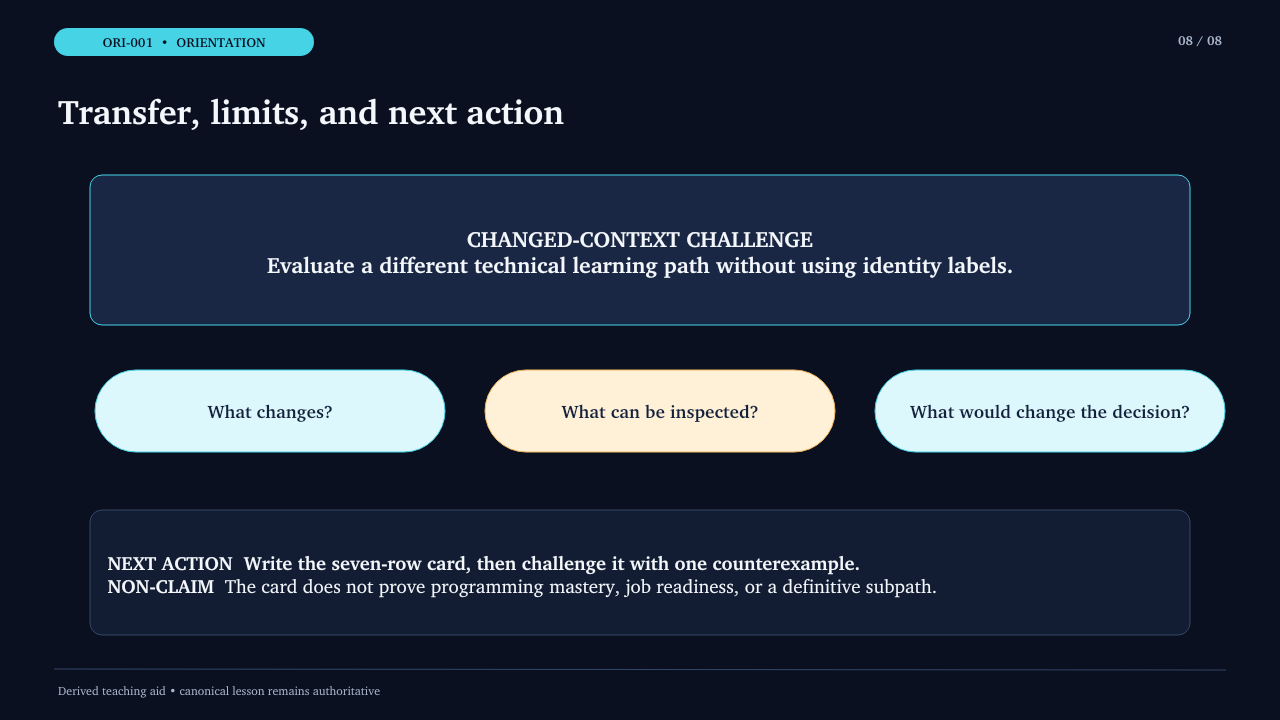
Choose a different technical learning path—security, data analysis, software operations, interface design, or another field. Rebuild the method without Foundation, Repair, or other MAKNOW route labels:
Goal → Problem → Artifact → Evidence → Decision
Then add one claim boundary and one update condition: state what the result does not establish and what new evidence or constraint would make you reconsider it.
If you can reconstruct the logic in a changed context, that is useful evidence that you are using the model rather than merely copying its form, but it is not definitive proof on its own.
How do you know the card actually shows anything?
A complete form is not automatically good evidence.
Use four checks.
1. The decision follows from the goal and problem
If the main reason is “I am new,” “I am experienced,” or “I like AI,” the card is still relying on a shortcut.
2. An artifact and relevant evidence are visible
The main artifact in this lesson is the card itself. The evidence is the reasoning it exposes, the claim boundary it preserves, and the way the method survives transfer to another context.
3. At least one claim boundary is explicit
Include a sentence beginning with: “This decision does not prove that…”
For this lesson, a path-fit decision does not establish technical programming mastery, job readiness, or mastery of the whole program.
4. The card contains an update condition
For example:
- if my claimed prior evidence cannot be inspected, I will revisit my assumption that some material can be compressed;
- if I discover that my actual goal is delivery rather than learning, I will choose a different kind of help;
- if I cannot reconstruct the model independently in a changed context, I still need more scaffold.
When AI has been used, add one more check: can you identify which suggestions you accepted, modified, or rejected? The final path-fit decision must remain yours.
Assessment should test the decision, not just vocabulary
Knowing the words Goal, Problem, Artifact, and Evidence is not enough. The assessment has to reveal whether you can use the model.
First, reconstruct the five links without looking. Then apply the card to a new case. Diagnose a weak argument such as “I use AI every day, so the Experienced path is automatic.” Repair it by asking for claim-relevant evidence and keeping uncovered gaps visible.
Then make a decision for your own real goal. State the rationale, one limitation, and the evidence or constraint that would change the answer.
The hardest task is transfer: evaluate a different technical learning path without MAKNOW's route names. If the answer merely copies one of the worked cases, transfer has not been shown.
Reflection should also remain honest. Your first and final decisions are allowed to be the same. A useful final note may be: “The result did not change, but the reason moved from a label to a goal, problem, artifact, and evidence.” Your reasoning may also remain unchanged. Record that honestly instead of inventing improvement for the reviewer.
The target of the assessment is not to make you say yes to MAKNOW. It is to make the decision bounded, transparent, and revisable.
Why this lesson deliberately avoids claims about today's tools
You do not need to compare today's model names, provider features, prices, version numbers, productivity claims, or job-market trends to make this decision. The question here is narrower: whether your current learning goal, the kind of work you are willing to do, and the evidence you can produce line up with this path.
That makes the central decision independent of which tool happens to be current. You still need to know what you want, what problem you face, what you are willing to build, and what evidence can support or change your conclusion.
If you later use information about a particular tool, model, platform, market condition, or measured learning effect to make this decision, treat it as a separate claim that needs current, checkable support. Do not let it quietly become part of the reasoning just because it sounds relevant.
Keep the boundary simple as well. Here you are deciding whether this learning path fits your current goal and the responsibility you are prepared to take for learning. The card may indicate what kind of support you need or where prior evidence might reduce repetition, but it does not select a definitive Foundation, Repair, or Experienced subpath. Choosing one requires learner-facing information specific to that subpath. Returning to programming after years away is a different problem, so this lesson stops before trying to solve it.
Return now to the sentence you wrote at the start:
“Right now, I think this path is ___ for me because ___.”
Rewrite it using the Goal → Problem → Artifact → Evidence model. Then add two final lines:
“This decision does not prove that…”
“I would revisit this decision if…”
If those lines contain real answers rather than placeholders, the lesson has done what it is supposed to do.
Assessment
There is no answer key in this lesson pack; answer it yourself and mark honestly. "Needs review" sends the lesson to your review queue.
Q1 retrievalCORE
Without looking at the lesson, reconstruct Goal → Problem → Artifact → Evidence → Decision and explain why years of experience alone cannot determine the route.
Q2 applicationBLOCKING_CORE
Build a Path Fit Decision Card for a learner who wants to build a small real product, accepts practice and verification, and has little experience. Include one claim boundary and one update condition.
Q3 diagnosisCORE
Diagnose and repair this reasoning: “I use AI every day, so the Experienced path is automatic for me.”
Q4 decisionBLOCKING_CORE
For your real current goal, decide fit, not a fit for the current goal, or need more evidence. State the rationale, one claim boundary, and an update condition.
Q5 transferBLOCKING_TRANSFER
Evaluate a different technical learning path using Goal → Problem → Artifact → Evidence → Decision and defend the result without MAKNOW route labels. State one claim boundary and one update condition.
Q6 reflectionNON_BLOCKING
Compare your initial decision and reasoning with the end of the lesson. Report only a real change; if the result did not change, state explicitly whether the reasoning became clearer or remained the same.
Assessment rubric
Decision/scope correctness — critical
Sufficient evidence uses Goal, Problem, Artifact, and Evidence to justify a bounded fit decision. A route label, job title, or enthusiasm for AI alone is insufficient.
Evidence adequacy — critical
The learner names evidence or constraints that support the decision and states an update condition: evidence or constraints that would trigger reconsideration. An AI assistant cannot serve as independent evidence for its own output.
Non-claim honesty — critical
The learner states an explicit claim boundary and avoids job/income guarantees, technical-mastery claims, and whole-program claims from evidence in this lesson.
Transfer — critical
The learner reconstructs the decision method in a changed technical-learning context without copying the worked cases or relying on MAKNOW route labels, and states one explicit claim boundary plus one update condition.
Human decision policy
Application, final decision, and transfer are non-compensatory. Retrieval strength cannot compensate for a blocking failure. AI may challenge, summarize, or surface counterexamples but cannot issue the learner's final path-fit decision.
References & freshness
Case studies
Lesson visuals
Path Fit Decision Card showing Goal, Problem, Artifact, Evidence, Decision, Claim Boundary, and Update Condition.
What information must be visible before a path-fit decision is defensible?
Decision flow from Goal to Problem, Artifact, Evidence, and Decision, with a Need More Evidence state plus claim-boundary and update-condition guards.
How does a path-fit decision move from goal to evidence without letting identity labels decide the route?
Optional video script
Open with three situations: a new learner who wants durable capability, an experienced programmer with inspectable prior evidence for part of the route, and a person who wants an immediate deliverable rather than a learning process. Ask: “Can a label alone determine the right route?” Do not answer immediately.
Show Visual 1 — Path Fit Decision Card and introduce the five-link model: Goal → Problem → Artifact → Evidence → Decision. Fill one Path Fit Decision Card, state a claim boundary, and add an update condition that would trigger reconsideration.
Use the experienced case to show that prior evidence may compress material it genuinely covers, while years of experience cannot erase current or uncovered gaps that still matter to the claim. Use the delivery-only case to show that “not a fit for the current goal” is a legitimate scope decision rather than a judgment about ability.
Diagnose the shortcut “I use AI every day, so the Experienced path is automatic for me.” Tool exposure is context; the relevant question is what independent verification and evidence-supported judgment the learner can defend.
Close by applying the same model to a different technical learning path without MAKNOW route labels. If AI was used to challenge the card, mark material suggestions ACCEPT, MODIFY, or REJECT and keep the final path-fit decision human-owned. The video adds no new empirical claims.
Canonical terminology
| Term | Policy | Boundary |
|---|---|---|
Goal → Problem → Artifact → Evidence → Decision | Use the five-link canonical sequence exactly when naming the model. | This is the bounded decision model for this lesson, not a universal empirical theory. |
Artifact | Use Artifact consistently for the inspectable output in the five-link model. | An inspectable output connected to the bounded claim; not proof of broad mastery by itself. |
Evidence | Use Evidence consistently for claim-relevant support. | Evidence must match the bounded claim being made. |
Foundation | Use Foundation as a route label/reference; the Decision Card does not by itself select a definitive Foundation subpath. | A need for more guided support may be a preliminary signal; it does not itself select Foundation. |
Repair | Use Repair as a route label/reference; the Decision Card does not by itself select a definitive Repair subpath. | Current gaps can justify targeted review as a support need; they do not by themselves select Repair. |
Experienced path | Use Experienced path / Experienced-path as a route label/reference. The Decision Card does not by itself select a definitive Experienced subpath. Do not use Quick Path in current reader-dependent text. | Inspectable prior evidence may support reduced repetition; it does not by itself select the Experienced path, and current gaps remain subject to claim-relevant checks. |
Claim Boundary | Use Claim boundary for what the current decision does not prove. | Keeps the claim no larger than the evidence. |
Update Condition | Use Update condition for evidence or constraints that would trigger reconsideration. | A revisability condition, not a promise that the decision must change. |
Need More Evidence | Use need more evidence / I do not have enough evidence yet as a valid decision state. | Uncertainty is an allowed bounded result. |
ACCEPT / MODIFY / REJECT | Use ACCEPT / MODIFY / REJECT for the human disposition of material AI suggestions. | AI may challenge reasoning; the final path-fit decision remains human-owned. |
Lesson media & slides
Teaching files (download)