بازگشت به مهندسی مدرن و کار با هوش مصنوعی · فصل صفر — جای خودت را در مسیر پیدا کن · 4
What Is Project-Based Programming Learning, and Why Does It Work Better?
Understand project-based programming learning as a build-feedback-repair-transfer evidence loop rather than passive content consumption. میتواند برای یک مهارت فنی، artifact و شواهدی تعریف کند که نشان دهد واقعاً توان اجرای آن را پیدا کرده است.
آموزش پروژهمحور برنامهنویسی چیست و چرا بهتر یاد میگیریم؟ — fa-IR
Lesson summary
Understand project-based programming learning as a build-feedback-repair-transfer evidence loop rather than passive content consumption.
میتواند برای یک مهارت فنی، artifact و شواهدی تعریف کند که نشان دهد واقعاً توان اجرای آن را پیدا کرده است.
This lesson produces
میتواند برای یک مهارت فنی، artifact و شواهدی تعریف کند که نشان دهد واقعاً توان اجرای آن را پیدا کرده است.
Who it is for
Foundation
Explicit vocabulary + worked case + guided artifact.
Repair
Target the diagnosed misconception; do not replay mastered material.
Experienced
Compress explanation; increase ambiguity, contrast and transfer demand.
Prerequisites
No prerequisites — this is a starting point.
Two learners can both say they have “finished” a programming topic while having very different evidence of learning. One watched several hours of explanations and can repeat the examples. The other built something small, encountered a failure, diagnosed it, repaired it, and then used the same idea in a changed context.
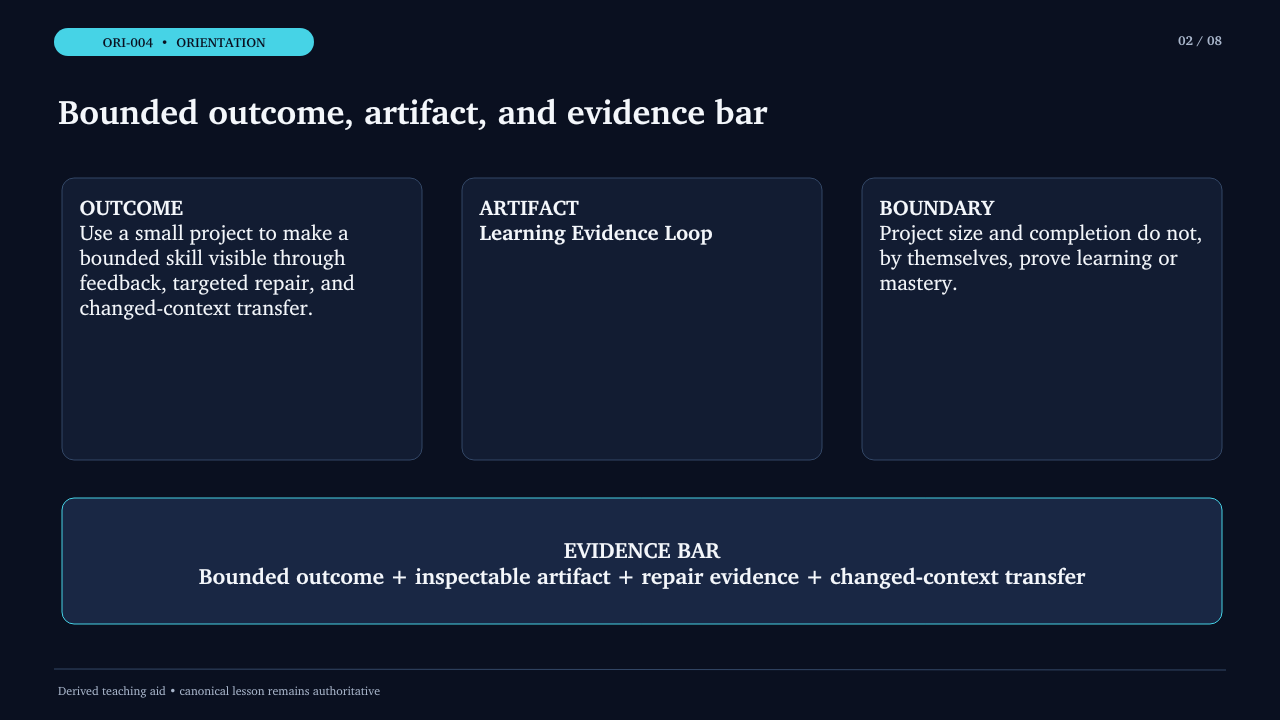
In this lesson, “better” does not mean that every project is universally superior to every other learning method. It means that for a bounded skill, a well-designed project can make learning more inspectable: you build an artifact, collect feedback, repair what failed, and test transfer. Your output is a Learning Evidence Loop, not a large showcase project.
Make the difference between “I understand the explanation” and “I can do the task” visible
Suppose you read an article about input validation. The explanation makes sense, and you can repeat the main points. Does that show you can recognize invalid inputs and preserve expected behavior in a real task? Not yet.
Instead of counting study hours or project size, build a small loop:
- Bounded skill/outcome: What exactly do you want to be able to do?
- Artifact: What small output makes that capability visible?
- Evidence: What would show that the artifact is not merely finished, but behaves as required?
- Feedback and failure: Where does the result differ from the expectation?
- Repair: What do you change because of that feedback?
- Transfer probe: Can you use the same skill in a meaningfully changed context?
- Claim Boundary: What does this evidence still not establish?
This loop does not prove complete mastery, job readiness, or capability across an entire skill family. It helps connect one bounded learning claim to more inspectable evidence.
Project-based does not mean “the project must be large”
A useful learning project can be very small. If your target is to write a validation function, a focused artifact with a few input cases and a clear behavior contract may provide better learning evidence than a large copied application.
Project size matters only when the outcome actually requires that scale. A large project can add unrelated load: environment setup, UI work, dependencies, and failures that say little about the target skill. A small artifact can expose exactly where your model or execution breaks.
So the central question is not:
“How big is my project?”
It is:
“What bounded claim does this artifact make inspectable, and what evidence could support or overturn that claim?”
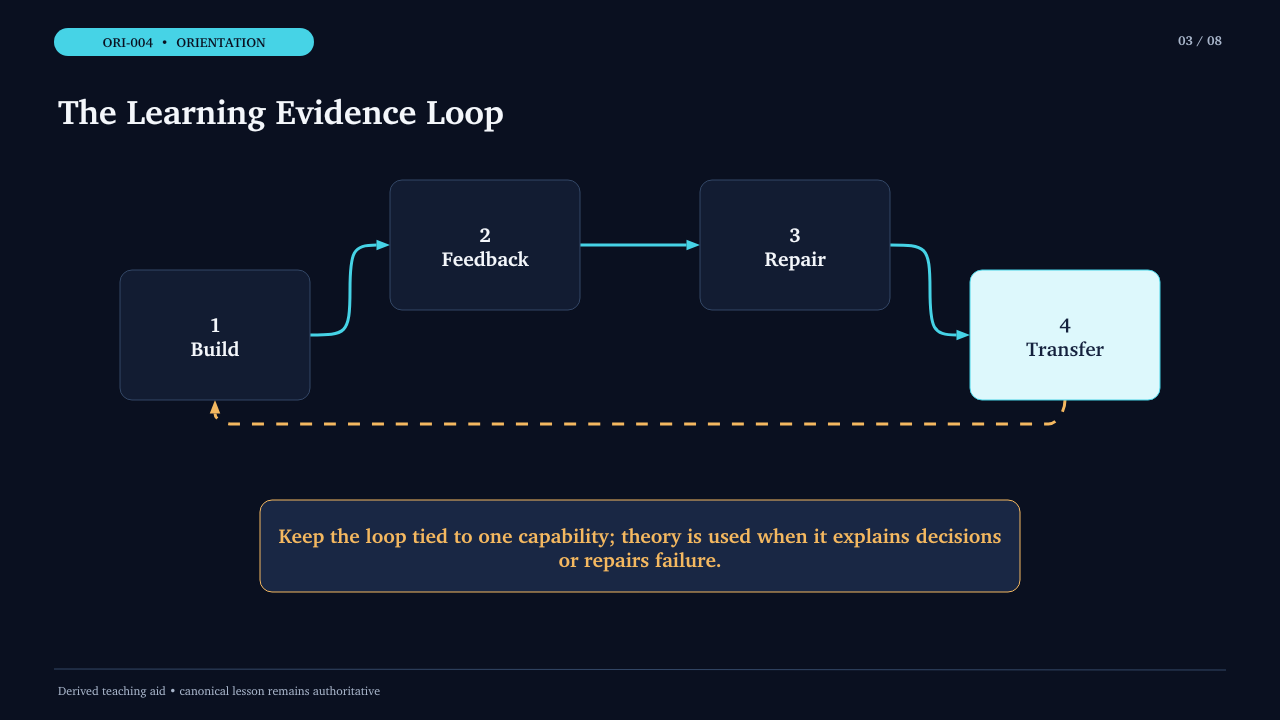
Core model: Build → Feedback → Repair → Transfer
The Learning Evidence Loop has four main moves, and each must remain tied to the bounded outcome.
1) Build: create something that makes the skill observable
An artifact can be a small function, query, component, test, design, or documented technical decision. The key requirement is that you can name which bounded skill it is meant to expose.
If the artifact is so large that it mixes ten skills, a failure tells you little about the actual cause.
2) Feedback: compare the result with a defined basis
Feedback is not just “looks good” or “did not work.” It should approach inspectable evidence: expected output, a relevant test, a task constraint, review, runtime behavior, or another signal that matches the claim you are testing.
AI may suggest options or counterexamples or summarize evidence you provide, but it should not become the sole basis for accepting its own output or invent experience you did not have.
3) Repair: change what the failure actually points to
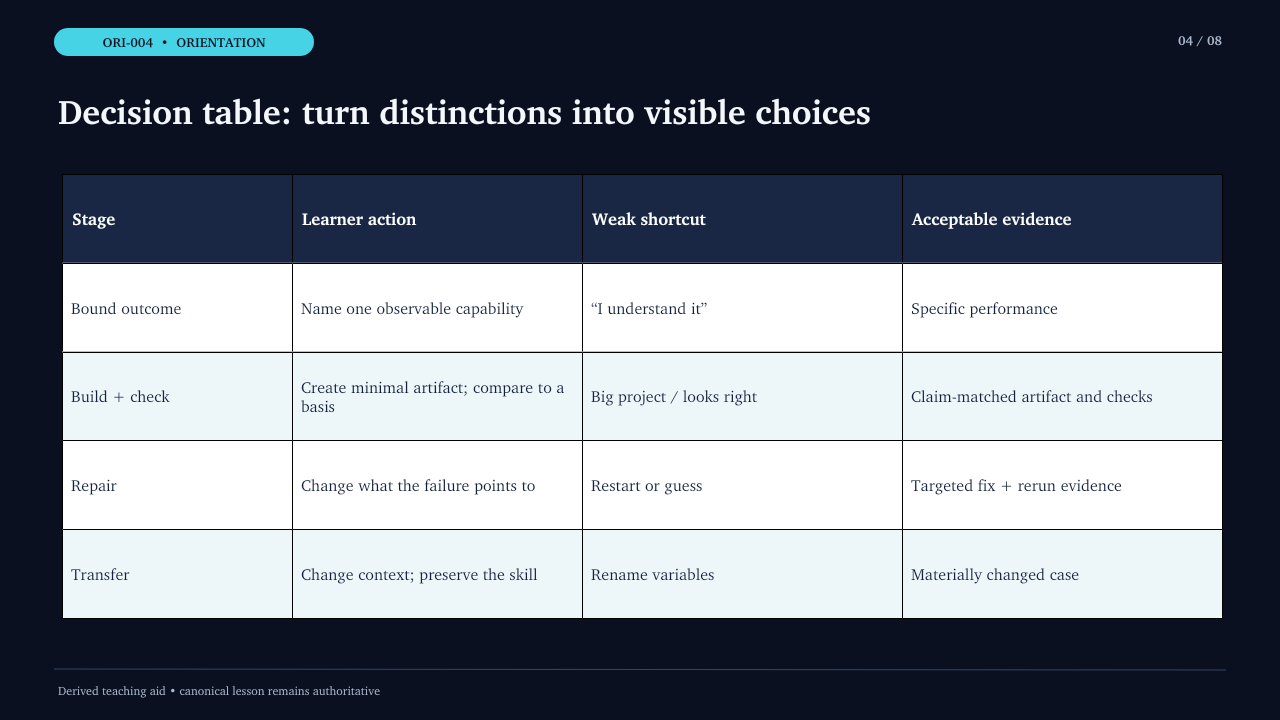
Repair does not mean “restart the whole course.” If the evidence shows one part of your model or execution is weak, target that part. Syntax may be fine while an edge condition is wrong; replaying an entire language course would be wasteful.
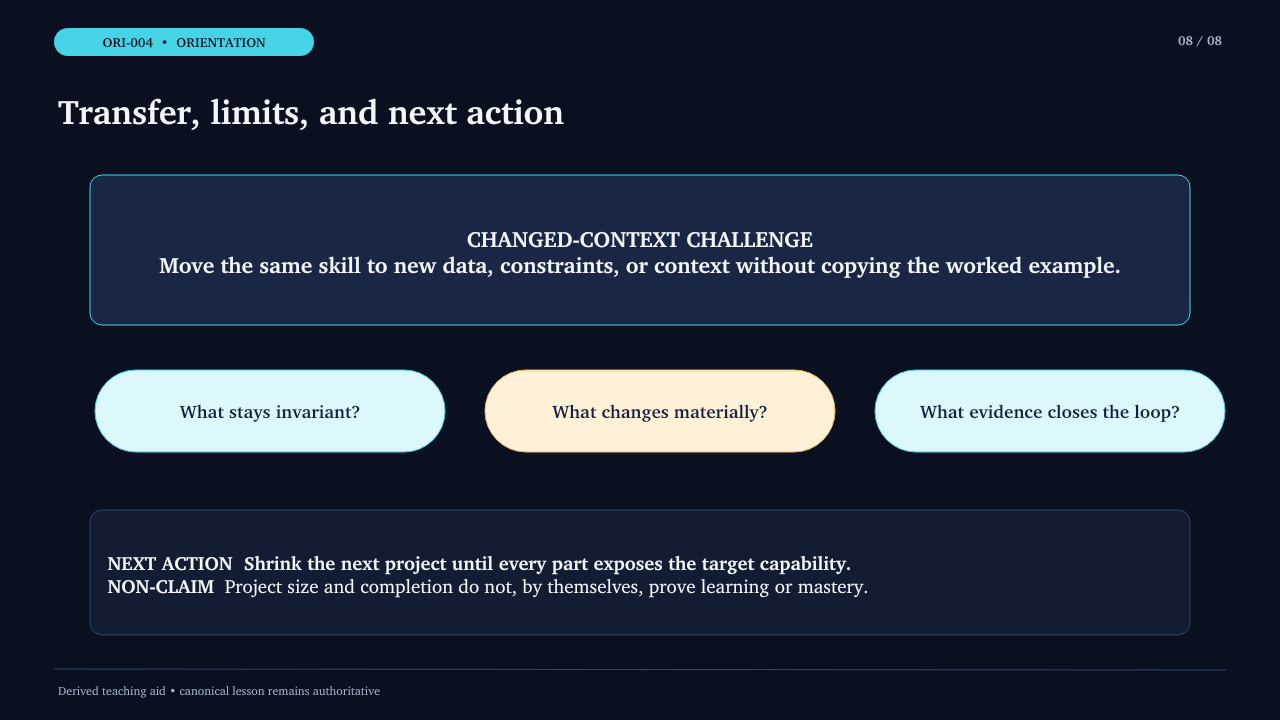
4) Transfer: test the same skill in a changed context
If you only repeat the original example with renamed variables, you may have memorized a surface pattern. A transfer probe should change part of the data, constraints, or problem shape while preserving the target skill.
Successful transfer strengthens the claim, but only within the boundary of that skill and the evidence collected.
If you are new, keep each loop small
You do not need a complete product. A 15–30 minute loop is often more useful than a multi-day project whose evidence is unclear.
For one skill, complete this structure:
- Outcome: “I want to be able to …”
- Artifact: “I will create a small output that …”
- Evidence: “If I observe …, this bounded claim is supported to this extent.”
- Failure signal: “If … happens, I know which part needs repair.”
- Repair: “I will change that part and collect the evidence again.”
- Transfer: “Then I will change this part of the context and try again.”
- Non-claim: “This result still does not show that …”
This structure helps separate the feeling of understanding from evidence of performing the task.
Why can the build–feedback loop make learning more trustworthy?
Reading and explanation are important for building an initial model. Project-based learning does not mean theory is unnecessary. Theory becomes more useful when you can use it to predict behavior, explain a failure, and choose a repair.
A project loop exposes three gaps that passive consumption can hide:
Recognition versus production
A solution can look familiar when you see it while still being difficult to produce without the example in front of you. Building an artifact exposes that gap.
Completion versus correctness
Finishing a project only shows that an output exists. A claim such as “I can perform this skill” needs evidence that tests the relevant behavior.
Repetition versus transfer
Rebuilding the taught example may only show that you remember its surface structure. A controlled change of context helps test whether the underlying idea can be used independently.
Project-based learning is useful when the project acts as a vehicle for producing evidence, not as a substitute for the learning outcome.
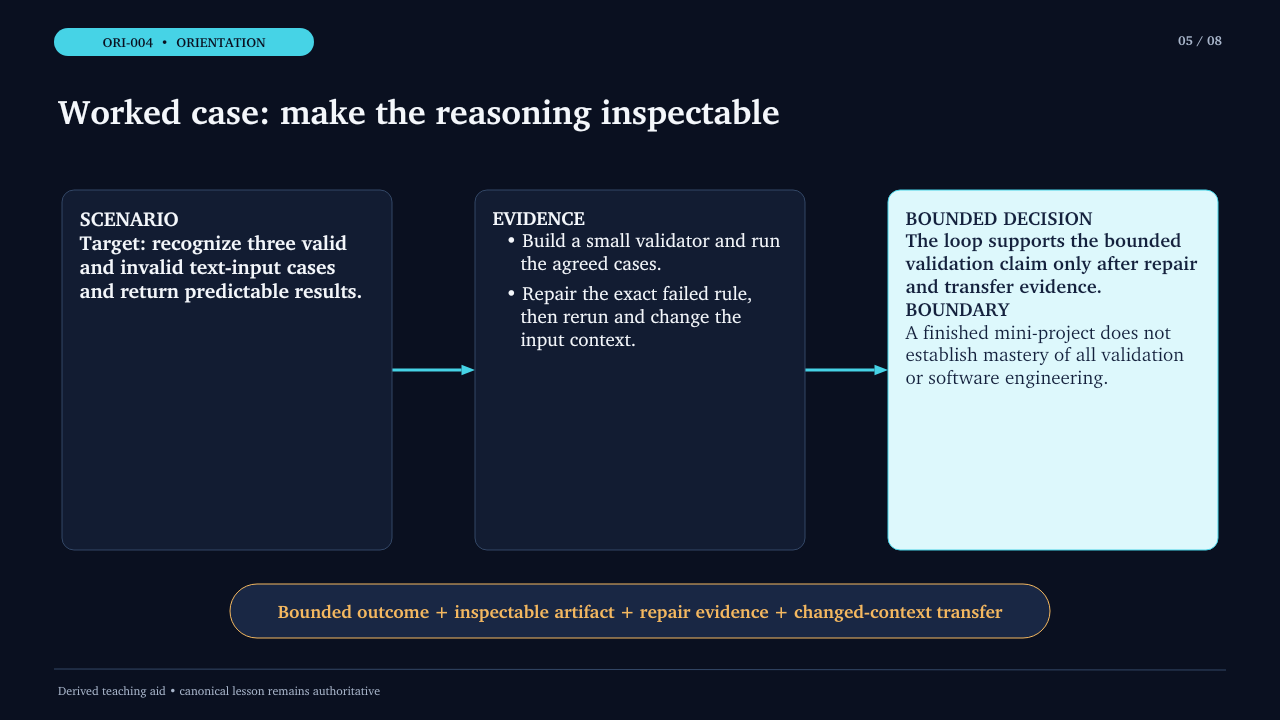
Worked example: “I learned input validation”
Suppose the bounded outcome is:
“I can recognize three specified valid/invalid cases for a text input and return predictable results.”
A Learning Evidence Loop could look like this:
Build: Write a small function for the three defined rules.
Evidence: For each rule, run at least one valid and one invalid example and compare the result with the expected behavior.
Failure: An empty input is incorrectly accepted.
Repair: Fix the empty-input condition and rerun all relevant evidence instead of making an unverified one-line guess.
Transfer: Change the data shape or constraint and design the same kind of reasoning for another field without copying the previous solution.
Claim Boundary: This does not establish mastery of system-wide validation design, input security, or every edge case. It supports only the bounded outcome to the extent of the evidence collected.
Why would a larger project not automatically be better?
Putting the same skill inside a large application may consume time on routing, UI, or configuration. Those activities may matter for a different learning outcome, but they do not automatically improve the evidence for this bounded skill.
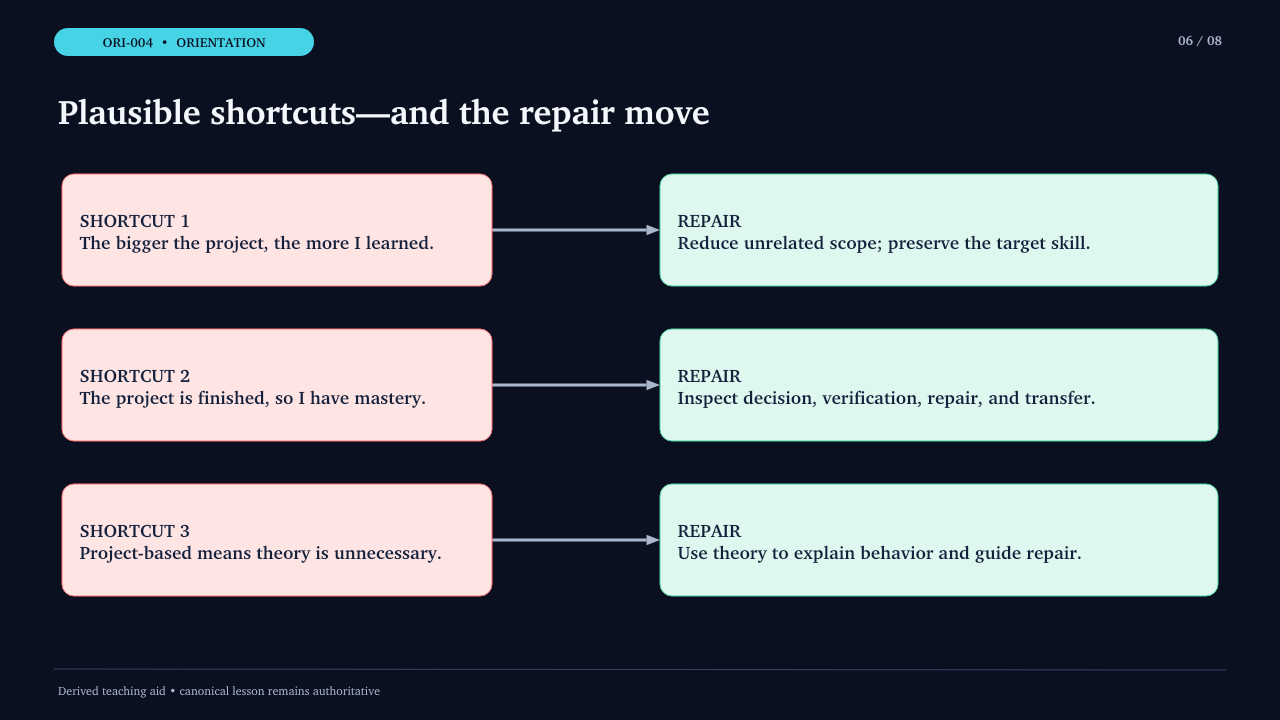
Three shortcuts that weaken learning evidence
“The bigger the project, the more I learned”
Project size is not an independent measure of learning. If you cannot connect parts of the artifact to the target skill, size mainly adds complexity.
“The project is finished, so I have mastery”
Completion is an event, not proof of mastery. The output may have been completed with heavy assistance, copying, guessing, or weak checks. Evidence needs to test the claim itself.
“Project-based means theory is unnecessary”
Without enough theory, failures can turn into trial-and-error repair and transfer can remain weak. Explanations and conceptual models should help you build, diagnose failure, and choose repairs.
If you already program, turn the project into a probe
For an experienced learner, compress familiar explanation and increase ambiguity. Instead of rebuilding something you have done many times, create a small artifact that targets the exact uncertainty.
If you are unsure about an otherwise familiar concept, choose an edge case or new constraint that cannot be solved by replaying the old example. Then ask:
- What evidence actually tests this claim?
- If it fails, is the problem in the theory, execution, or definition of the outcome?
- What context change would show that I did more than memorize the pattern?
The fast path does not lower the evidence bar. It removes explanation you no longer need and makes the probe denser.
When should you use an article, a short exercise, or a project?
These methods are not absolute competitors.
- Article/video: useful for an initial model, vocabulary, or orientation.
- Focused exercise: useful for a micro-skill and fast feedback.
- Small project: useful when several pieces need to work together in a more realistic outcome and failure/repair matters.
- Larger project: useful when integration, trade-offs, or multi-part constraints are themselves part of the outcome.
Choose based on the evidence you need, not the prestige of the project. If a 20-line exercise tests the claim more directly, it can be stronger evidence than a large showcase application.
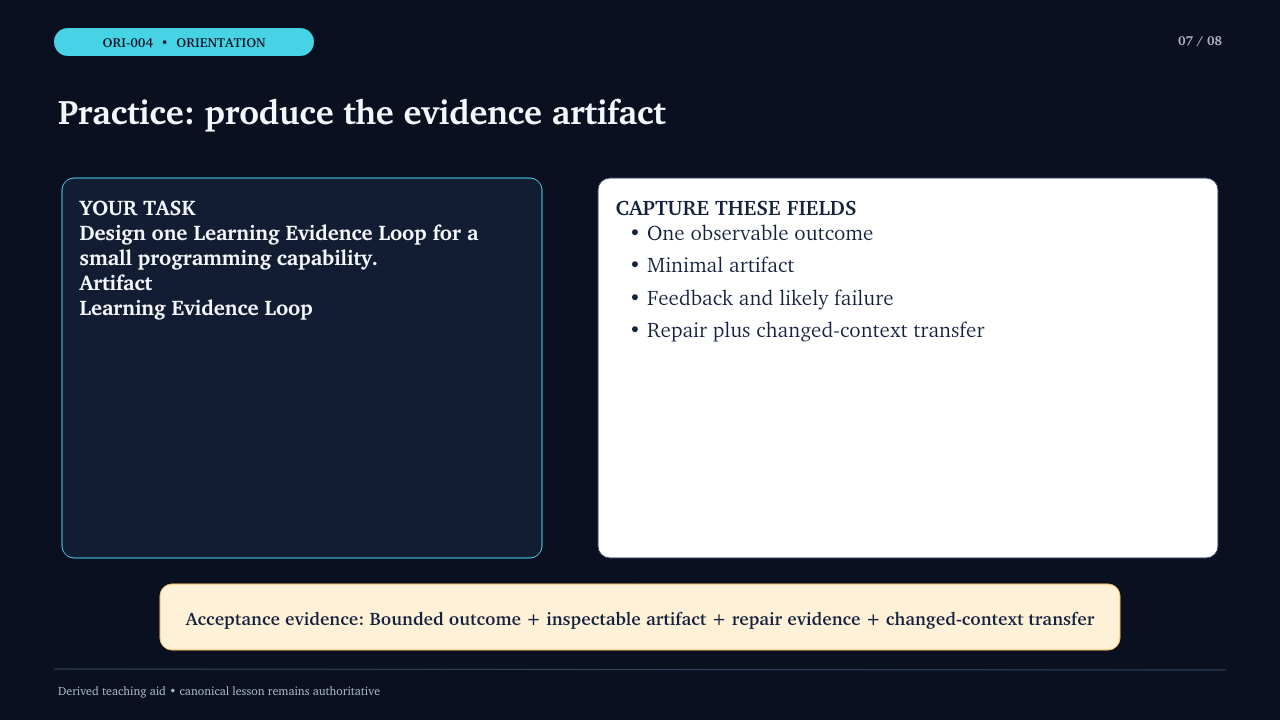
Guided practice: design one loop for one skill
Choose a bounded technical skill that you have read or watched explanations about but are not yet sure you can perform.
Complete this table:
| Part | Your answer |
|---|---|
| Bounded outcome | What must you be able to do? |
| Artifact | What small output makes it observable? |
| Evidence | What result supports or overturns the claim? |
| Failure signal | What would show that repair is needed? |
| Repair | What part would you change because of that failure? |
| Transfer probe | What context would you change? |
| Claim Boundary | What does this evidence still not prove? |
Run the loop once. If you use AI, state its role—for example, suggesting edge cases or critiquing the plan. The decision about whether the evidence is sufficient for the claim must remain tied to a defensible basis and accountable human ownership.
Independent practice
For a different skill that you have only studied through an article or video, design a small artifact and transfer probe without copying this worked example. Preserve the loop, but choose the artifact, evidence, and context change for the new skill.
When is a Learning Evidence Loop defensible?
Before saying “I learned this skill,” answer four questions:
- Is the outcome bounded enough to define specific evidence?
- Does the artifact expose that skill, or does it mix many unrelated skills?
- Could the evidence actually change the decision, or does it only confirm success?
- Does the transfer probe change something meaningful in the context while preserving the target skill?
If any answer is unclear, narrow the claim or improve the evidence design.
Success contract for this lesson
You do not need to deliver a large product. For one bounded skill, you need to be able to:
- define a small relevant artifact;
- specify inspectable evidence for the outcome;
- connect a plausible failure to a targeted repair;
- design a transfer probe in a changed context;
- and keep at least one explicit non-claim.
Project name, project size, or the sentence “it is finished” is not sufficient evidence of learning.
About the evidence in this lesson
This lesson teaches a stable method for designing learning evidence and does not depend on the current capability of a particular tool or version. The examples illustrate the learning decision; they do not prove that one kind of project is always superior to every other method. For a real skill, match the evidence to the outcome and constraints of that task.
Assessment
There is no answer key in this lesson pack; answer it yourself and mark honestly. "Needs review" sends the lesson to your review queue.
Q1 retrieval
Q2 application
Q3 diagnosis
Q4 decision
Q5 transfer
Assessment rubric
A response is sufficient only when every critical dimension required by the question is supported by inspectable reasoning.
Critical dimensions
1. Decision / scope correctness — critical
The learner defines one bounded technical outcome and does not use project size, title, or completion as a substitute for the outcome.
2. Evidence adequacy — critical
Evidence is matched to the named claim and could plausibly change the learner's conclusion. “It is finished” is not sufficient.
3. Non-claim honesty — critical
The learner states at least one capability that the artifact/evidence does not establish.
4. Transfer — critical
The transfer probe preserves the target skill while materially changing context, data, constraints, or problem shape. Mere renaming or replaying the worked example is insufficient.
Blocking questions
Q2, Q4, and Q5 are blocking. A blocking response fails when it lacks claim-matched evidence, inflates scope, treats completion as mastery, or copies the transfer surface without adapting it.
AI support
AI may suggest options, counterexamples, or critique. It may not invent learner experience/evidence or decide by itself whether the critical evidence is sufficient.
References & freshness
Case studies
Lesson visuals
Loop diagram: bounded Outcome → Build/Artifact → Feedback/Evidence → Repair → Transfer, with transfer returning to the bounded claim and Claim Boundary remaining visible beside the loop.
How does evidence from failure drive repair before transfer?
Two-column comparison: a large project with unrelated scope and ambiguous completion versus a small artifact with a bounded outcome, explicit evidence, repair, and transfer probe. Main message: project size is not a learning measure.
Why can a small focused artifact provide stronger evidence for a bounded skill than a large showcase project?
Optional video script
Two learners can both say, “I finished this topic,” while only one has evidence that the skill can be performed and transferred.
In this video, we choose one bounded skill. First we build a small artifact. Then we compare the result with claim-matched evidence. If we observe a failure, we repair the part that failed and collect the evidence again. Finally, we change the context in a meaningful way to create a transfer probe.
The key point is that a larger project does not automatically produce stronger evidence. A small artifact can be a better fit for a bounded claim when it exposes the target skill, makes failure diagnosable, and supports transfer.
Artifact completion also does not prove mastery. The conclusion is only as strong as the evidence, and the learner must keep visible what remains unproven.
Lesson media & slides
Teaching files (download)