بازگشت به مهندسی مدرن و کار با هوش مصنوعی · فصل صفر — جای خودت را در مسیر پیدا کن · 2
Returning to Programming After a Few Years: Where Should You Start?
Choose an evidence-based re-entry point for a returning programmer by separating retained competence, repair needs, and new gaps.
بازگشت به برنامهنویسی بعد از چند سال: از کجا شروع کنیم؟ — fa-IR
Lesson summary
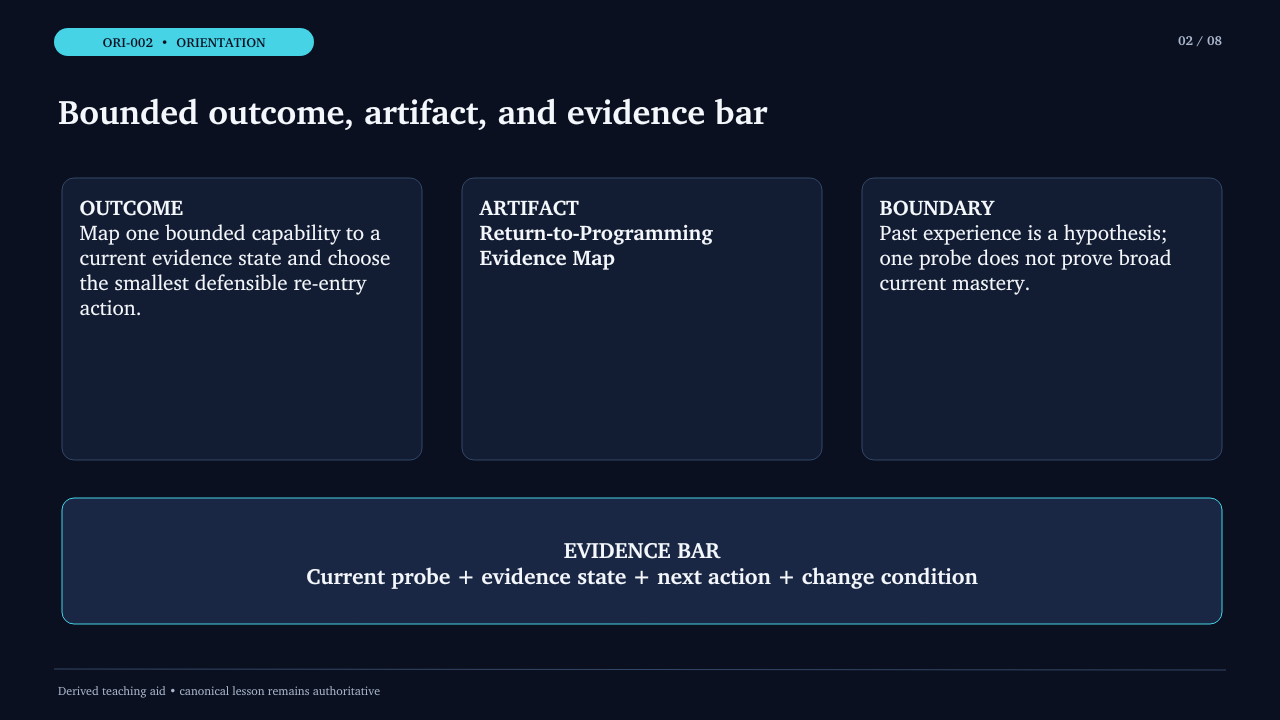
Choose an evidence-based re-entry point for a returning programmer by separating retained competence, repair needs, and new gaps.
Who it is for
Foundation
Explicit vocabulary + worked case + guided artifact.
Repair
Target the diagnosed misconception; do not replay mastered material.
Experienced
Compress explanation; increase ambiguity, contrast and transfer demand.
Prerequisites
No prerequisites — this is a starting point.
After a few years away from day-to-day programming, two answers can feel immediately plausible: “everything has changed, so I should start from zero,” or “I used to be experienced, so I am still ready at the same level.” Both answers make the same mistake: they use history as a verdict instead of asking what you can support with evidence now for a specific task.
This lesson does not erase your experience, and it does not certify that you are “ready.” It helps you break prior experience into smaller, inspectable parts: what is still reliable for a bounded task, what needs targeted repair, and what is genuinely new to you. Your output is a Return-to-Programming Evidence Map that supports a defensible re-entry point.
You have experience; the question is which parts still produce usable evidence
Imagine that you have been away from regular coding for three years. You can still explain data modeling, the structure of a function, or how you used to approach debugging. Yet when you face a real task, some details may be rusty, some working habits may need practice, and some topics may not have existed in your previous role at all.
If you compress all of that into “I know it” or “I do not know it,” you will choose a poor starting point. For each skill or task, this lesson asks you to record four things:
- Current task: what exactly should you be able to do?
- Current evidence: what can you show now, rather than what title you held before?
- State: is this reliable for the bounded task, in need of repair, a new gap, or still under-tested?
- Next step: given that evidence, where should you begin?
Your map also needs a claim boundary. A strong result on one task does not prove job readiness, broad programming mastery, or whole-program mastery.
Start from an inspectable task, not from your old title
You may once have been a senior developer, freelancer, technical lead, or specialist. That history provides context, but it does not answer the re-entry question by itself. What matters is whether your prior experience still turns into observable performance on a specific task.
For example, “I worked with databases for years” is still too broad. You might be able to explain a relational model clearly and reason about keys and constraints, while your ability to plan a structural change in a running system needs fresh practice and evidence. Both can be true at the same time.
Keep the unit of decision small: skill or task, not professional identity.
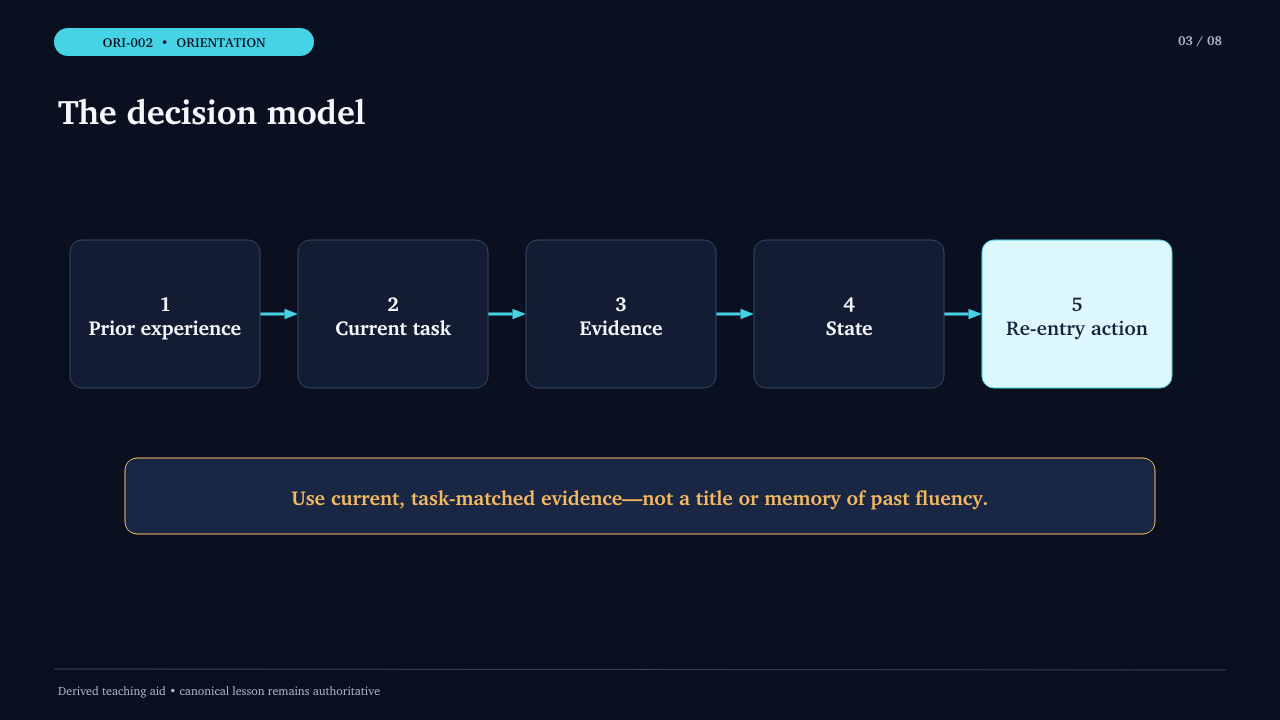
The model: prior experience → current task → evidence → state → re-entry action
The Return-to-Programming Evidence Map has five links.
1. Prior experience: what did you actually do before?
Do not list technologies only. Record the kinds of problems you solved, decisions you made, and outputs you produced. This gives you hypotheses about retained capability, not proof of current capability.
2. Current task: what bounded ability are you testing now?
Instead of asking “do I know JavaScript?”, narrow the question: “Can I read an asynchronous flow, explain its error behavior, and design a test for an unreliable path?”
The narrower the task, the less your decision depends on memory or confidence.
3. Evidence: what is inspectable today?
Evidence may be a precise explanation, a design, a bug fix, a small code change, a test, or a defended decision. It has to match the claim you are trying to make.
“I used to do this a lot” is useful context. “I can solve this task now and explain why the solution is sound” is stronger evidence for present capability.
4. State: what does the current evidence support?
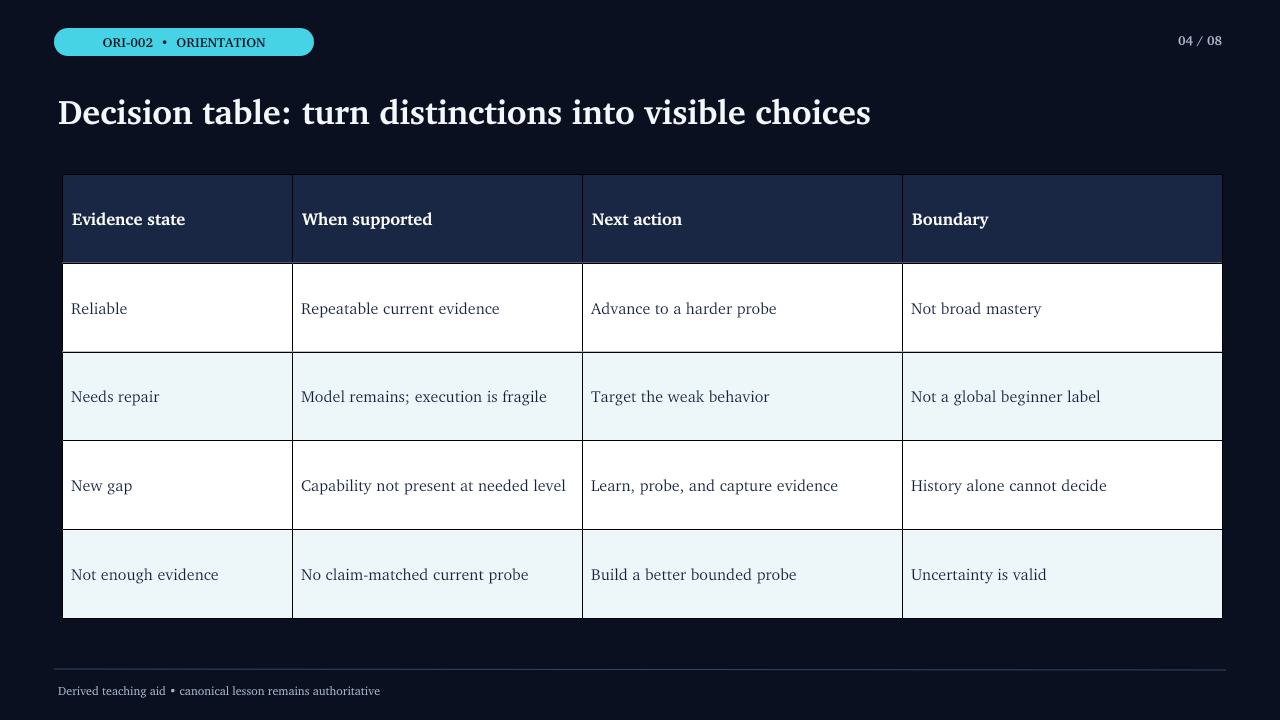
Reliable for this task: your current evidence supports the bounded ability at the level you need. This does not imply broad mastery.
Needs repair: part of the mental model remains, but current execution is unstable, repeated errors appear, or you depend on guidance that should be rebuilt through practice.
New gap: current evidence shows that the bounded capability is not yet present at the needed level, and relevant history does not show a retained underlying model or capability to repair. History helps distinguish repair from new learning; if you have not run a suitable current probe, the state is Not enough evidence yet.
Not enough evidence yet: you have not run a good probe. This is a valid result and is better than guessing.
5. Re-entry action: decide only as far as the evidence allows
If a skill is reliable for the bounded task, you do not need to replay its basics automatically; move to a harder probe or the next relevant capability. If it needs repair, target the weak behavior. If current evidence supports a new gap, learn that capability and then produce fresh evidence. If evidence is missing, build a small probe first.
This is not a permanent route label. New evidence can change the decision.
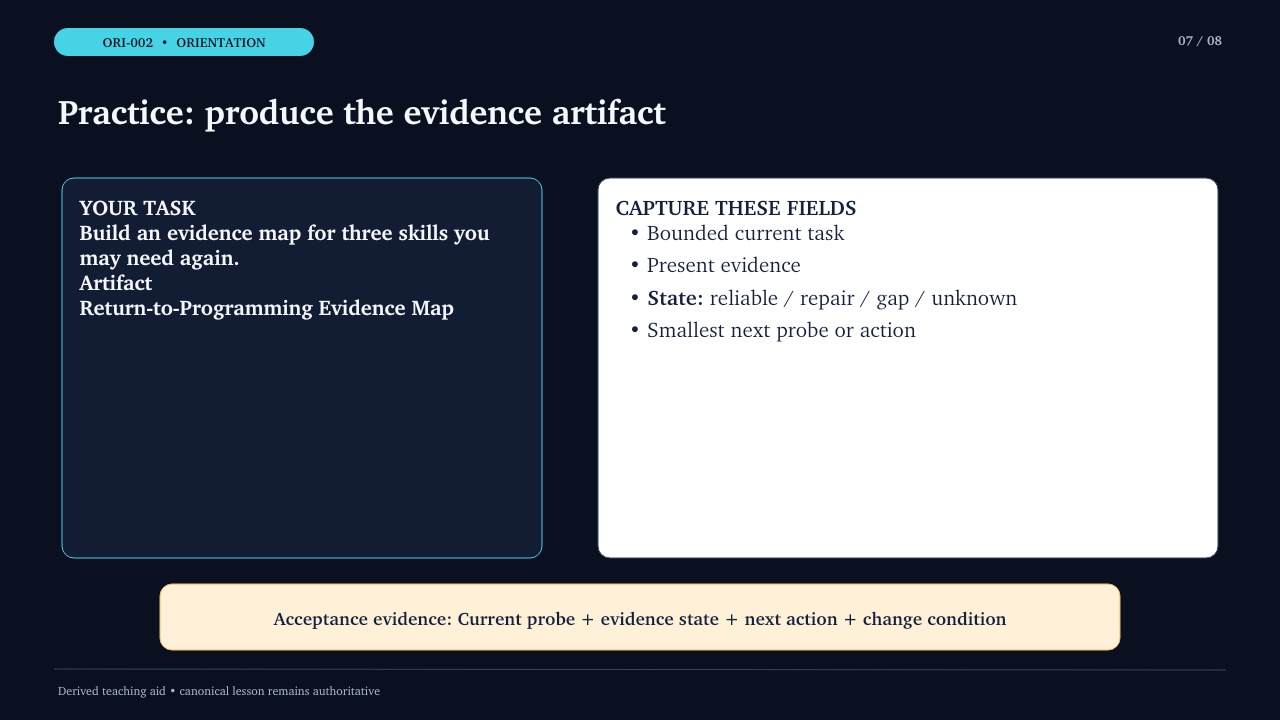
Start the map with one real row
Create one row for each skill or task:
| Field | What to record |
|---|---|
| Skill/task | One bounded ability you can actually test |
| Relevant history | Prior experience that genuinely relates to this task |
| Current probe | What you will do now to test it |
| Evidence | Inspectable output or reasoning |
| State | Reliable / Needs repair / New gap / Not enough evidence |
| Next step | Advance, targeted repair, new learning, or a better probe |
| Claim boundary | What this row does not prove |
| Update condition | What evidence would change your decision |
Two rules matter.
First, split a broad skill into multiple rows when needed. Data modeling may be reliable while operational planning for a structural change needs repair.
Second, choose the state from evidence, not from comfort. Recognizing an API, remembering syntax, or having seen similar code does not by itself demonstrate problem-solving ability.
Keep what transfers; repair what has become unreliable
A good return is neither “start from zero” nor “skip everything because I have experience.” The goal is to reduce unnecessary repetition without hiding real gaps.
Suppose you can still reason about separation of responsibilities, function inputs and outputs, and likely failure paths. That part of your mental model may have transferred. But if you cannot reproduce a new bug, form hypotheses, gather evidence, and verify the fix with a repeatable check, debugging at that level is not yet reliable.
At the other extreme, a task that was absent from your prior experience is context, not a New gap verdict by itself. Run a current probe. If you can already demonstrate the bounded capability, the state may be Reliable for this task; if the probe shows the capability is missing and there is no retained basis to repair, New gap becomes defensible.
Where can AI help?
You can ask AI to propose probe ideas, challenge your reasoning, or generate a counterexample. You should not treat an AI judgment such as “you are ready” or “you belong at this level” as evidence simply because it sounds confident.
The final re-entry decision has to remain connected to evidence you can inspect and defend yourself.
Three cases: prior experience is not one indivisible thing
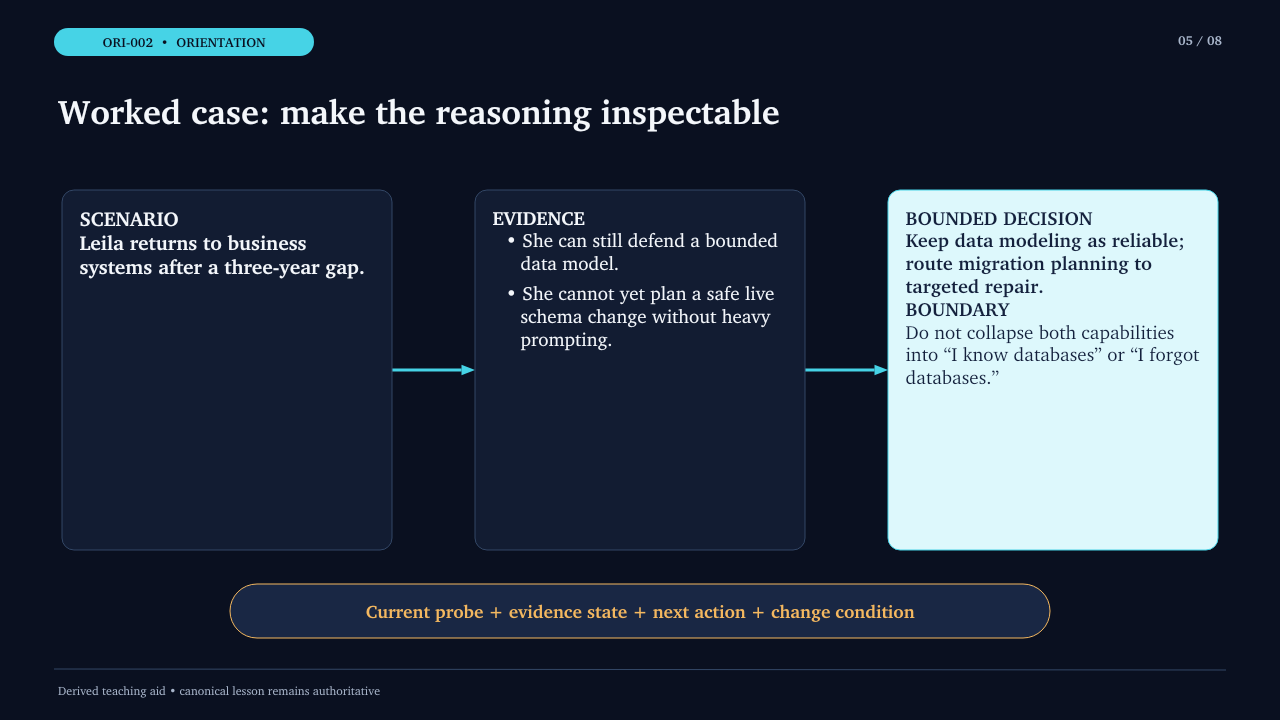
Case 1: the data model is retained; operational execution needs repair
Leila worked on business systems several years ago. Given a small domain problem, she can identify the main entities, relationships, and constraints and defend the design. That is useful evidence for the conceptual modeling task.
When asked to plan a structural data change in a running system, however, her answer relies mostly on memory and guesswork. Her map should not say “I know databases” or “I forgot databases.” It needs separate rows: modeling is currently more reliable; operational change planning needs fresh practice and evidence.
Case 2: JavaScript familiarity is not current capability evidence
Amir remembers syntax quickly and can read familiar code. In a new exercise with several asynchronous operations and error paths, he cannot explain the behavior accurately, and his test covers only the successful path.
This does not make Amir “a beginner.” It says that for this bounded ability, old familiarity is not enough. Reasoning about asynchronous flow, failure, and testing needs repair.
Case 3: debugging transfers into a changed context
Sara has years of debugging experience but has never seen the code or tooling in the exercise. Given a new failure, she reproduces it, narrows the search space, rejects hypotheses with evidence, and verifies the fix with a repeatable check.
The important signal is not familiarity with that codebase. The problem-solving pattern survived the context change. That is meaningful evidence for transferable debugging capability, while still proving nothing about every system, role, or programming domain.
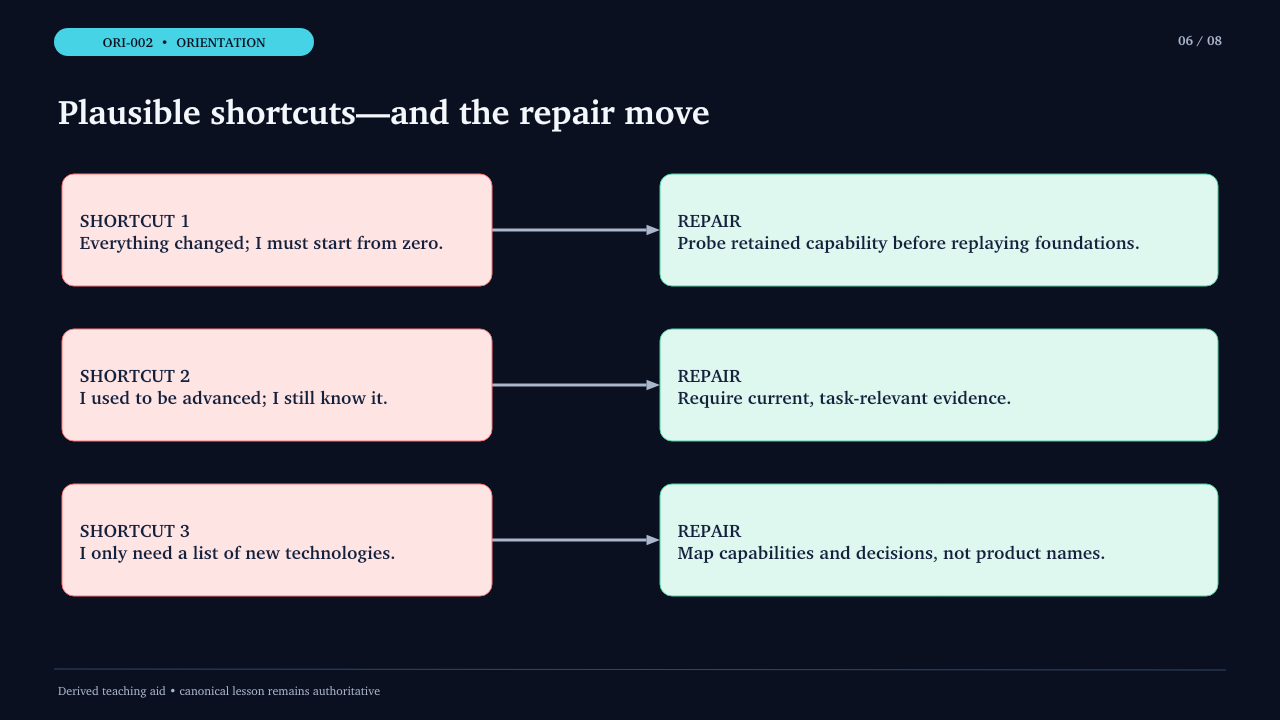
Three shortcuts that damage the starting-point decision
Shortcut 1: “everything changed, so I will start from zero”
The cost is not only wasted time. Replaying material you can already handle prevents you from locating the real edge of your capability.
Repair: choose a small but real task. If the evidence is strong, keep that capability and probe the next level.
Shortcut 2: “I used to be advanced, so I still know it”
Experience matters, but it is not current evidence by itself. A mental model can survive while precise execution becomes rusty.
Repair: define a present-day probe for the exact claim. Decide after you see the result.
Shortcut 3: “I just need a list of new technologies”
A list of names turns re-entry into tool chasing. It does not tell you which engineering abilities transferred and which gaps actually matter.
Repair: start from tasks and capabilities. Bring a technology into the map only when it matters for the task being tested.
If you are experienced, raise the quality of the probe instead of removing it
Introductory drills may produce little useful evidence for an experienced programmer. The answer is not to skip verification. Make the probe smaller, denser, and more realistic.
Instead of five syntax exercises, use one task with ambiguity, failure, or a constraint. Instead of defining a concept, defend a design choice against a plausible alternative. Instead of repeating familiar code, use the same capability in a changed context.
Success gives you stronger evidence to advance. Failure gives you a more precise repair target.
Different skills can have different starting points
You do not need one label for your entire profile. A single week of evidence might produce a map like this:
- simple data modeling: currently reliable;
- tests around complex failure behavior: needs repair;
- an architectural task you have not used before, where a current probe shows the needed capability is missing and there is no retained basis to repair: new gap;
- service deployment: not enough evidence yet, so build a probe.
That unevenness is expected. The map exists to make it visible.
Build your own map, then retest one row in a changed context
Round 1: choose one old skill
Pick something you are neither completely confident about nor completely new to. Turn it into a testable task.
Too broad: “backend development.”
Better: “I can define error behavior for a small API and write tests for two failure cases.”
Round 2: build a current probe
Keep it small enough to complete, but real enough that familiarity cannot carry you through. Before starting, write what you will count as evidence.
Round 3: record the state and next step
Choose the state because the evidence supports it, not because it is more flattering:
- reliable for this task;
- needs repair;
- new gap;
- not enough evidence.
For New gap, lack of prior experience is not sufficient by itself: a current probe must show the needed capability is missing, and relevant history must show no retained basis to repair. If you have not run a suitable probe, choose Not enough evidence.
Then write one concrete next step.
Round 4: changed-context transfer
Create a second task that looks different from your old experience but still requires the same underlying capability. If you succeed only when familiar surface cues are present, what remains may be recognition rather than transferable competence.
If you can analyze the new situation, make a decision, and produce evidence, your map has a stronger reason to treat that skill as reliable. This still does not prove broad mastery by itself.
What makes the map defensible?
Before accepting a row, ask four questions:
- Is the decision about a specific skill or task rather than a broad identity label?
- Does the state come from current evidence rather than history or confidence alone?
- Does the next step match the state?
- Are the claim boundary and update condition explicit?
If any answer is no, the map is not yet strong enough to choose a starting point.
The main assessment: repeat the method with less support
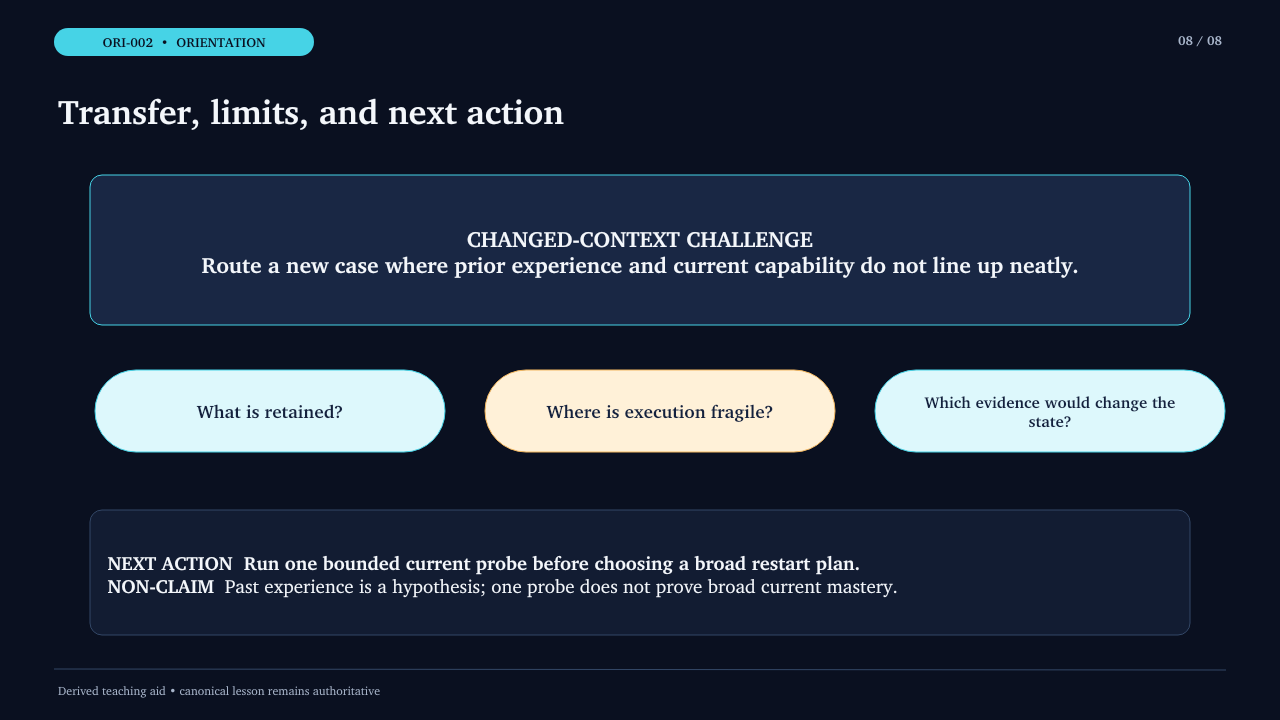
In the final task, you receive a new case where prior experience and current capability do not line up neatly. You must separate retained capability, repair needs, new gaps, and missing evidence. Then choose a bounded re-entry action and state what evidence would change it.
Transfer matters more than memorizing the four state names. Rebuilding the model in a changed context is evidence that you understand the decision method; it is not proof of the entire technical skill.
Why this lesson does not maintain a list of “old” and “new” technologies
The lesson teaches a durable re-entry method rather than a list that will age as tools change. The age of a technology does not determine your re-entry point by itself; test the bounded task with a current probe and inspectable evidence. If a particular tool or capability matters for your work, give it its own row in the map and test your present ability for that task.
Assessment
There is no answer key in this lesson pack; answer it yourself and mark honestly. "Needs review" sends the lesson to your review queue.
Q1 retrieval
Why are an old job title or years of experience insufficient by themselves for choosing a re-entry point?
Q2 application
A returning programmer can still explain a relational model well, but planning a structural change in a running system relies mostly on memory and guesswork. Build two appropriate Evidence Map rows and assign a state and next step to each.
Q3 diagnosis
Diagnose this reasoning: “I used to be a senior developer, so there is no need to test my testing capability again.”
Q4 decision
For one of your old skills, write a complete Evidence Map row: task, relevant history, current probe, evidence, state, next step, claim boundary, and update condition.
Q5 transfer
For the same skill, design a changed-context task that removes familiar surface cues while still requiring the underlying capability. State what result would keep or change the map state.
Assessment rubric
Critical dimensions
1. Decision and scope correctness — critical
Sufficient work makes a decision about a bounded skill/task rather than a global identity label. The state and next step do not claim more than the lesson supports.
2. Evidence adequacy — critical
The learner names inspectable current evidence that is relevant to the exact task. Past title, confidence, familiarity, or an AI verdict cannot substitute for evidence.
3. Non-claim honesty — critical
The artifact states at least one explicit claim boundary: what the current row does not prove.
4. Transfer — critical
The changed-context task preserves the underlying capability while changing surface cues. The learner explains what evidence would keep or change the state.
Blocking failure conditions
- a re-entry state with no supporting evidence;
- whole-person beginner/advanced classification from a single row;
- past history treated as sufficient proof of current capability;
- AI output treated as the final authority;
- transfer task is only a renamed copy of the original;
- claim boundary or update condition is missing in a blocking artifact.
Human decision policy
AI may suggest probes, counterexamples, or critique. The learner remains responsible for the final bounded state and next step.
What passing does not prove
Passing this lesson does not prove technical programming mastery, job readiness, or whole-program mastery.
References & freshness
Case studies
Lesson visuals
Decision flow from prior experience to current task, probe, evidence, state, and next step, with claim-boundary and update-condition guards.
How do prior experience, a current probe, and evidence lead to a bounded re-entry state?
Example map showing four separate skills in reliable, repair, new-gap, and insufficient-evidence states.
How can one returning programmer have different states across different skills?
Optional video script
After a few years away, the first question is not “am I still advanced?” A better question is: “for this specific task, what evidence can I produce now?”
Split broad skills into bounded tasks. “Databases” may become one row where data modeling is reliable and another where planning a structural change in a running system needs repair. That is not a contradiction; it is a more precise map.
For each row, record the current task, probe, evidence, state, next step, claim boundary, and update condition. If the evidence is missing, do not guess. “Not enough evidence” is a valid state.
Finally, test one old skill in a changed context. If the underlying capability survives without familiar surface cues, you have stronger transfer evidence. That evidence still supports only the bounded capability you tested.
Canonical terminology
| Term | Policy | Boundary |
|---|---|---|
Return-to-Programming Evidence Map | Use the full name at first mention; Evidence Map is acceptable afterward. | A bounded decision artifact, not a mastery certificate. |
Reliable for this task | Use reliable for this task / bounded task, not mastered. | Supported only for the tested task and evidence. |
Needs repair | Use needs repair; avoid remedial labels about the whole learner. | Task-level repair need, not global learner classification. |
New gap | Use new gap only when current evidence shows the bounded capability is missing at the needed level and relevant history shows no retained basis to repair. | History is context, not sufficient evidence. No suitable current probe means Not enough evidence; a successful current probe may support Reliable even without prior experience. |
Not enough evidence | Use not enough evidence yet as a valid state. | Defers judgment until a better probe exists. |
Claim boundary | Use claim boundary for the explicit non-claim. | Prevents evidence from being inflated into broad mastery. |
Update condition | Use update condition for evidence that would trigger reconsideration. | Revisability, not instability. |
Lesson media & slides
Teaching files (download)