امنیت، هویت، استقرار و تابآوری · فصل ۸ — Security، Tenant، Rights و Hallucination · 122
Hallucinated Claim
Triage synthetic generated claims into supported, contradicted, unsupported and unknown states; trace each claim to evidence that actually entails it; require abstention or human review when support is insufficient; and prove correction with a changed-evidence case rather than trusting the model’s confidence. میتواند failure family «Hallucinated Claim» را بازتولید/تشخیص دهد و detection، containment و recovery مناسب را تعیین کند.
Lesson summary
Triage synthetic generated claims into supported, contradicted, unsupported and unknown states; trace each claim to evidence that actually entails it; require abstention or human review when support is insufficient; and prove correction with a changed-evidence case rather than trusting the model’s confidence.
میتواند failure family «Hallucinated Claim» را بازتولید/تشخیص دهد و detection، containment و recovery مناسب را تعیین کند.
This lesson produces
میتواند failure family «Hallucinated Claim» را بازتولید/تشخیص دهد و detection، containment و recovery مناسب را تعیین کند.
Who it is for
Foundation
Use a guided boundary matrix and one explicit ambiguity repair.
Repair
Re-run only the failed evidence dimension with a smaller deterministic synthetic case.
Experienced
Start from mixed evidence; require competing explanations, negative evidence and transfer.
Prerequisites
1. Fluent, cited text can still contain a false or unsupported claim
A generated answer can sound certain, include precise numbers, and show a plausible citation while the claim itself is unsupported, contradicted, or based on stale evidence. NIST uses confabulation for a class of generative-AI behavior in which erroneous or false content is confidently presented, including output that diverges from inputs or prior generated statements. [NIST-AI-600-1] The first move in this lesson is therefore to separate fluency and confidence from evidence.
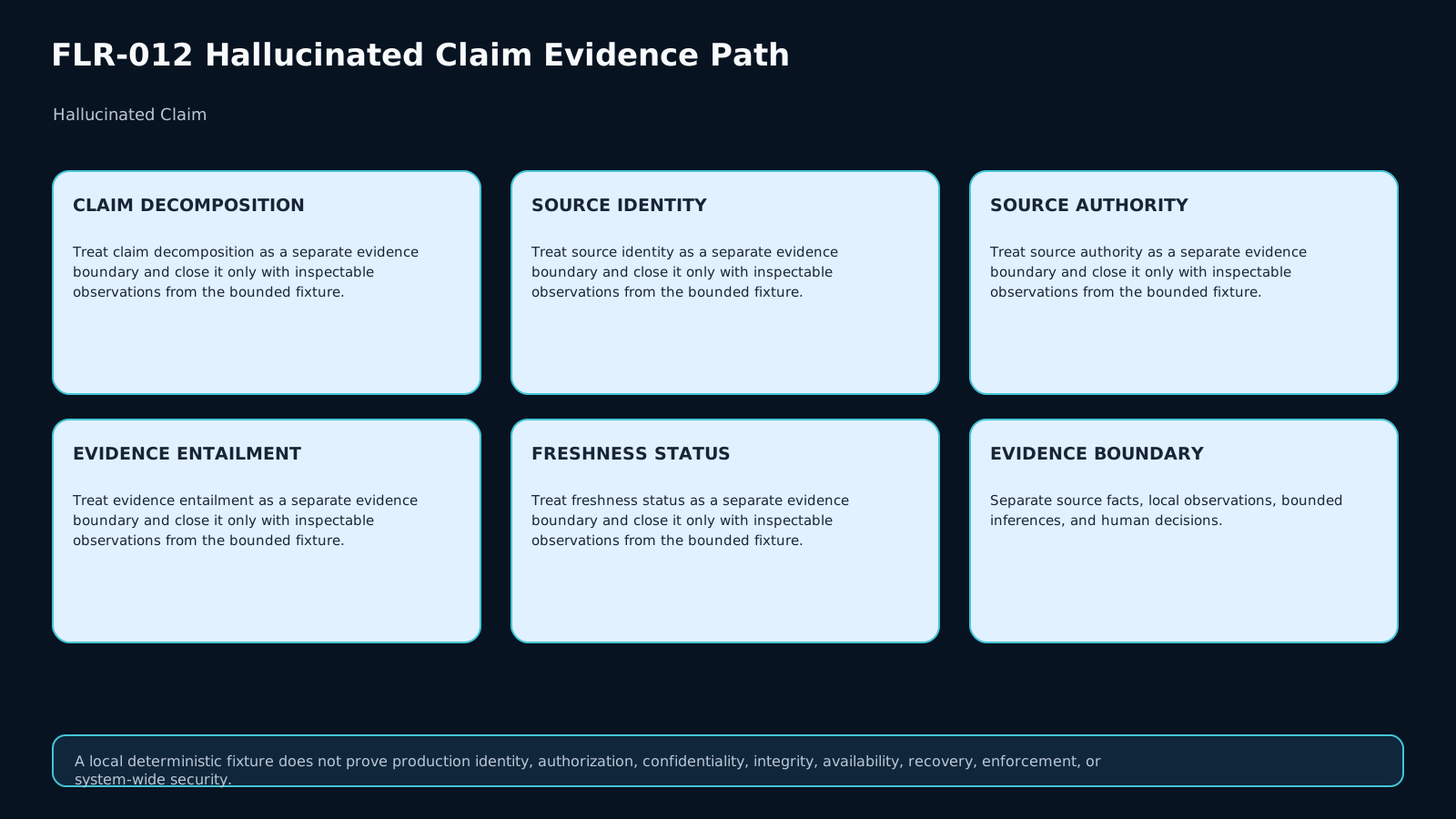
2. Verify atomic claims, not an answer-wide impression
Decompose the response into small claims that can be checked independently. Each row should have a clear subject, predicate, and time/scope when relevant. “Product X became faster and cheaper in 2026” contains at least two claims. If they remain fused, a source supporting only speed can accidentally make the whole sentence look grounded.
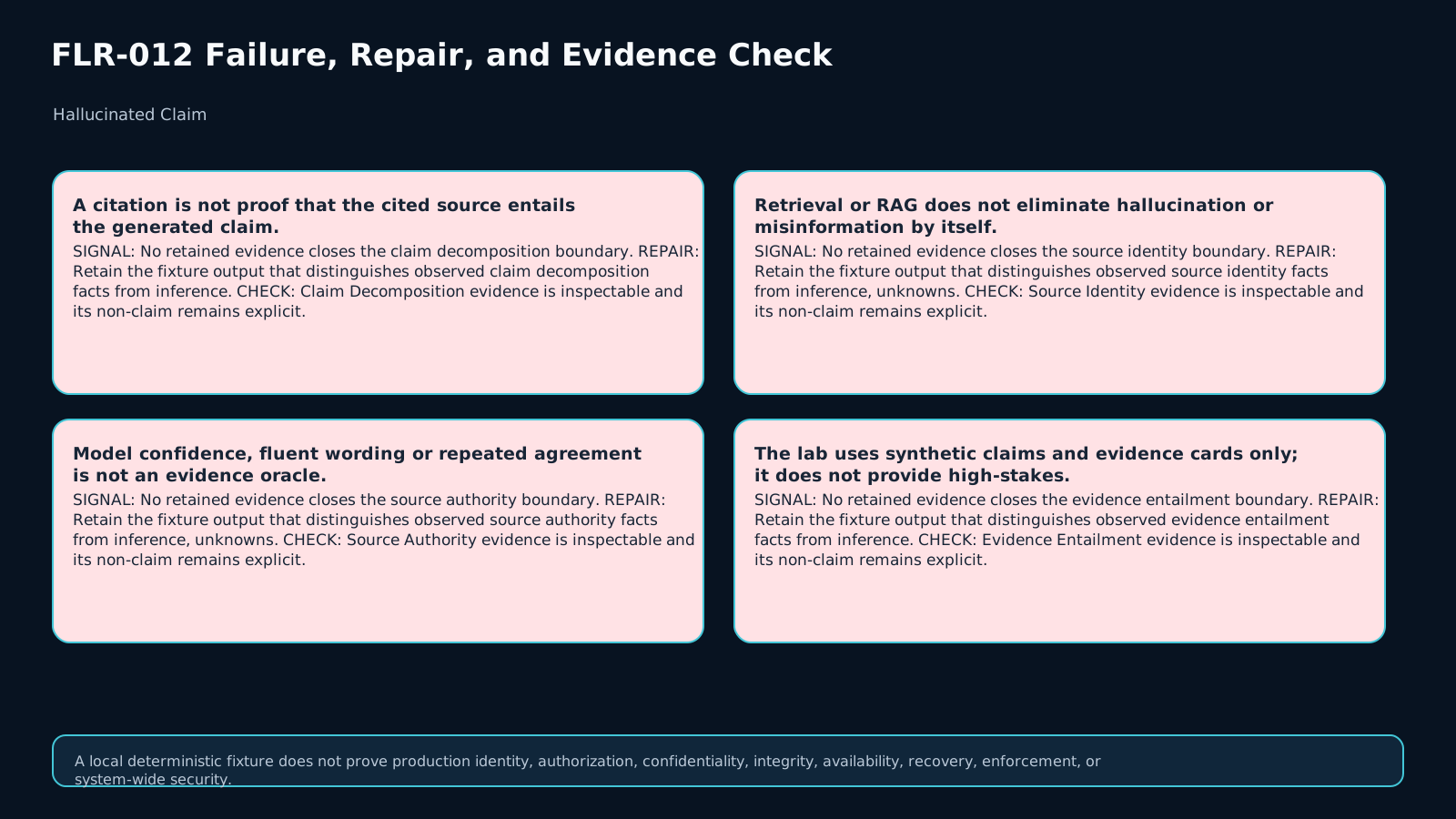
3. Citation presence is not entailment
A citation only shows that a source was attached. It does not prove that the cited passage entails the claim. Ask separately whether the source covers the right entity/version, whether the passage is relevant, and whether the passage logically supports the exact statement. A nearby but non-entailing source leaves the claim UNSUPPORTED or UNKNOWN.
4. Authority and freshness are independent dimensions
An authoritative source can be too old for a time-sensitive claim, while a fresh source can lack authority. Record source identity, source authority, and freshness separately. A claim that was correct yesterday can become unsafe after a release, price change, policy update, or official correction.
5. Preserve four core support states
This lesson uses four operational states. SUPPORTED means fresh, adequate evidence entails the claim. CONTRADICTED means adequate evidence rejects it. UNSUPPORTED means the available evidence does not support it. UNKNOWN means the evidence is insufficient, stale, ambiguous, or of unresolved authority. UNKNOWN is a safety boundary, not an analytical failure.
6. Do not reduce hallucination or misinformation to one cause
OWASP LLM09:2025 treats misinformation as a significant risk for LLM applications and identifies hallucination and overreliance as important contributors. [OWASP-LLM09] That does not mean every false claim has the same mechanism or that retrieval automatically solves it. This lesson classifies the evidence state of the claim rather than guessing the model's internal cause.
7. Model confidence is not an evidence oracle
A model can be highly confident about a false claim and hesitant about a true one. Confidence scores, repeated agreement across models, or phrases such as “according to reliable sources” are signals only. They cannot repair a broken evidence chain. The lab deliberately includes high-confidence claims that must still be classified as contradicted or unsupported.
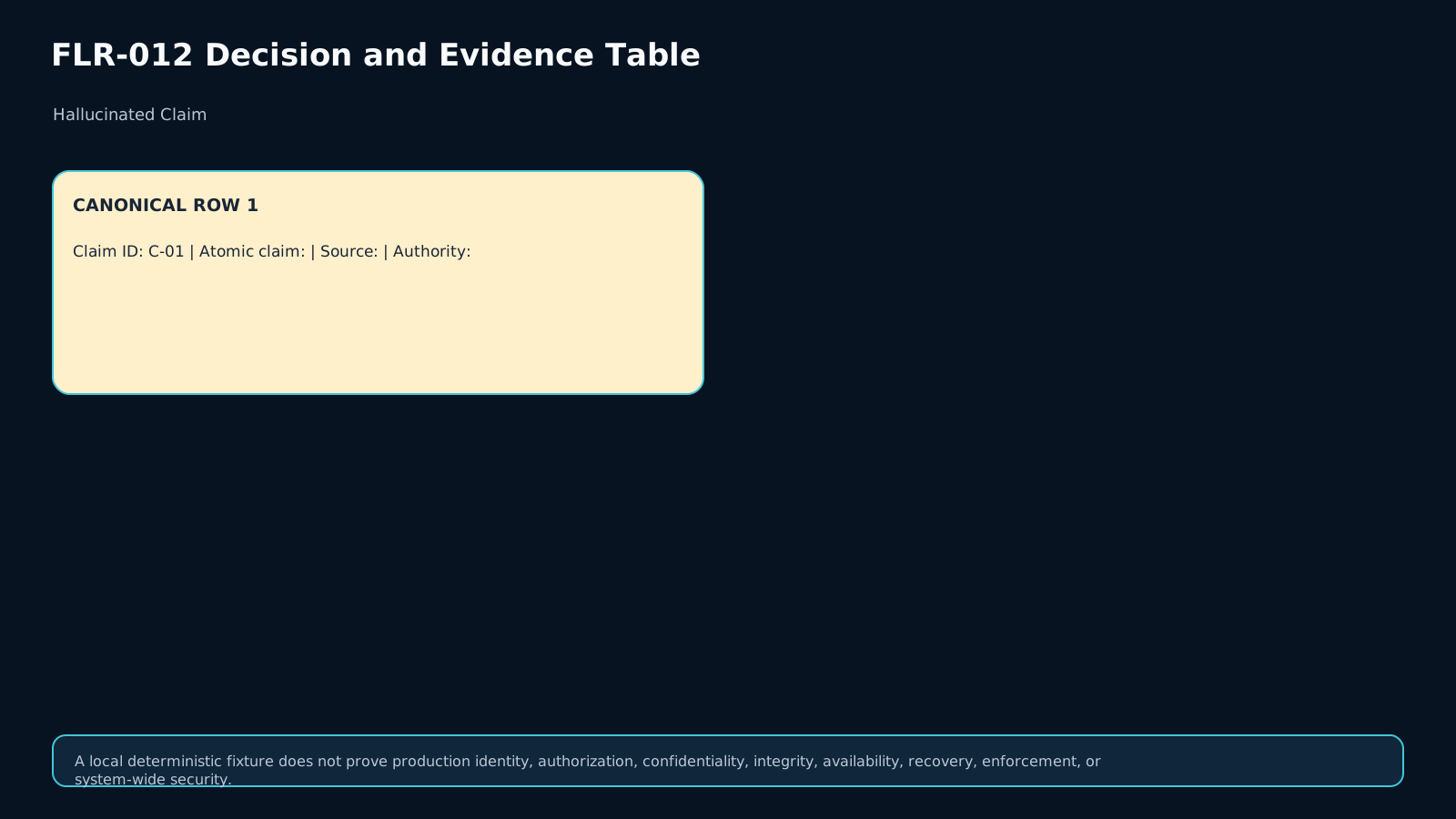
8. Claim Grounding & Hallucination Triage Record v1
The owned artifact is an auditable row-level record: Claim ID, atomic claim, source identity, authority, evidence passage, entailment, freshness, support state, contradiction evidence, publication action, human-review trigger, and residual uncertainty. A reviewer should be able to reconstruct the decision from the record without hidden reasoning.
9. Actively reject at least one competing explanation
When a claim lacks support, do not immediately conclude “the model hallucinated.” Retrieval may have fetched the wrong document, the wrong source version may be in use, the claim may fuse two propositions, or the current evidence pack may be incomplete. A useful probe changes one boundary at a time: source, passage, version, or freshness snapshot.
10. Containment prevents unresolved claims from being published as facts
For a CONTRADICTED claim, correction or removal is required. For UNSUPPORTED and UNKNOWN, containment usually means abstaining, narrowing the wording, exposing uncertainty, or routing to human review. Adding a random citation, lowering temperature, or regenerating without new evidence is not valid containment.
11. Recovery requires a changed evidence chain
Recovery occurs when evidence actually changes: a fresh authoritative source arrives, a relevant passage is found, the claim is narrowed, or conflicting evidence is resolved. Rebuild the classification from that evidence. Repeating the same claim with higher confidence is not recovery.
12. Closure requires a changed-evidence rerun
After correction, rerun the same verification gate. Then use a changed-evidence case: one previously unsupported claim becomes SUPPORTED when new evidence arrives, while a previously supported claim falls back to UNKNOWN when its evidence becomes stale. A system that cannot detect both changes is memorizing labels rather than evaluating evidence.
13. Know when human review is required
Escalate when authority is unresolved, contradiction remains unresolved, freshness cannot be determined, or the claim has consequential use. This lesson does not provide real medical, legal, or professional decisions; all fixtures are synthetic. The skill is to record the review trigger and residual uncertainty precisely.
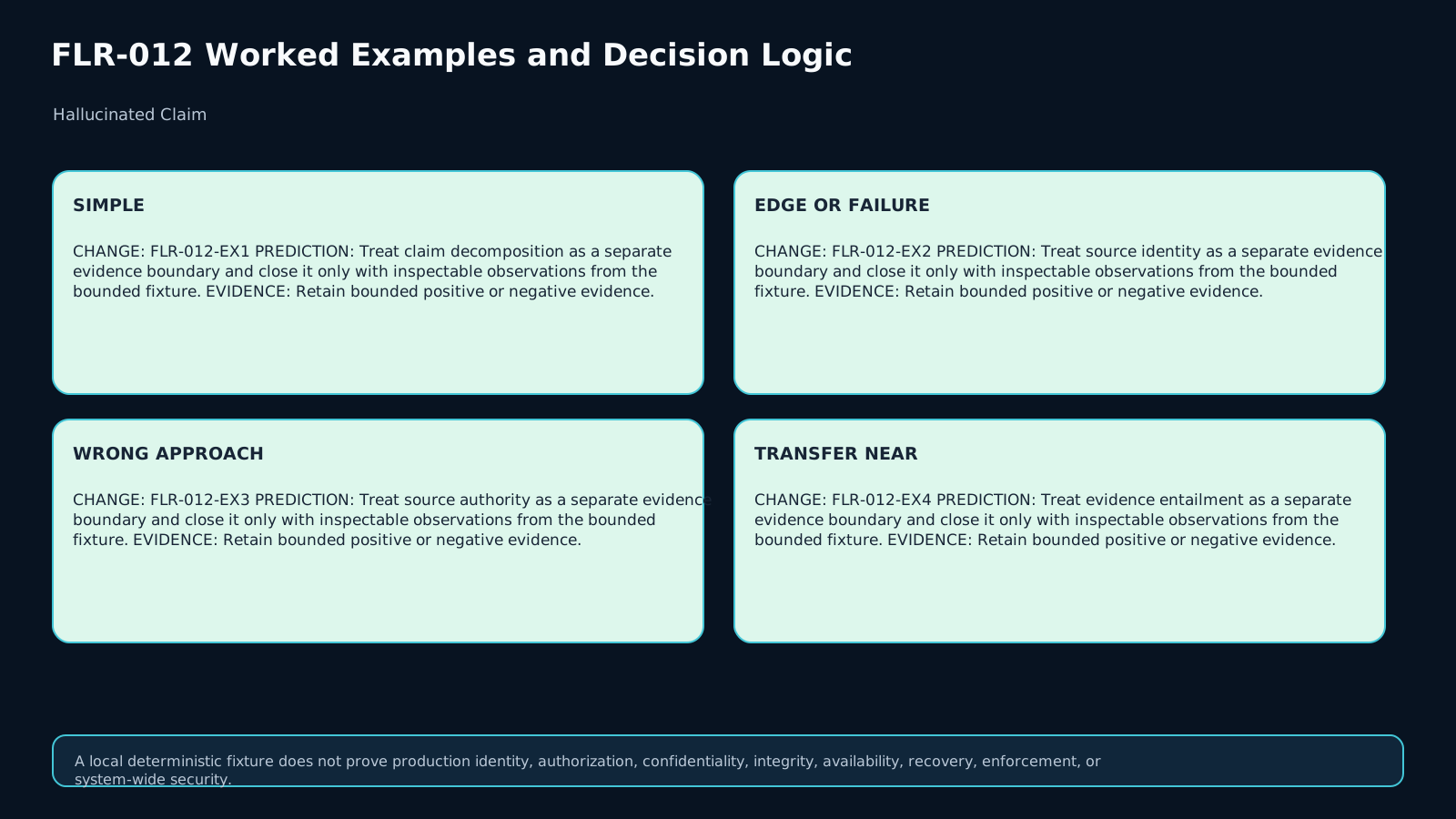
14. Lab: eight fixtures and 64 assertions
The lab contains eight cases: grounded baseline, direct contradiction, irrelevant citation, stale evidence, no evidence, ambiguous entailment, a transfer that upgrades a claim with new support, and a transfer where prior support becomes stale. The evaluator returns eight fields per case, and the admin test checks exactly 64 assertions. Everything is local and deterministic.
15. Exit checklist and transfer
Before exit, you should be able to state how the claim was decomposed, what authority the source has, what the passage entails, how freshness was checked, the final support state, the publication action, what remains UNKNOWN, and what evidence would change the classification. In transfer, rebuild the record from the new evidence pack rather than copying prior truth labels.
Assessment
There is no answer key in this lesson pack; answer it yourself and mark honestly. "Needs review" sends the lesson to your review queue.
FLR-012-AF1 formative
FLR-012-AF2 formative
FLR-012-AF3 formative
FLR-012-AS1 summative
FLR-012-AS2 transfer
Assessment rubric
A passing submission must: (1) decompose composite output into atomic claims; (2) trace each decision to source identity, authority, passage, entailment and freshness; (3) preserve UNKNOWN when evidence is insufficient; (4) distinguish contradiction from lack of support; (5) choose a bounded publication/abstention/review action; (6) state residual uncertainty; and (7) rebuild the transfer case from changed evidence rather than copied labels.
A submission fails if citation presence, retrieval success, confidence, or repeated model agreement is treated as proof of factual support.
References & freshness
Case studies
Lab files
Implement an evidence-bounded evaluate(case) function over eight synthetic claim/evidence cases. Treat each claim independently. Your decision must use source authority, evidence entailment, freshness, contradiction evidence, and availability of evidence.
Do not treat citation presence or model_confidence as proof. Preserve UNKNOWN when evidence is stale, ambiguous, unavailable, or has unresolved authority. The changed-evidence cases must be re-evaluated from their post-evidence fields rather than from the original label. No network, production data, or real high-stakes decision is required.
Lesson media & slides
Teaching files (download)