امنیت، هویت، استقرار و تابآوری · فصل ۸ — Security، Tenant، Rights و Hallucination · 118
Credential Compromise
Classify a synthetic credential-compromise incident by separating authenticator state, session state, recovery state and authorization scope; bound the blast radius; choose reversible containment; and prove that compromised access paths are invalidated without claiming that one reset closes every session or token. میتواند failure family «Credential Compromise» را بازتولید/تشخیص دهد و detection، containment و recovery مناسب را تعیین کند.
Lesson summary
Classify a synthetic credential-compromise incident by separating authenticator state, session state, recovery state and authorization scope; bound the blast radius; choose reversible containment; and prove that compromised access paths are invalidated without claiming that one reset closes every session or token.
میتواند failure family «Credential Compromise» را بازتولید/تشخیص دهد و detection، containment و recovery مناسب را تعیین کند.
This lesson produces
میتواند failure family «Credential Compromise» را بازتولید/تشخیص دهد و detection، containment و recovery مناسب را تعیین کند.
Who it is for
Foundation
Use a guided boundary matrix and one explicit ambiguity repair.
Repair
Re-run only the failed evidence dimension with a smaller deterministic synthetic case.
Experienced
Start from mixed evidence; require competing explanations, negative evidence and transfer.
Prerequisites
1. One suspicious signal does not prove the compromise boundary
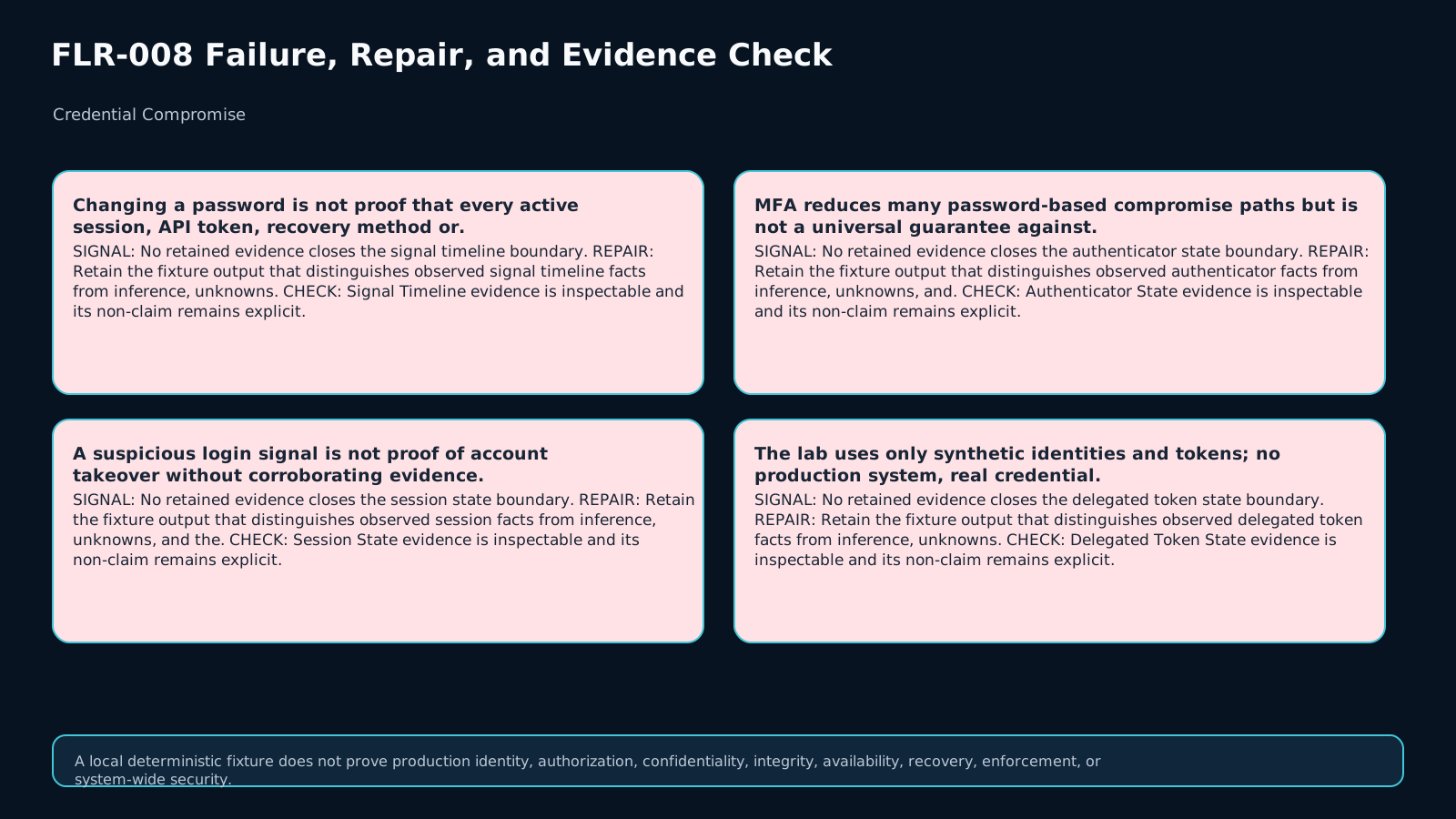
A new-device login, recovery-channel change, leaked-password signal, or unexpected session is evidence to inspect, not a complete diagnosis. The affected path may be an authenticator, an existing session, a delegated token, or a recovery path. This lesson keeps unsupported dimensions UNKNOWN rather than turning one signal into a takeover story.
2. Keep four states separate
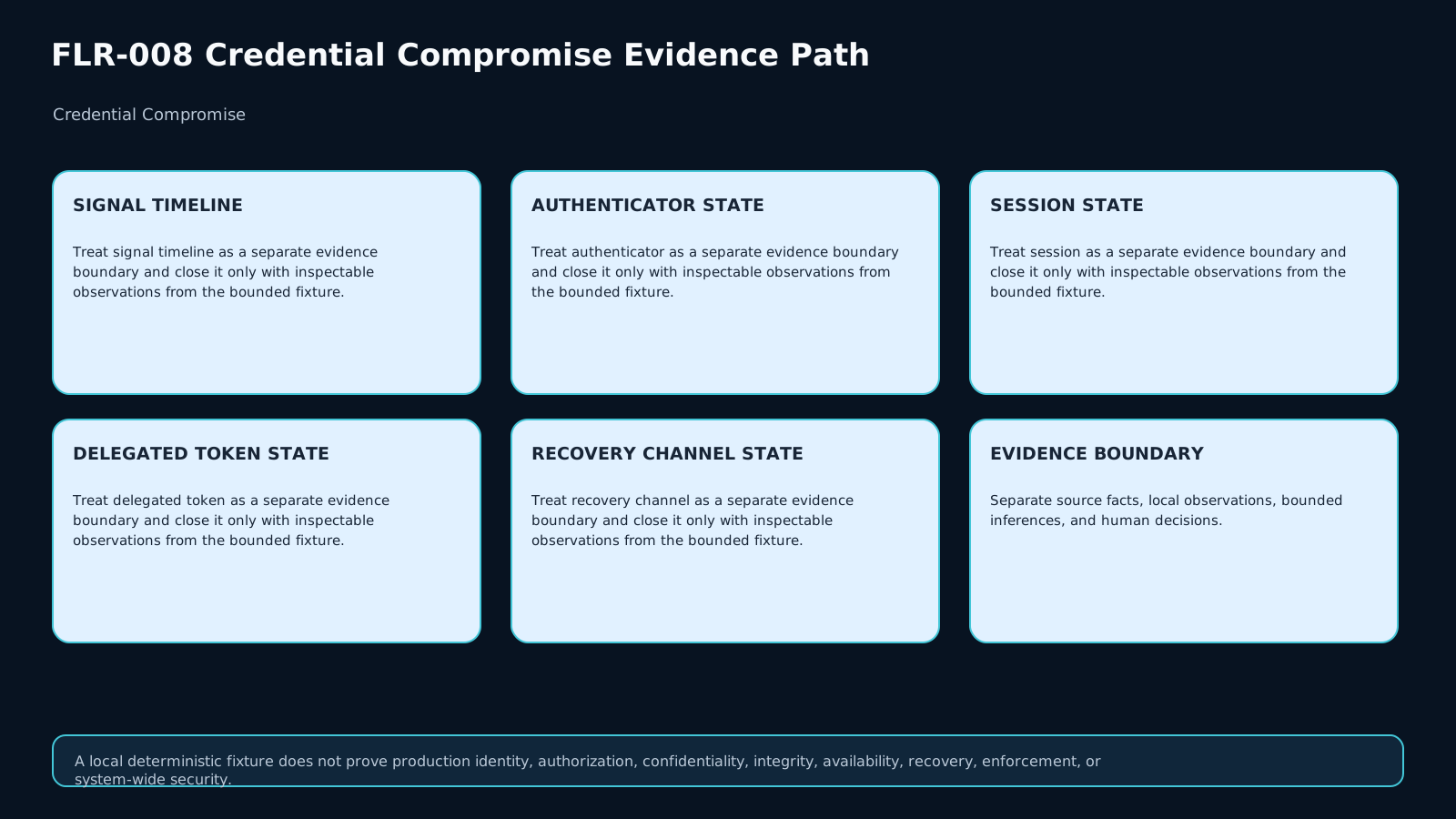
Track authenticator state, session state, recovery state, and delegated-access state independently. A password change affects the relevant authenticator but does not automatically prove that existing sessions or tokens ended. Conversely, a stolen session can exist while the primary authenticator remains intact.
3. What NIST says about authenticator compromise
NIST SP 800-63B-4 requires compromised authenticators to be promptly suspended, invalidated, or destroyed after compromise detection and defines invalidation as removal of the binding between the authenticator and subscriber account. [NIST-63B4] That authority is about the authenticator boundary; it is not proof that every application session or delegated token has also ended.
4. MFA matters, but it is not closure proof
OWASP describes MFA as a strong defense against most password-related attacks such as credential stuffing and recommends layered defenses and monitoring. [OWASP-CREDENTIAL] MFA is therefore an important control, not evidence that no stolen session, abused recovery route, or residual delegated access exists.
5. Build a timeline, not a narrative
Record signal time, authenticator changes, session creation or continuation, recovery changes, and token activity separately. A timeline distinguishes “observed after reset” from “closed because of reset.” If ordering is unknown, do not invent causality.
6. Bound blast radius path by path
Blast radius is the set of access paths that evidence shows can still act: authenticator, active session, delegated token, or recovery route. Scope it from observed state rather than worst-case imagination. When evidence is incomplete, keep the radius bounded and mark uncertainty explicitly.
7. Suspicious login is not the same as takeover
A login from a new IP or device can be legitimate. Classification needs corroborating evidence, state inconsistency, or access-path evidence. The negative-control case in this lesson contains a suspicious recovery change later proven legitimate; it must not be escalated to confirmed takeover without support.
8. Separate containment from recovery
Containment can suspend a suspected authenticator, terminate a session, revoke a token, or freeze a recovery path. Recovery restores legitimate access and independently verifies that the compromised path is closed. Containment should be bounded and reversible where practical.
9. Password rotation closes only one path
If a password authenticator is compromised, rotation can be part of recovery. But one fixture deliberately keeps an old session valid after password rotation. Closure therefore has to inspect the session registry, token state, and recovery state separately.
10. Session compromise is not identical to credential compromise
The transfer fixture keeps the authenticator healthy while a stolen session becomes the primary concern. The bounded response is session termination and scope review, not automatically rotating every credential. This distinction reduces both blind spots and unnecessary response.
11. Do not forget delegated tokens
An API token or delegated grant can remain usable after authenticator invalidation depending on architecture. Record token scope and revocation state independently. If token state is unknown, full containment cannot be claimed.
12. Recovery is itself an access path
An unauthorized email, phone, or recovery-factor change can create persistence. Verify whether the recovery change was authorized before declaring restoration complete. If evidence cannot resolve the boundary, OPEN_BOUNDARY_UNRESOLVED is a valid state.
13. Closure needs an independent probe
After containment, do not merely re-read the original symptom. Verify authenticator invalidation or binding state, session termination, token revocation, and authorized recovery state independently for the paths in scope. Close only what the evidence closes and preserve residual uncertainty.
14. Lab: eight fixtures and 64 assertions
The lab is fully local and synthetic. Eight cases cover a safe baseline, authenticator compromise, a session surviving password rotation, residual delegated token access, recovery-path compromise, a false-positive recovery signal, incomplete evidence, and a stolen-session transfer case. The hidden evaluator checks eight outputs per case for 64 assertions.
15. Exit checklist and claim boundary
Before exit, separate the four access-path states, reject at least one alternative with evidence, bound blast radius, distinguish containment from closure, preserve UNKNOWN, rebuild the transfer case from fresh evidence, and state that passing the synthetic fixture proves only bounded lesson reasoning—not absence of compromise in a real system.
Assessment
There is no answer key in this lesson pack; answer it yourself and mark honestly. "Needs review" sends the lesson to your review queue.
FLR-008-AF1 formative
FLR-008-AF2 formative
FLR-008-AF3 formative
FLR-008-AS1 summative
FLR-008-AS2 transfer
Assessment rubric
A passing submission must: (1) separate authenticator, session, delegated-token, and recovery state; (2) preserve OPEN_BOUNDARY_UNRESOLVED when evidence cannot identify the compromised path; (3) reject at least one plausible alternative or false-positive interpretation; (4) bound blast radius from evidence; (5) distinguish containment from recovery/closure; (6) use a path-specific independent closure probe; and (7) rebuild the transfer fixture from fresh evidence.
A submission fails if password rotation, MFA presence, one suspicious login, or one green rerun is generalized into proof that every access path is safe.
References & freshness
Case studies
Lab files
Implement a bounded evaluate(case) function over eight synthetic cases. Treat authenticator, session, delegated-token, and recovery state independently.
Do not infer account takeover from one suspicious signal. Preserve OPEN_BOUNDARY_UNRESOLVED when evidence is insufficient. Password rotation does not automatically terminate sessions or tokens. The transfer case deliberately keeps the authenticator healthy while a stolen session is the affected path.
The lab is fully local and defensive; no real credential, production account, phishing flow, customer data, or external target is involved.
Lesson media & slides
Teaching files (download)