امنیت، هویت، استقرار و تابآوری · فصل ۸ — Security، Tenant، Rights و Hallucination · 121
Rights/Canon Breach
Audit a synthetic content bundle against explicit rights metadata and canonical-source/version rules; separate legal/policy uncertainty from technical provenance; quarantine unsupported material; and produce a human-reviewable decision without pretending the lesson supplies jurisdiction-specific legal advice. میتواند failure family «Rights/Canon Breach» را بازتولید/تشخیص دهد و detection، containment و recovery مناسب را تعیین کند.
Lesson summary
Audit a synthetic content bundle against explicit rights metadata and canonical-source/version rules; separate legal/policy uncertainty from technical provenance; quarantine unsupported material; and produce a human-reviewable decision without pretending the lesson supplies jurisdiction-specific legal advice.
میتواند failure family «Rights/Canon Breach» را بازتولید/تشخیص دهد و detection، containment و recovery مناسب را تعیین کند.
This lesson produces
میتواند failure family «Rights/Canon Breach» را بازتولید/تشخیص دهد و detection، containment و recovery مناسب را تعیین کند.
Who it is for
Foundation
Use a guided boundary matrix and one explicit ambiguity repair.
Repair
Re-run only the failed evidence dimension with a smaller deterministic synthetic case.
Experienced
Start from mixed evidence; require competing explanations, negative evidence and transfer.
Prerequisites
1. Technical access does not establish authorization to publish
A system may successfully retrieve a file, passage, image, or version and still lack answers to two separate questions: “Is this the project-approved current source/version?” and “Does the recorded permission or policy cover the intended use?” This lesson keeps those questions separate so retrieval success is never converted into authorization or canon integrity by assumption.
2. Rights and canon are independent axes
Canon is a project-governance concept in this lesson: which source and version is the approved reference for the product, course, or knowledge base. Rights/Permission asks something else: under the supplied metadata and policy, which uses are allowed, restricted, or unknown. An item can be canonical but outside the permitted adaptation scope, or permitted for reproduction while using a superseded non-canonical version.
3. Citation is not permission
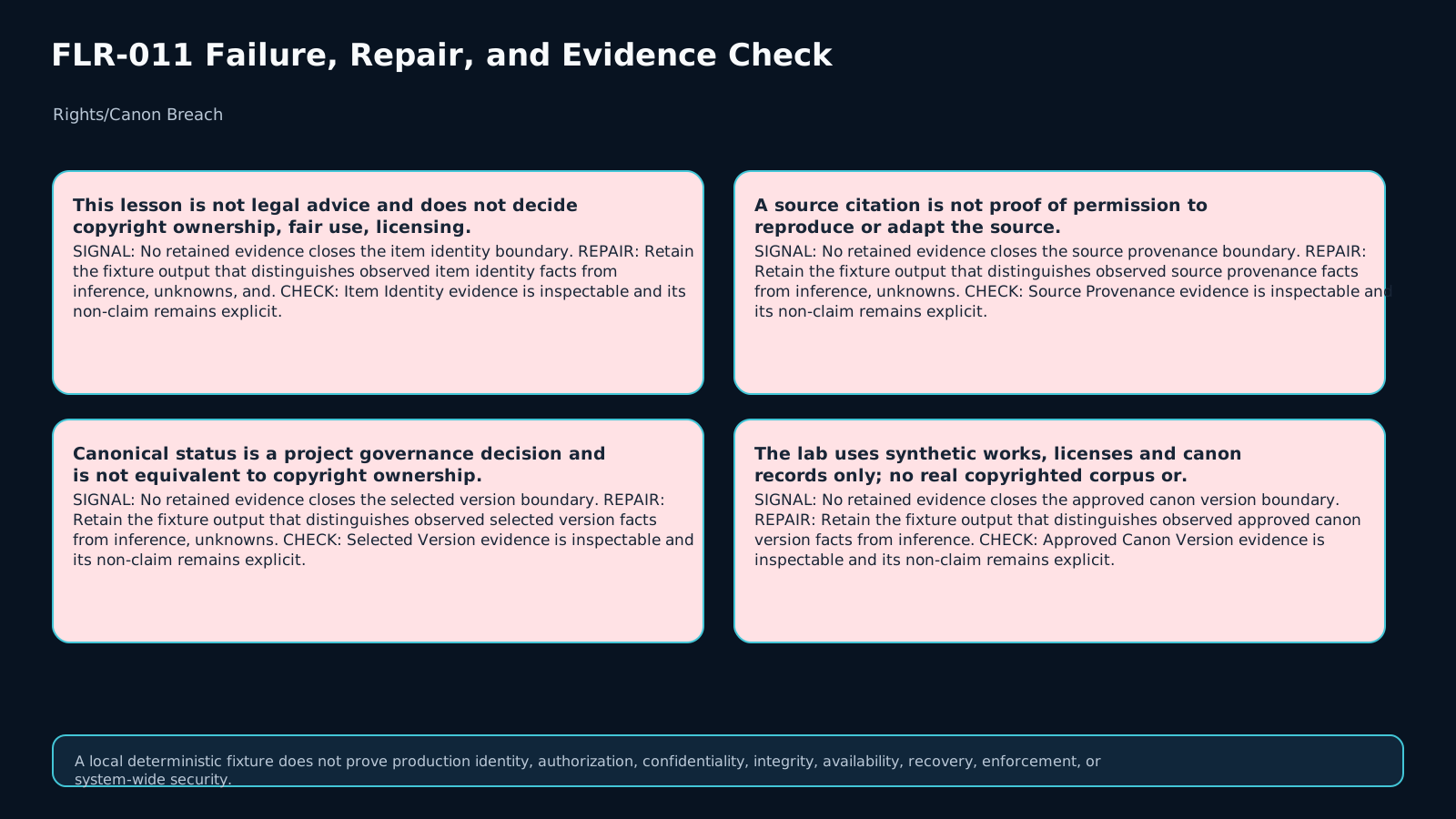
A citation improves provenance or attribution; it does not create permission to reproduce, adapt, or distribute. WIPO’s copyright overview distinguishes economic and moral rights and notes that limitations and exceptions depend on national law. [WIPO-COPYRIGHT] In this lesson, citation presence is therefore evaluated separately from rights_metadata and permission_scope, and missing rights information remains UNKNOWN.
4. Canon version must be explicit and auditable
Recording only the source name is not enough. Each item should carry at least source_id, selected_version, and approved_canon_version. If the selected version differs from the governance-approved version, the fixture has a canon breach even when permission is otherwise sufficient. That is a governance decision, not a legal ownership conclusion.
5. Compare permission scope with intended use
A license, consent, or policy record may allow reproduction but exclude adaptation, or permit internal use while excluding public release. “Permission exists” is therefore not a sufficient boolean. The intended use must be compared with the recorded scope. All scopes in the lab are synthetic and decisions are limited to those supplied policy records.
6. Keep legal boundaries separate from technical boundaries
WIPO notes that copyright limitations and exceptions vary across countries, while the U.S. Copyright Office describes U.S.-law rights including reproduction, derivative works, and distribution and distinguishes protected expression from ideas, procedures, methods, and systems. [WIPO-COPYRIGHT] [USCO-CIRC1] These sources frame the lesson; they do not let the lab decide real-world ownership, fair use, license validity, or legal exceptions.
7. Generated or adapted material still needs provenance
If content is AI-generated, summarized, or adapted, the relevant source or input records and the applicable project policy still need to be known. A “generated” label does not create clearance. If provenance required to apply the policy is missing, the state stays open or the item is quarantined until evidence is available.
8. Rights & Canon Integrity Review Record v1
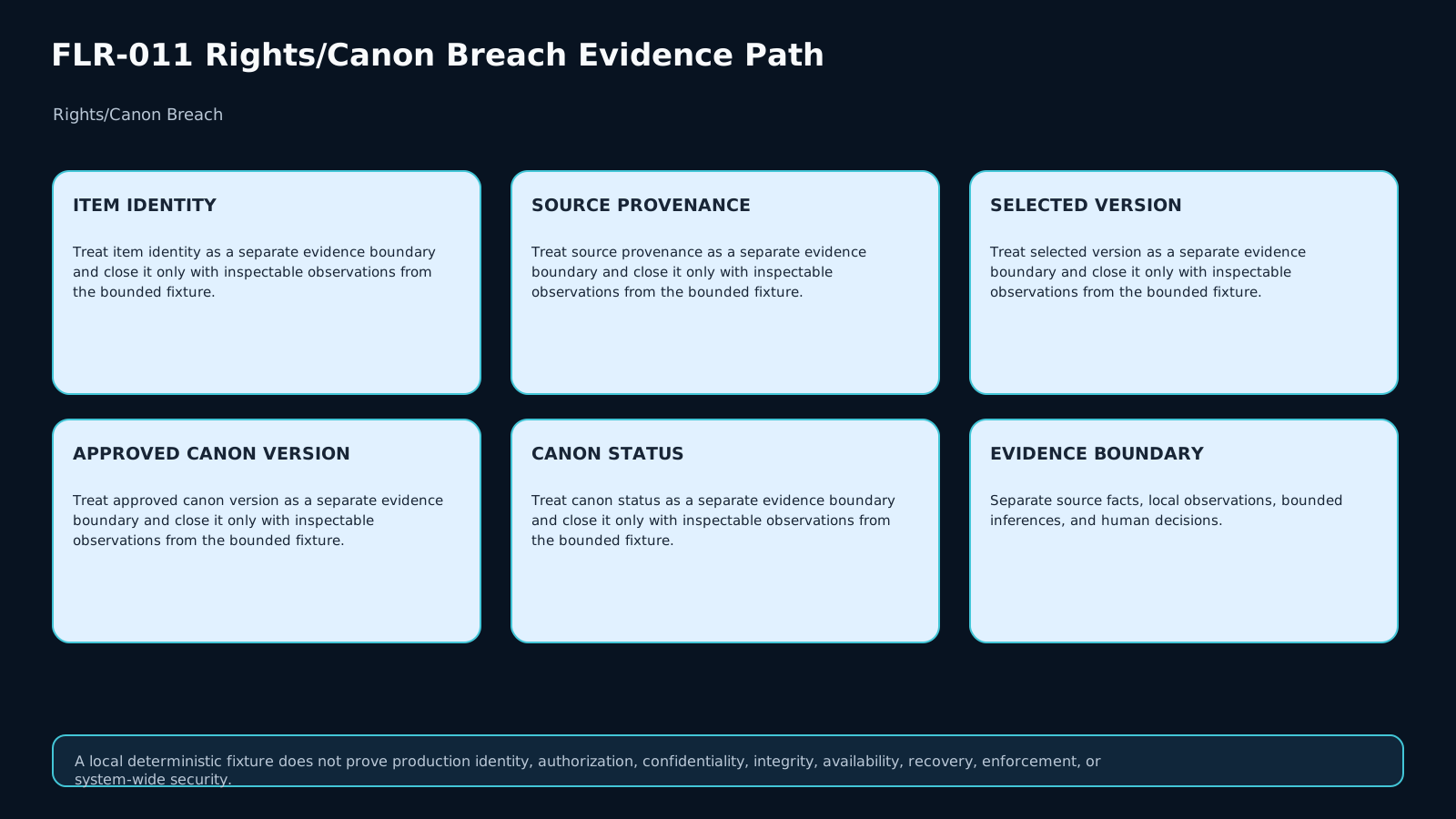
The owned artifact is a row-level record: Item ID, Source, Selected Version, Approved Canon Version, Canon Status, Rights Metadata, Permission Scope, Intended Use, Attribution Requirement, Provenance, Policy Decision, Legal/Policy Uncertainty, Review Trigger, and Release State. A reviewer must be able to reconstruct the decision from visible evidence rather than hidden reasoning.
9. Do not collapse the four-state matrix
There are four important combinations: canon OK + rights OK, canon OK + rights blocked/unknown, canon breach + rights OK, and canon breach + rights blocked/unknown. Only the first can become release-eligible under the fixture policy. The other states require different containment and recovery, so collapsing them into a generic “copyright problem” leads to the wrong repair.
10. UNKNOWN is a valid state, not a reporting defect
When rights metadata is missing, scope is ambiguous, provenance is incomplete, or the question genuinely requires legal interpretation, the system must not invent certainty. UNKNOWN/REVIEW means the evidence is insufficient for release. The lesson deliberately separates a deterministic policy breach inside the fixture from an unresolved legal or policy status.
11. Containment stops release without destroying evidence
Appropriate containment can include quarantine, withholding, returning to an approved canon version, narrowing the intended use, or routing to human review. Removing citations, deleting metadata, or swapping content without preserving provenance is not a repair; it damages the evidence chain. Containment should stay reversible and auditable.
12. Recovery must change the failed dimension
For a canon breach, recovery means selecting or approving the correct version and rerunning the gate. For a rights-scope breach, permission scope or intended use must become policy-compatible. For missing rights metadata or provenance gaps, evidence must be added or the case must remain under review. A green rerun with no relevant evidence change is not defensible closure.
13. Test closure with changed-context transfer
After a repair, do more than rerun the original fixture. Use a changed case where permission remains the same but the approved canon version changes. If the system copies the prior label, it will miss the new breach. In this lesson’s transfer case, an item is initially release-eligible but must return to quarantine after canon authority changes.
14. Lab: eight fixtures and 64 assertions
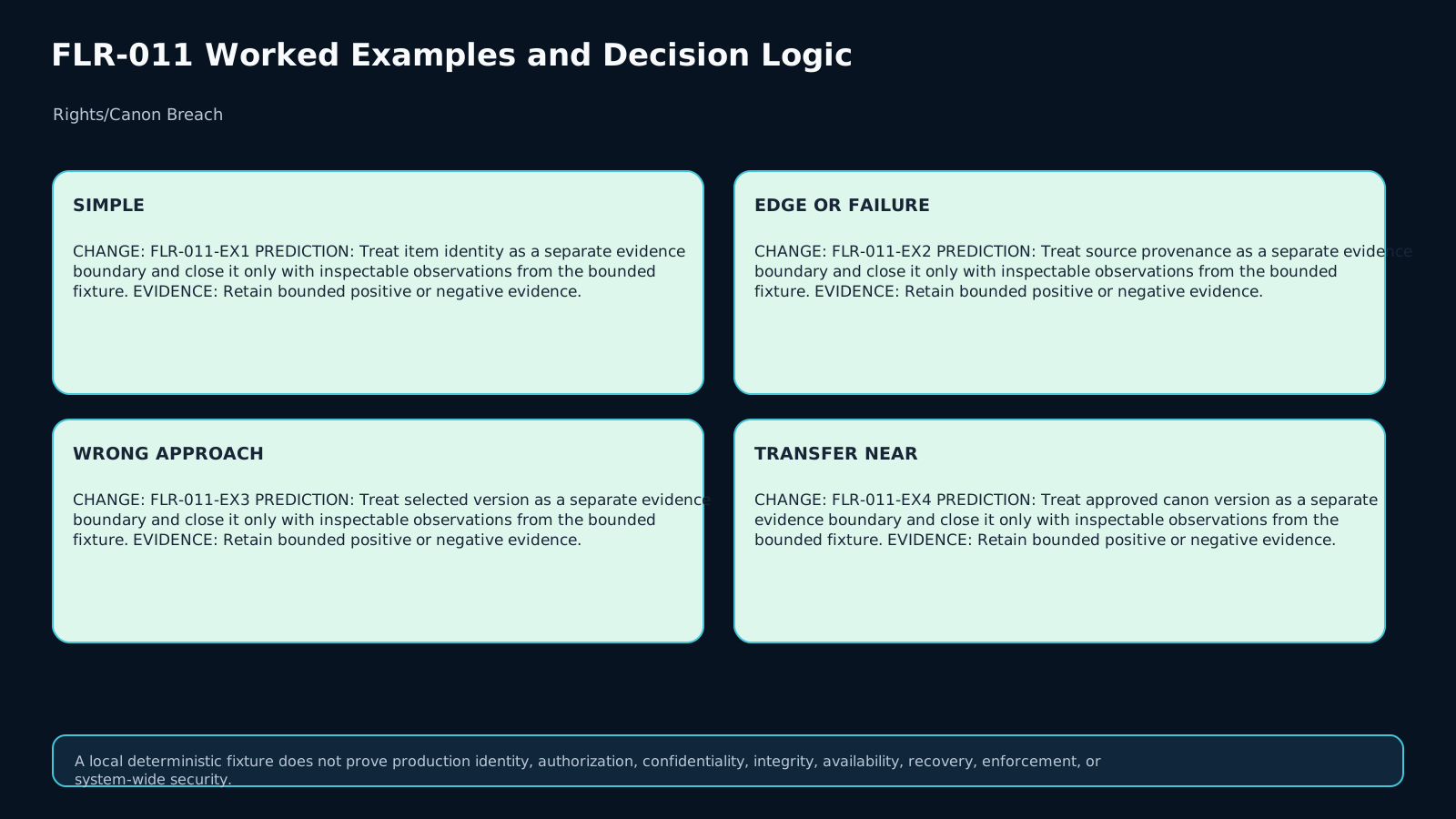
The lab includes eight synthetic cases: allowed baseline, superseded version, adaptation outside permission, unknown rights metadata despite a citation, missing required attribution, incomplete provenance for a generated summary, permitted but non-canonical content, and a transfer case where a canon change invalidates prior release eligibility. Each case yields eight outputs, for exactly 64 admin assertions.
15. Exit checklist and responsibility boundary
Before exit, you should be able to state canon status, what the rights metadata says, whether intended use is inside scope, whether attribution and provenance are complete, the release action, residual uncertainty, and what evidence would change the state. This is a governance and evidence-handling lesson, not legal advice; questions beyond explicit supplied policy require human review or qualified counsel.
Assessment
There is no answer key in this lesson pack; answer it yourself and mark honestly. "Needs review" sends the lesson to your review queue.
FLR-011-AF1 formative
FLR-011-AF2 formative
FLR-011-AF3 formative
FLR-011-AS1 summative
FLR-011-AS2 transfer
Assessment rubric
A passing submission must: (1) keep canon/version authority separate from rights/permission status; (2) compare intended use with explicit permission scope; (3) preserve REVIEW_UNKNOWN when rights or provenance evidence is insufficient; (4) distinguish attribution/provenance policy failures from legal conclusions; (5) choose a bounded release, quarantine, or review action; (6) state residual legal/policy uncertainty; and (7) rebuild the transfer case when canon authority changes.
A submission fails if citation, retrievability, generated status, or canonical status is treated as automatic permission, or if synthetic policy evidence is presented as a jurisdiction-specific legal determination.
References & freshness
Case studies
Lab files
Implement a bounded evaluate(case) function over eight synthetic content-governance cases. Treat project canon/version authority and supplied rights/permission metadata as separate axes. Compare intended_use with allowed_uses; do not infer permission from citation_present.
Preserve review/unknown when rights metadata, canon authority, or required provenance is unresolved. Attribution and provenance are policy inputs, not substitutes for legal advice. Re-evaluate the changed-context fields from scratch. No real copyrighted corpus, production rights record, customer data, or jurisdiction-specific legal determination is used.
Lesson media & slides
Teaching files (download)