وب مدرن، رابط کاربری و تجربهی وب · فصل ۱ — مرورگر، سرور، رندر و معماری صفحه · 30
Static vs Dynamic Pages: Which Fits What?
Understand and decide static versus dynamic delivery decisions without prematurely choosing an implementation stack. For a bounded page requirement, identify what can remain pre-produced, what must vary, where variation can occur, and what evidence would justify the decision.
صفحهی ثابت و صفحهی پویا چیست و کدام برای چه چیزی مناسب است؟ — fa-IR
Lesson summary
Understand and decide static versus dynamic delivery decisions without prematurely choosing an implementation stack.
For a bounded page requirement, identify what can remain pre-produced, what must vary, where variation can occur, and what evidence would justify the decision.
This lesson produces
For a bounded page requirement, identify what can remain pre-produced, what must vary, where variation can occur, and what evidence would justify the decision.
Who it is for
Foundation
Use labeled diagrams, one concept per card, and explicit before/after examples.
Repair
Return to the failure counterexample and require the learner to name the collapsed boundary before continuing.
Experienced
Skip basic vocabulary and require exception handling, tradeoff language, and a changed-context decision.
Prerequisites
_Locale: en-US · Lesson: WEBF-003 · Public order: 30_
Outcome and working artifact
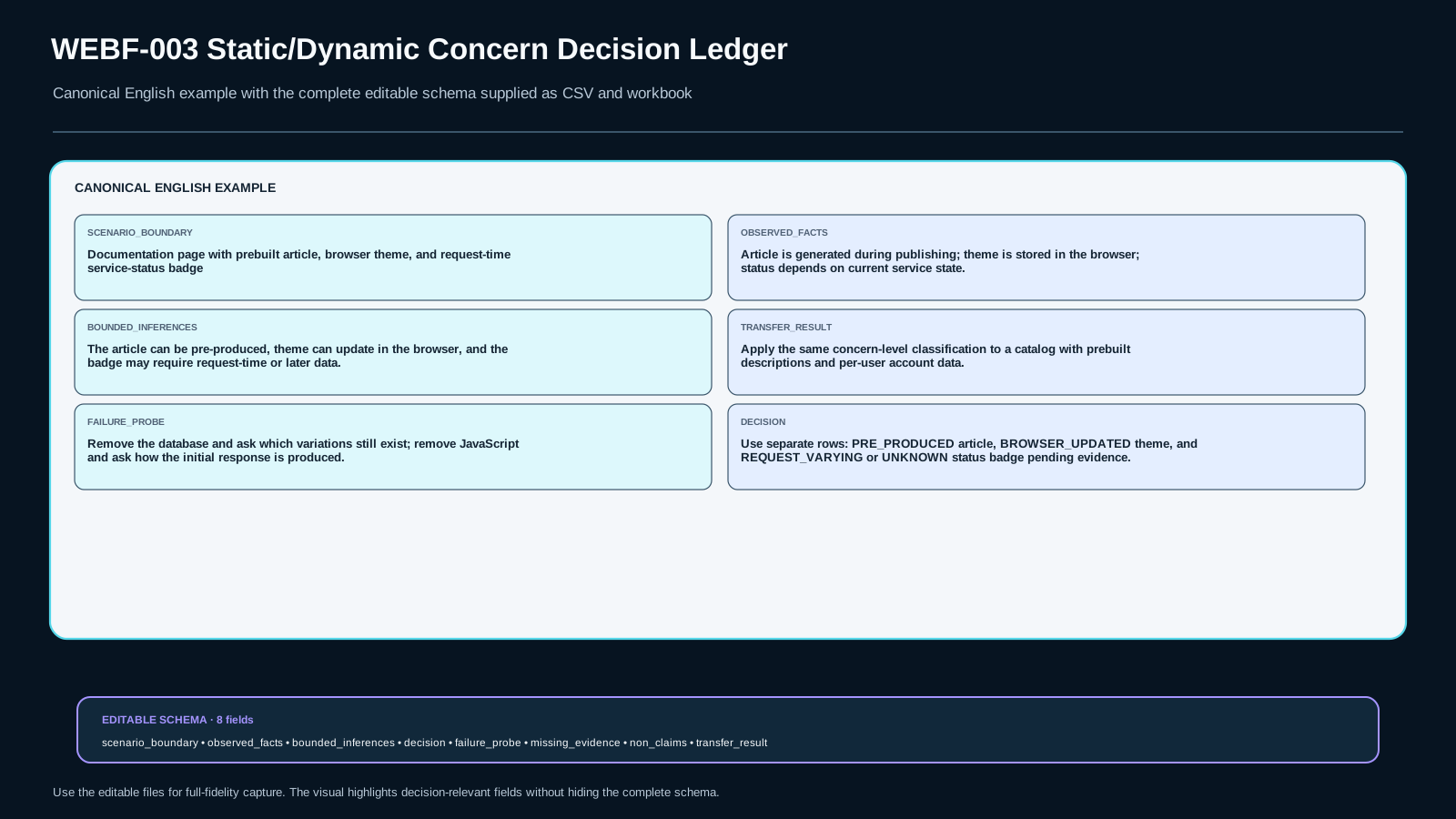
This lesson produces a Static/Dynamic Decision Ledger v1: a decision artifact that separates observations, assumptions, limits, and required evidence. The goal is a transferable model, not memorized tool names.
For a bounded page requirement, identify what can remain pre-produced, what must vary, where variation can occur, and what evidence would justify the decision.
Boundary model
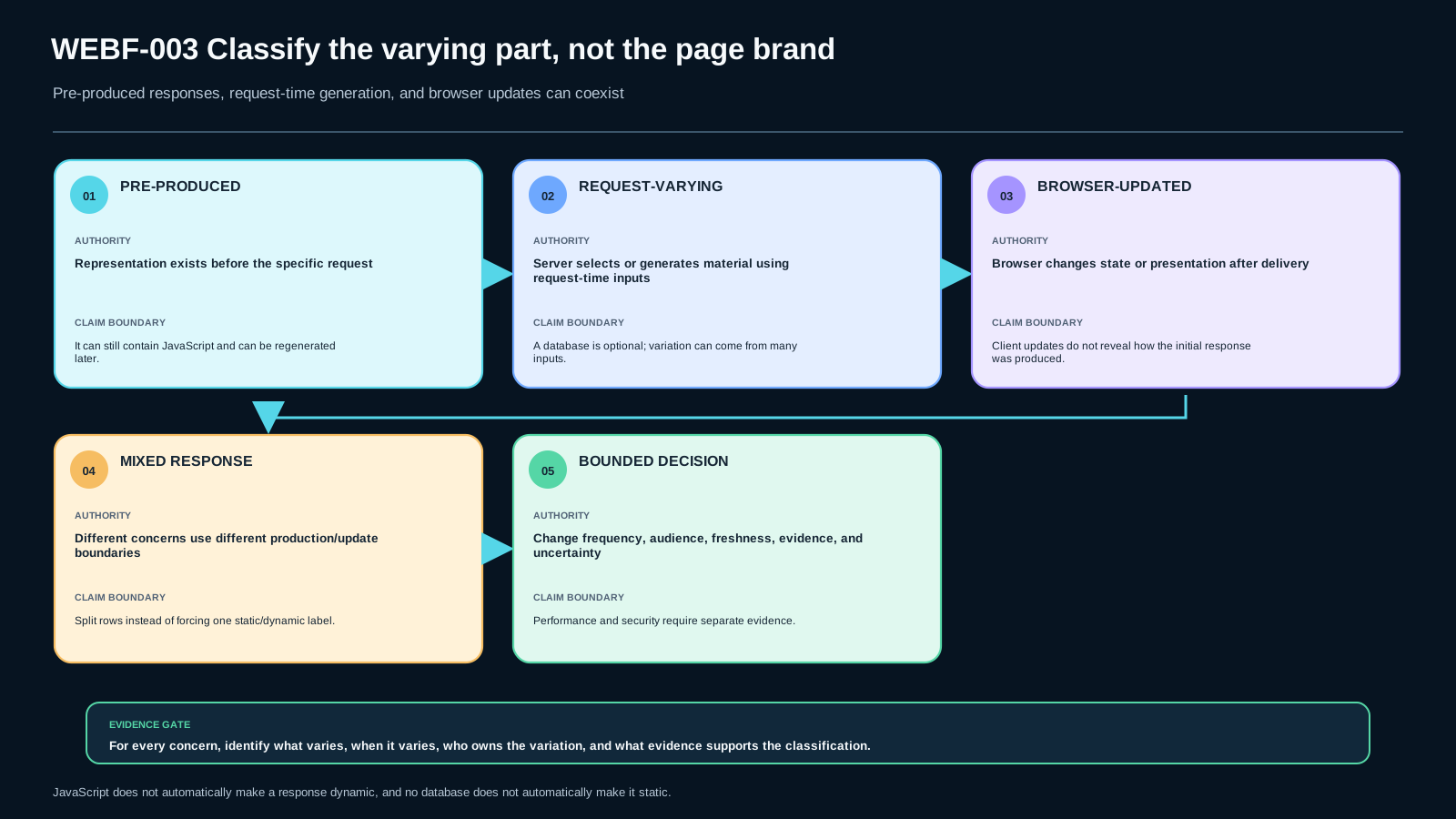
Static and dynamic describe where and when a representation varies; they do not map cleanly to 'without JavaScript' and 'with JavaScript', or to 'without a database' and 'with a database'. A page can be pre-produced and still run rich client code. A request-time response can be dynamic even if it reads no database. The decision starts with the source of variation.
Keep three labels throughout the work: observed, bounded inference, and needs verification. When evidence is unavailable, record unknown. A product name or a passing happy path is not a substitute for evidence.
1. Describe the response, not the brand
Ask whether the delivered representation was already available or was generated for this request. Framework names are implementation clues, not the classification itself.
2. Separate server generation from client updates
Pre-generated HTML can contain JavaScript that changes theme, filters a list, or fetches later data. That client-side change does not retroactively make the original server response request-generated.
3. A database is optional
Request-time output can depend on headers, time, a computation, an upstream service, or configuration. Conversely, a build process can read a database and emit fixed files.
4. Classify parts, not slogans
A page can combine a pre-produced shell, a request-time status fragment, and client-side personalization. One global label often hides the architecture that matters.
5. Tie the choice to change frequency and evidence
Record who changes the information, how quickly it must appear, whether it is user-specific, what failure behavior is acceptable, and how cache invalidation is controlled.
Five-step method
- Split the page into independently varying regions.
- For each region, identify the variation source: content author, deployment, request context, user state, or live upstream data.
- Choose the production moment: build time, request time, or browser runtime.
- Record cache scope, invalidation trigger, failure fallback, privacy boundary, and accessibility impact.
- Use a mixed classification when the architecture is mixed; do not force one label onto every region.
Worked case
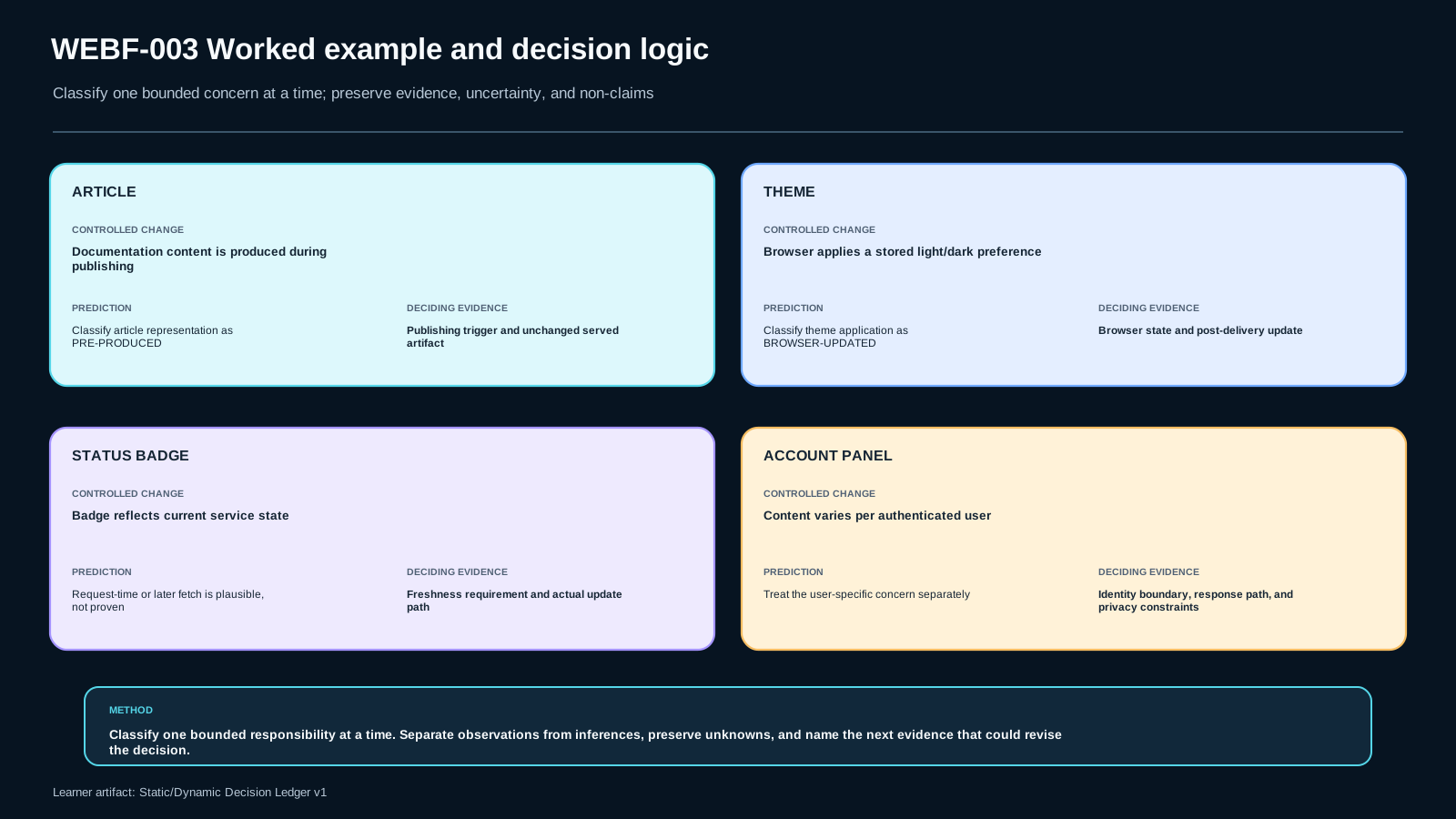
A documentation page ships pre-built HTML. A theme preference is read in the browser and changes classes without asking the server. A small service-status badge is fetched at request time from an endpoint. The defensible ledger calls the document body pre-produced, the theme client-dynamic, and the badge request-dependent. It then records separate cache and failure rules. Calling the entire page simply 'dynamic' would lose the decision boundaries.
Decision and evidence matrix
| Concern | Boundary or owner | Evidence | Decision or limitation |
|---|---|---|---|
| Article body | Build time | Shared pre-produced HTML | Invalidate on editorial publish |
| Theme | Browser runtime | Per-device preference | Readable default without script |
| Service badge | Request/runtime fetch | Short-lived shared status | Show timestamped unknown on failure |
| Account panel | Request or client fetch | Private per-user data | Never place in public cache |
Failure probes and repair
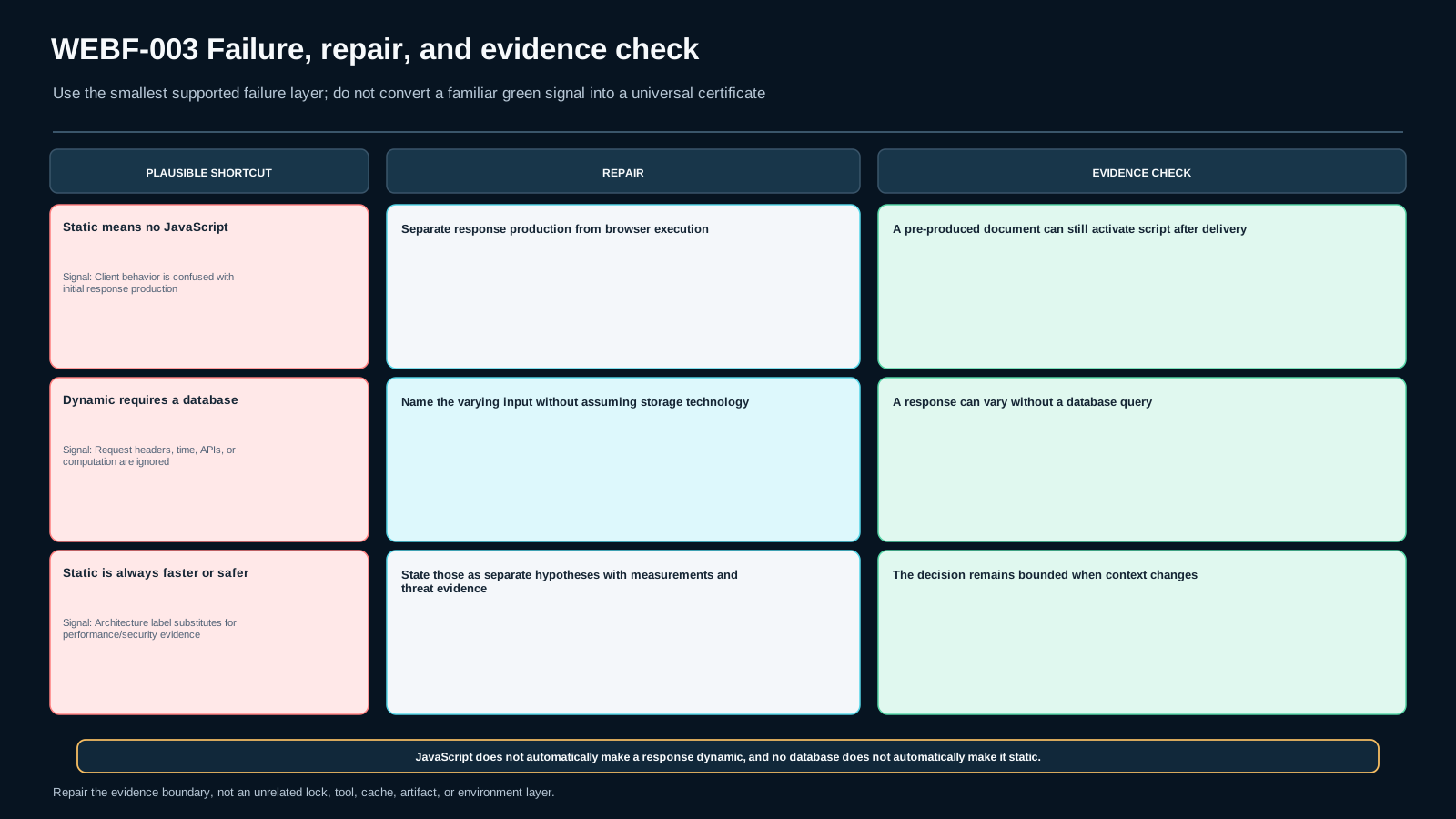
- Static pages cannot include JavaScript.
- Dynamic pages require a database.
- Static is always faster or more secure.
- This split-curriculum page does not claim ownership of the complete WEB-000 Web Mental Model.
For each statement, narrow the claim, create a counterexample, and name the observation that could confirm or reject it.
Transfer challenge
Change the scenario so that one assumption in the worked case no longer holds. Rebuild the Static/Dynamic Decision Ledger v1 without copying the earlier decision, then explain what changed in the input and what stayed stable in the decision rule.
What this does not prove
This lesson does not claim certification, production guarantees, or coverage of every implementation. Its conclusion is valid only within the scenario boundary, dated sources, and recorded observations.
Self-check
- [ ] Did I separate responsibilities from framework or tool names?
- [ ] Did I state at least one failure probe and its predicted observable?
- [ ] Are fact, inference, and design choice visibly separated?
- [ ] Did I record non-claims and missing evidence?
- [ ] Did I complete transfer in a changed context without a prepared answer?
Sources and freshness boundary
Sources were reviewed for the frozen Bible as of 2026-09-19. A review_due date triggers a versioned requalification; it does not authorize silent in-place edits.
- S-MDN-CS — Static and dynamic server response model. (https://developer.mozilla.org/en-US/docs/Learn_web_development/Extensions/Server-side/First_steps/Client-Server_overview; review: 2026-12-31)
- S-MDN-JS — Client-side and server-side dynamic behavior distinction. (https://developer.mozilla.org/en-US/docs/Learn_web_development/Core/Scripting/What_is_JavaScript; review: 2026-12-31)
Assessment
There is no answer key in this lesson pack; answer it yourself and mark honestly. "Needs review" sends the lesson to your review queue.
WEBF-003-SUM1 retrieval
WEBF-003-SUM2 application
WEBF-003-SUM3 diagnosis
WEBF-003-SUM4 decision
WEBF-003-SUM5 transfer
Assessment rubric
| Dimension | Critical | Sufficient evidence |
|---|---|---|
| boundary_accuracy | yes | Responsibilities in static versus dynamic delivery decisions are placed at the correct bounded layer/time/location and adjacent lessons are not absorbed. |
| evidence_and_uncertainty | yes | Current factual claims are source-bounded; conditional paths and unknowns are stated rather than guessed. |
| decision_quality | yes | The decision recorded in Static/Dynamic Response Decision Record v1 follows from the scenario constraints and states what would invalidate it. |
| transfer | no | The learner applies the same reasoning in a changed scenario without copying a fixed stack answer. |
A submission passes only when every critical dimension is sufficient and the learner states missing evidence honestly. AI suggestions are not observed evidence; the learner remains accountable for the final bounded judgment.
References & freshness
Case studies
Lesson media & slides
Teaching files (download)