امنیت، هویت، استقرار و تابآوری · فصل ۹ — Resource، Provider، Cost و Organizational Failure · 131
Premature SaaS
Diagnose premature SaaS from tenant definition, validated demand, isolation/SLA requirements, operations capacity and migration/reversibility evidence; distinguish necessary platform investment from speculative multi-tenant complexity; choose a bounded single-tenant, pilot or staged-tenancy path; and prove recovery by preserving a reversible architecture boundary until explicit SaaS requirements justify expansion. میتواند failure family «Premature SaaS» را بازتولید/تشخیص دهد و detection، containment و recovery مناسب را تعیین کند.
Lesson summary
Diagnose premature SaaS from tenant definition, validated demand, isolation/SLA requirements, operations capacity and migration/reversibility evidence; distinguish necessary platform investment from speculative multi-tenant complexity; choose a bounded single-tenant, pilot or staged-tenancy path; and prove recovery by preserving a reversible architecture boundary until explicit SaaS requirements justify expansion.
میتواند failure family «Premature SaaS» را بازتولید/تشخیص دهد و detection، containment و recovery مناسب را تعیین کند.
This lesson produces
میتواند failure family «Premature SaaS» را بازتولید/تشخیص دهد و detection، containment و recovery مناسب را تعیین کند.
Who it is for
Foundation
Use a guided boundary matrix and one explicit ambiguity repair.
Repair
Re-run only the failed evidence dimension with a smaller deterministic synthetic case.
Experienced
Start from mixed evidence; require competing explanations, negative evidence and transfer.
Prerequisites
1. The failure: SaaS complexity before the need is proven
Premature SaaS appears when a team commits to multitenancy, tenant provisioning, billing hooks, per-tenant quotas, a control plane, and multiple isolation tiers before its customer model and operating requirements are stable. The architecture can look sophisticated while the product still has one pilot, one internal deployment, and a contract that changes weekly. The problem is not sophistication itself; it is irreversible complexity that has crossed the evidence boundary too early.
2. SaaS and multitenancy are not inherently wrong
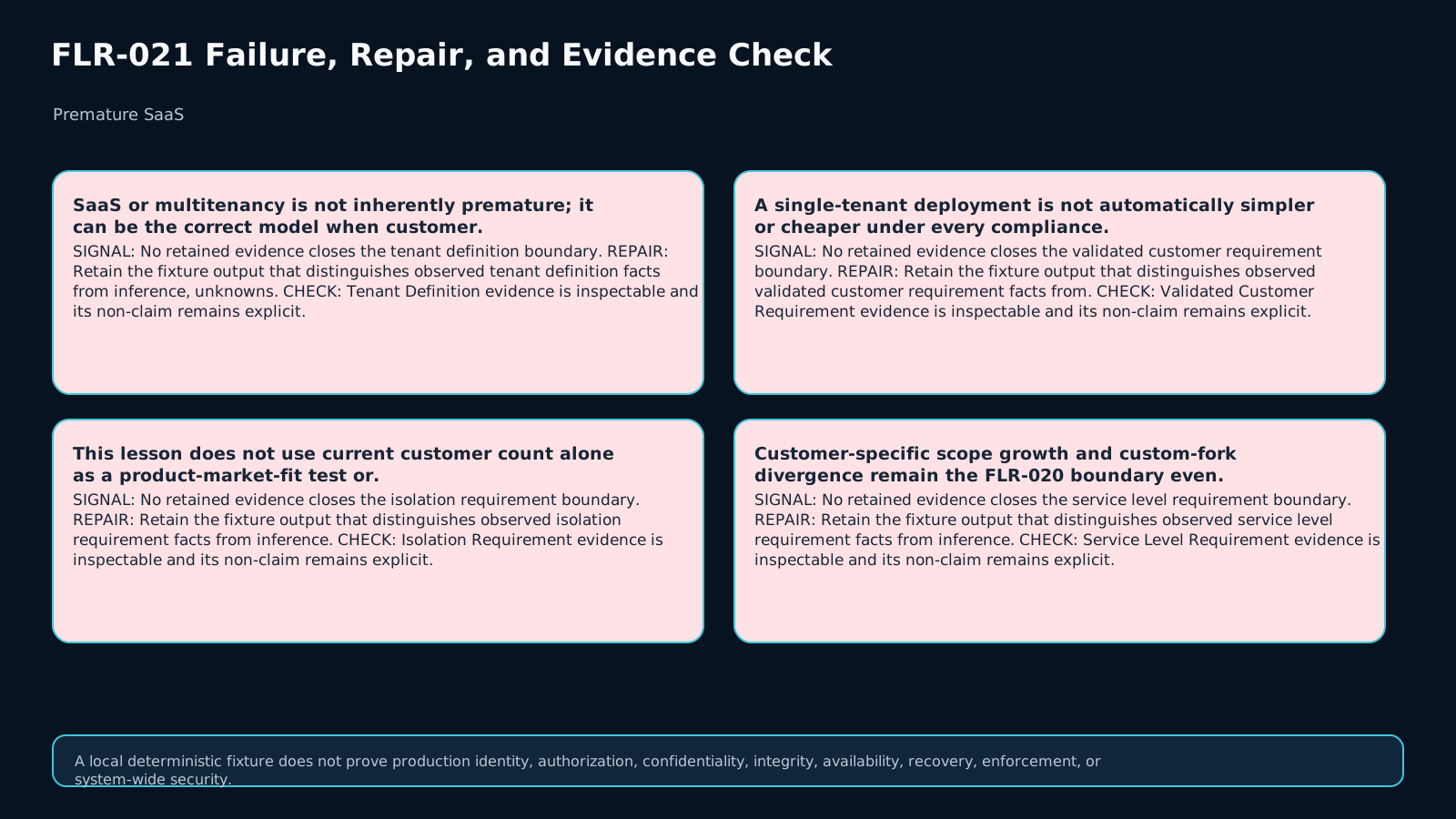
This lesson is not anti-SaaS. SaaS can be the correct model when the business model, customer requirements, isolation, reliability, scale, and operating model justify it. The failure is an expensive and hard-to-reverse commitment before that threshold is established. Ask which capabilities are justified now and which remain speculative, not whether SaaS is universally good or bad.
3. Define the tenant before choosing a tenancy model
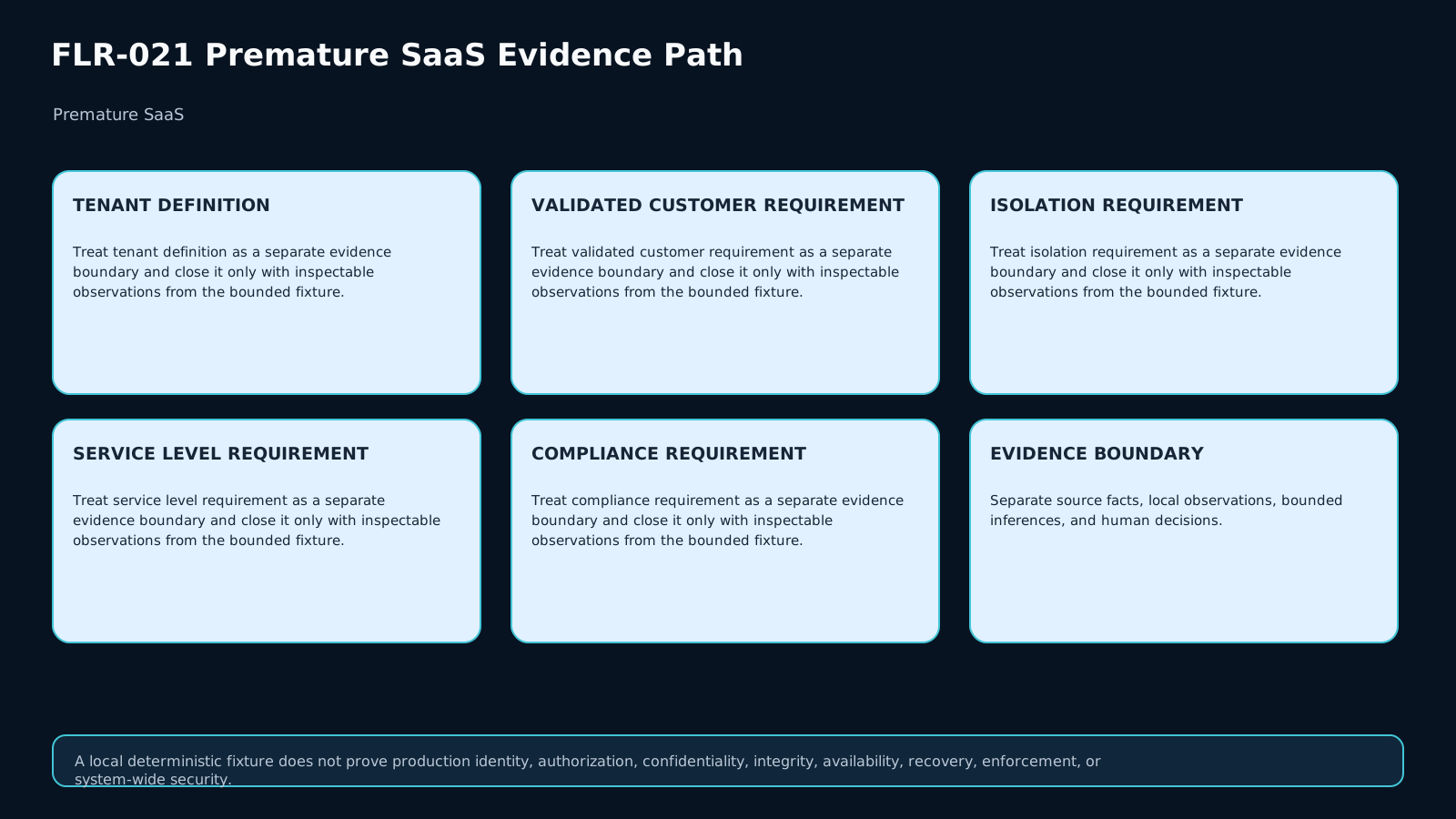
If “tenant” is ambiguous, a shared control plane or pooled data layer is ahead of the problem. Define whether a tenant is a company, department, environment, or account group; distinguish users from tenants; and record the tenant lifecycle and data boundary. Until that definition is stable, deep tenancy decisions stay OPEN or reversible.
4. Separate validated requirements from roadmap guesses
Two customers, a growth forecast, or enthusiasm for automated billing do not by themselves create a shared-tenancy requirement. The record distinguishes direct customer and contract evidence: Is shared tenancy required? Is self-service provisioning required? Is there a contractual SLO? Are data residency or compliance controls required? Unknown answers remain hypotheses rather than platform mandates.
5. Isolation, SLO, and compliance are hard evidence
The tenancy model changes data isolation, blast radius, noisy-neighbor risk, and operations. A regulated customer may require a dedicated deployment even when pooled resources look cheaper. Conversely, several customers with compatible isolation requirements may justify shared components. The architecture follows the requirement boundary rather than the visual elegance of a platform design.
6. Operations capacity is part of readiness
SaaS is not only application topology. Onboarding, upgrades, incident response, support, observability, access control, and capacity management must work across tenants. If a two-person team cannot reliably operate manual onboarding, a large control plane can create operating debt. Treat automation readiness and support capacity as separate evidence dimensions.
7. Shared-resource benefit must exceed added complexity
Resource sharing can reduce cost, but it adds isolation controls, metering, tenant-aware debugging, rollout segmentation, and noisy-neighbor management. If the economic benefit is only an estimate and usage is not measurable, it is not closure evidence. Put shared benefit, added complexity, and the evidence for each in the same decision record.
8. The middle path: single tenant, pilot, or staged tenancy
The choices are not binary. You can run single-tenant deployments today, preserve tenant-aware identifiers, automate a small provisioning seam, and keep a migration boundary for later hybrid or pooled models. Staged tenancy lets requirements justify capabilities incrementally instead of forcing the full SaaS platform at once.
9. Preserve reversibility and a migration seam
Recovery does not require deleting every future-facing idea. It requires a reversible architecture boundary: tenant identity separated from domain logic, explicit storage-partition boundaries, a small provisioning interface, and a testable migration path. If later movement requires a system-wide rewrite, migration cost and weak reversibility belong in the risk record.
10. Decide what not to build yet
A control plane, billing integration, pooled data layer, or extra isolation tier should be build-now only when current requirements and operating evidence justify it. Otherwise preserve the interface or seam instead of the full implementation. That is the difference between designing for future change and paying the full future-complexity cost immediately.
11. Separate containment, recovery, and closure
Removing speculative roadmap work or returning to a simpler deployment is containment. Recovery is stronger when the minimal architecture meets current needs while preserving a migration seam. Closure requires a record showing that build-now decisions trace to requirements, unknowns remain explicit, and revisit triggers are defined. One successful release is not causal proof.
12. SaaS Readiness & Reversibility Decision Record v1
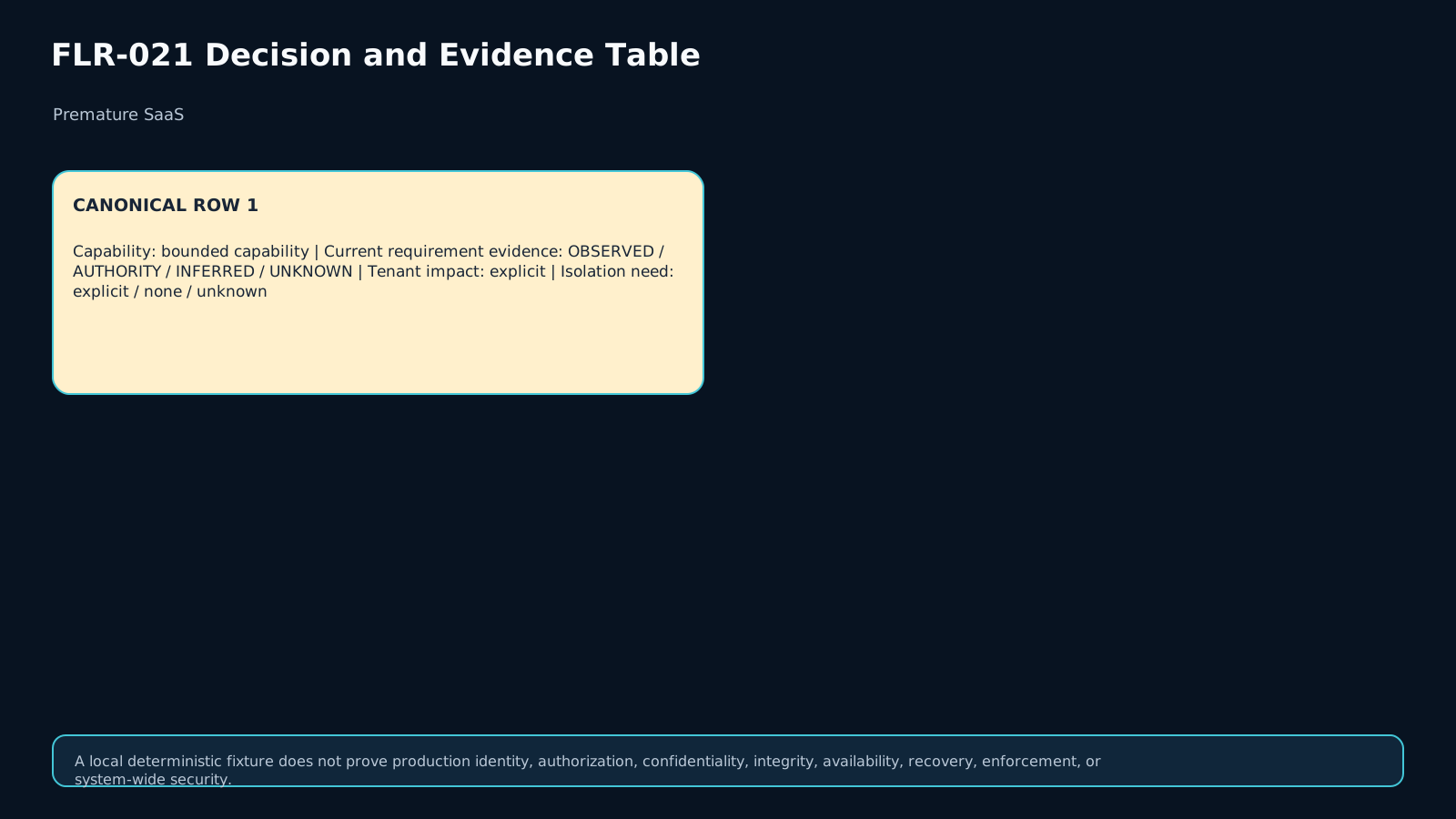
The record captures tenant definition, validated customer requirement, isolation, SLO, compliance, tenant forecast, operations capacity, automation readiness, shared-resource benefit, added platform complexity, migration cost, reversibility, pilot scope, revisit trigger, closure decision, and residual product risk. Each decisive field is marked OBSERVED, AUTHORITY, INFERRED, or UNKNOWN.
13. Classification: OPEN, PREMATURE, STAGED, or JUSTIFIED
OPEN means tenant or requirement evidence is insufficient. PREMATURE means platform commitment is ahead of evidence. STAGED means some capabilities—such as dedicated isolation, provisioning automation, or SLO operations—are justified while full shared SaaS is not. JUSTIFIED means requirements, operating readiness, automation, and reversibility align for the bounded scope. This is not a business valuation or permanent verdict.
14. Lab: eight fixtures and 64 assertions
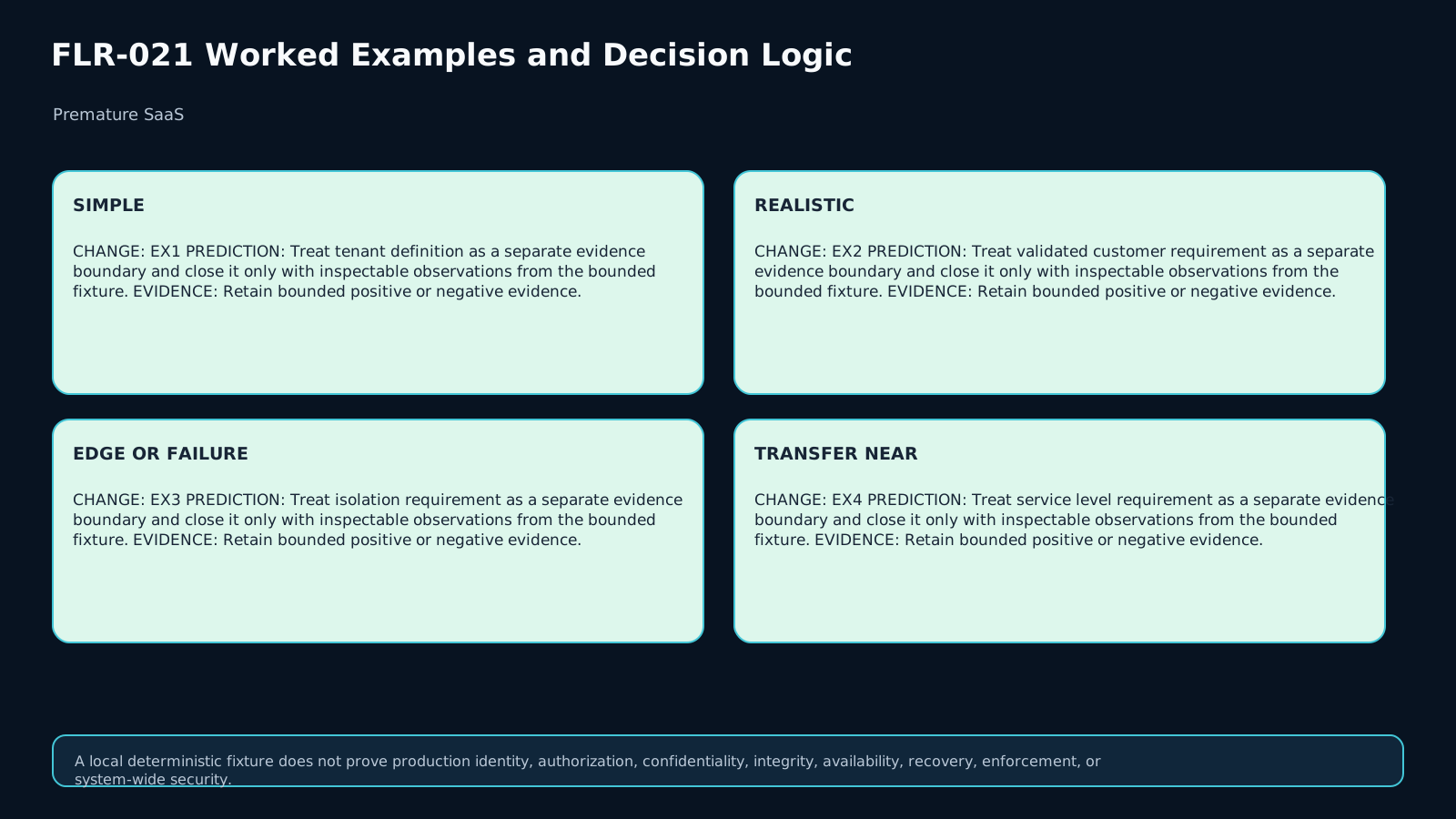
The lab includes eight cases: an overbuilt pilot, undefined tenant, two isolated customers, one customer with self-service/SLO needs, a shared-cost idea without isolation/automation readiness, a ready shared-SaaS case, a shared need with an operations gap, and the regulated-second-customer transfer fixture. Eight deterministic outputs are checked per case: tenant-definition state, requirement evidence, isolation/reliability state, operations readiness, complexity posture, reversibility, SaaS classification, and decision. That yields 64 assertions.
15. Exit checklist and transfer
Before exit, define the tenant; separate requirements from forecasts; record isolation/SLO/compliance needs; assess operations and automation readiness; compare shared benefit with platform complexity; state migration cost and reversibility; separate build-now from defer; and preserve revisit triggers and residual risk. Then rebuild the transfer fixture from blank evidence: a second regulated customer requires stronger isolation and a contractual availability target. Decide which capabilities now cross the threshold and which parts of full multitenancy remain premature.
Assessment
There is no answer key in this lesson pack; answer it yourself and mark honestly. "Needs review" sends the lesson to your review queue.
Q1 retrieval
Why does a second customer not automatically justify shared multitenancy?
Q2 application
A regulated customer requires a dedicated deployment and contractual uptime. Which capability can become justified before pooled multitenancy?
Q3 diagnosis
A team expects shared infrastructure to reduce cost but has no tested isolation model or automated onboarding. What is the bounded diagnosis?
Q4 decision
What is the recovery move when current requirements are modest but future SaaS growth is plausible?
Q5 transfer
A second regulated customer adds strong isolation and an availability target. What changes?
Assessment rubric
A sufficient response defines the tenant and bounded product context, separates current customer/contract evidence from inference, records isolation/SLO/compliance and operating readiness, compares platform benefit with added complexity, preserves UNKNOWN state, and chooses a reversible build-now/defer decision with a revisit trigger. A transfer response must be rebuilt from the changed fixture rather than copy the original classification.
References & freshness
Case studies
Lesson visuals
Lab files
Implement the bounded evaluator in starter.py for the eight supplied synthetic product/tenancy cases. No network calls are needed. Keep tenant definition, validated requirements, isolation/SLO/compliance, operations capacity, platform complexity and reversibility as separate evidence dimensions. Customer count or a cost hypothesis is never sufficient by itself. The evaluator should preserve OPEN state when decisive evidence is missing and distinguish premature commitment from a bounded staged path.
Run python run_checks.py to verify fixture shape before implementing the evaluator.
Lesson media & slides
Teaching files (download)