امنیت، هویت، استقرار و تابآوری · فصل ۷ — Dependency، Contract، Event و Network Failure · 114
Contract Drift
Compare declared API contract versions with synthetic request/response evidence, classify additive versus breaking drift, identify the consumer impact, and define a compatibility or coordinated-change repair path. میتواند failure family «Contract Drift» را بازتولید/تشخیص دهد و detection، containment و recovery مناسب را تعیین کند.
Lesson summary
Compare declared API contract versions with synthetic request/response evidence, classify additive versus breaking drift, identify the consumer impact, and define a compatibility or coordinated-change repair path.
میتواند failure family «Contract Drift» را بازتولید/تشخیص دهد و detection، containment و recovery مناسب را تعیین کند.
This lesson produces
میتواند failure family «Contract Drift» را بازتولید/تشخیص دهد و detection، containment و recovery مناسب را تعیین کند.
Who it is for
Foundation
Use a guided evidence table and one explicit misconception repair.
Repair
Re-run only the failed evidence dimension with a smaller fixture and contrast case.
Experienced
Start from ambiguous signals; require competing hypotheses, negative evidence and transfer.
Prerequisites
1. Core problem: the contract file, implementation, and consumer are different things
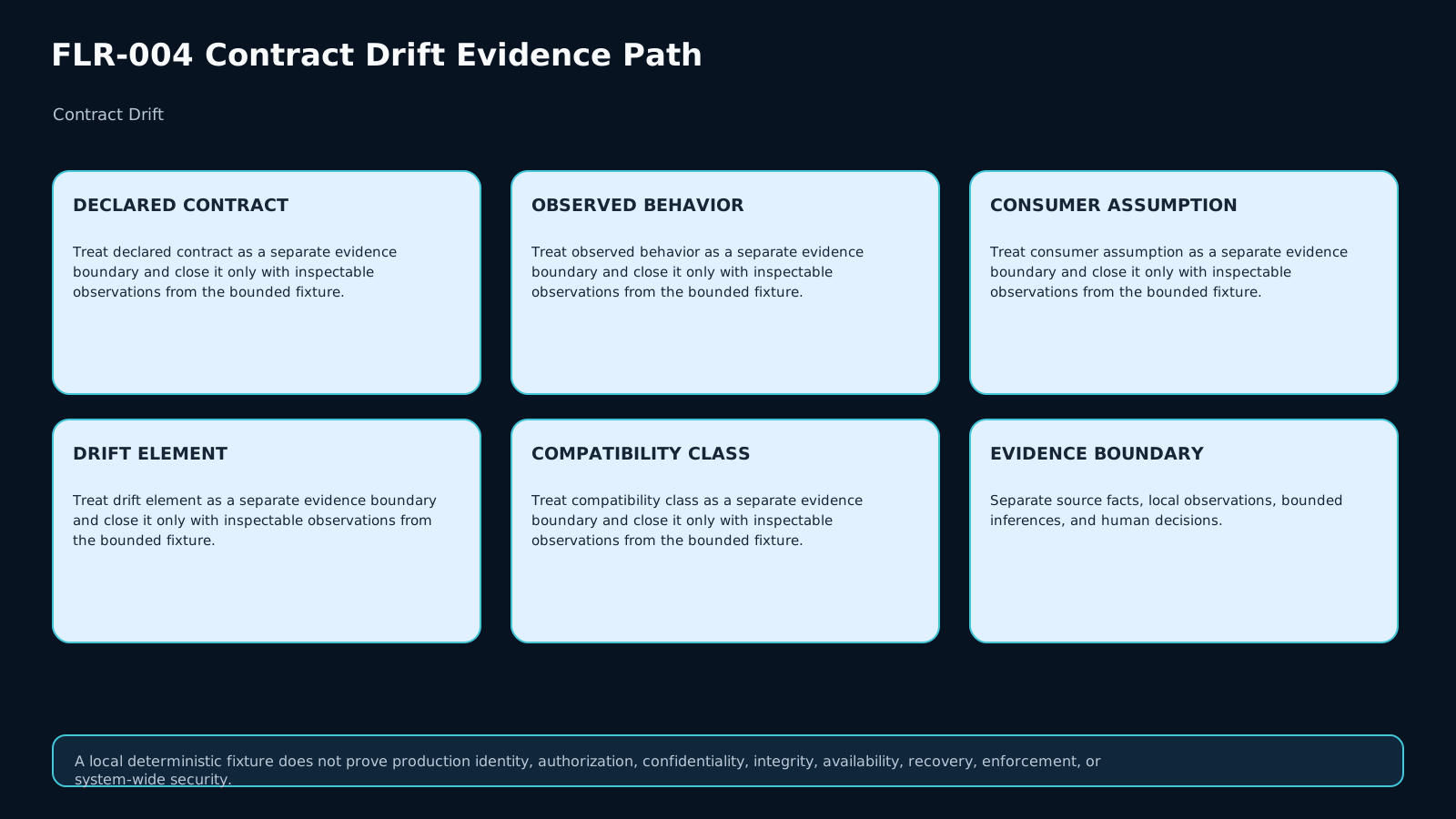
In Contract Drift, a producer, consumer, and OpenAPI file can each be internally consistent while disagreeing on an operation, required field, status code, or semantic rule. This lesson separates three evidence layers: the declared contract, observed implementation behavior, and consumer assumptions/dependencies. Without all three, declaring a breaking change can be premature.
2. OpenAPI describes an interface; it is not runtime proof
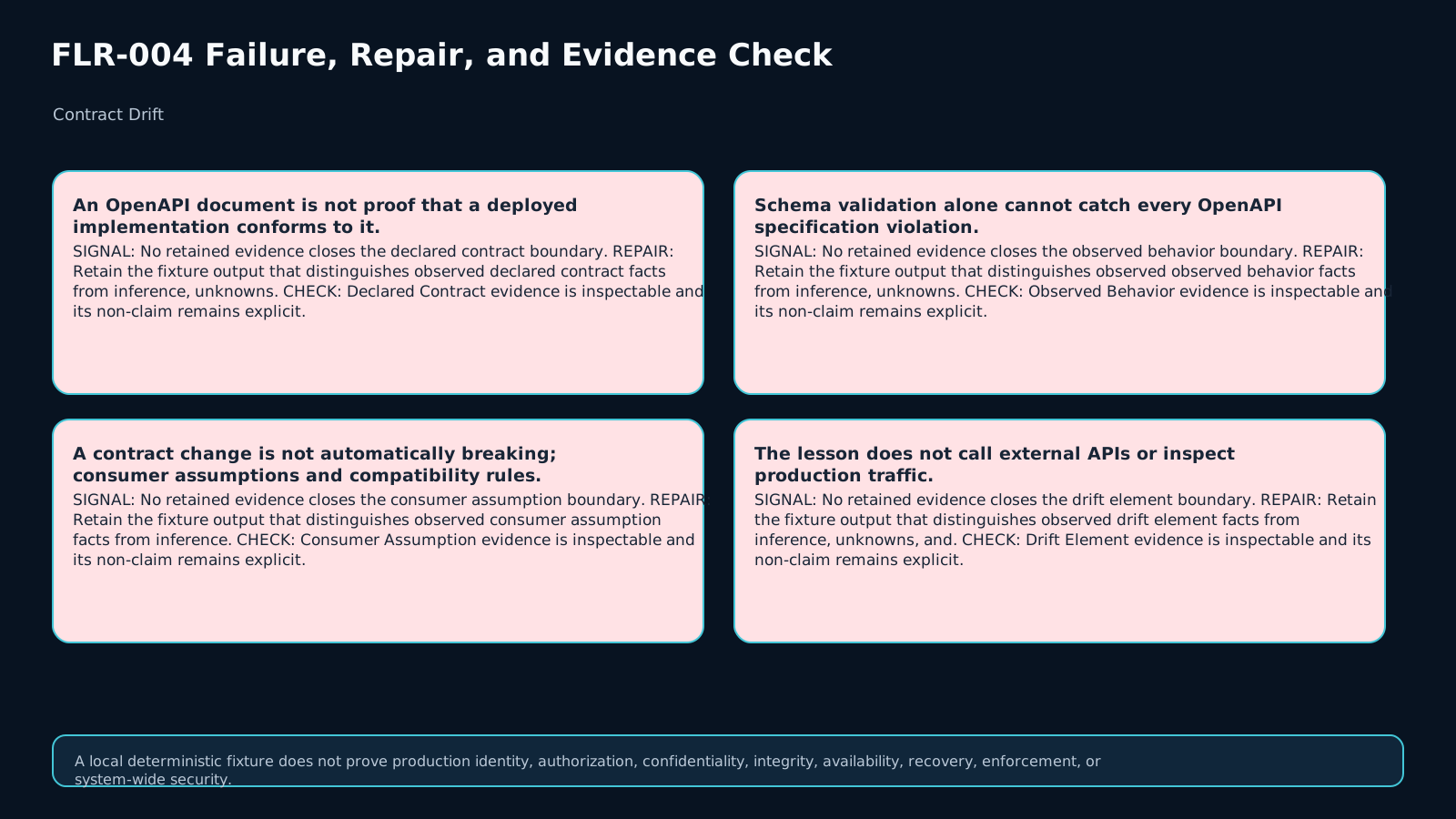
OpenAPI 3.2 defines a language-agnostic interface description for HTTP APIs so humans and tools can understand service capabilities. The current published patch is 3.2.1. [OAS-321] The presence of an OpenAPI Description alone does not establish that a deployment conforms to it; that distinction is central to drift diagnosis.
3. Schema validation does not catch every specification violation
The official OpenAPI schema page explicitly notes that schemas can catch many errors but are not guaranteed to catch every specification violation; if schema and specification text disagree, the specification text is authoritative. [OAS-SCHEMA] Therefore, “the validator is green” is not equivalent to “the contract and runtime are fully conformant.”
4. Name the exact drift element
Instead of saying “the API broke,” identify the changed element: path/operation, request parameter, required property, response field, enum domain, status code, or semantic meaning. The element boundary determines which consumers can actually be impacted.
5. An additive change is not automatically breaking
Adding an optional response property can be additive and non-breaking for a consumer that ignores unknown fields. A strict consumer may behave differently. Compatibility therefore cannot be derived from the file diff alone.
6. Optional-to-required needs consumer evidence
If a property that an older consumer omitted becomes required, old requests may fail. To call it breaking, record the declared difference and show that the observed consumer actually sends the old shape or depends on optionality. Without consumer evidence, you have a candidate break, not proven impact.
7. Status codes are part of behavioral contract
A status-code change can leave the body schema unchanged while breaking retry, fallback, or error mapping. In one fixture, the consumer retries only on 429, while the new producer emits 400 for the same bounded condition. That is semantic/behavioral drift, not merely a schema mismatch.
8. Enum narrowing can be breaking
Adding and removing enum values are not equivalent. If the consumer actually sends or expects a removed value, narrowing can be breaking. If the removed value is never used in the observed consumer path, impact must be derived from evidence rather than worst-case imagination.
9. Stale docs are not the same as a contract-version change
The declared vA and vB files can be identical while the synthetic implementation response differs. That is implementation-versus-declared-contract divergence, not necessarily a change between two contract versions. Repair may involve rollback, implementation correction, or documentation update; first identify which authority is intended.
10. Build compatibility from three inputs
For each element, combine declared difference, observed behavior, and consumer assumption/dependency. The result may be ADDITIVE_COMPATIBLE, BREAKING_FOR_OBSERVED_CONSUMER, IMPLEMENTATION_DIVERGENT, or UNKNOWN. This lesson does not define a universal compatibility policy; classification is bounded to the fixture and consumer profile.
11. Containment is not repair
Containment may temporarily preserve the old route, freeze a feature, enable a compatibility shim, or stop rollout. Repair means contract, implementation, and consumer return to an agreed state: backward-compatible producer, coordinated migration, versioned endpoint, or corrected docs/runtime. Do not present containment as proof of closure.
12. Counterexample: additive field ignored by the consumer
One fixture adds a new optional response property, while the consumer profile explicitly ignores unknown fields. A learner who labels every diff as breaking fails this case. The difference is real, but observed consumer impact is not; classification stays additive/non-breaking.
13. Transfer: REST to webhook callback
The transfer no longer centers on the primary REST success response. Callback payload and acknowledgement behavior become the contract boundary. A newly required callback field that the older receiver cannot provide can be breaking. Rebuild compatibility from webhook evidence rather than copying REST rules.
14. Lab: eight fixtures and 64 assertions
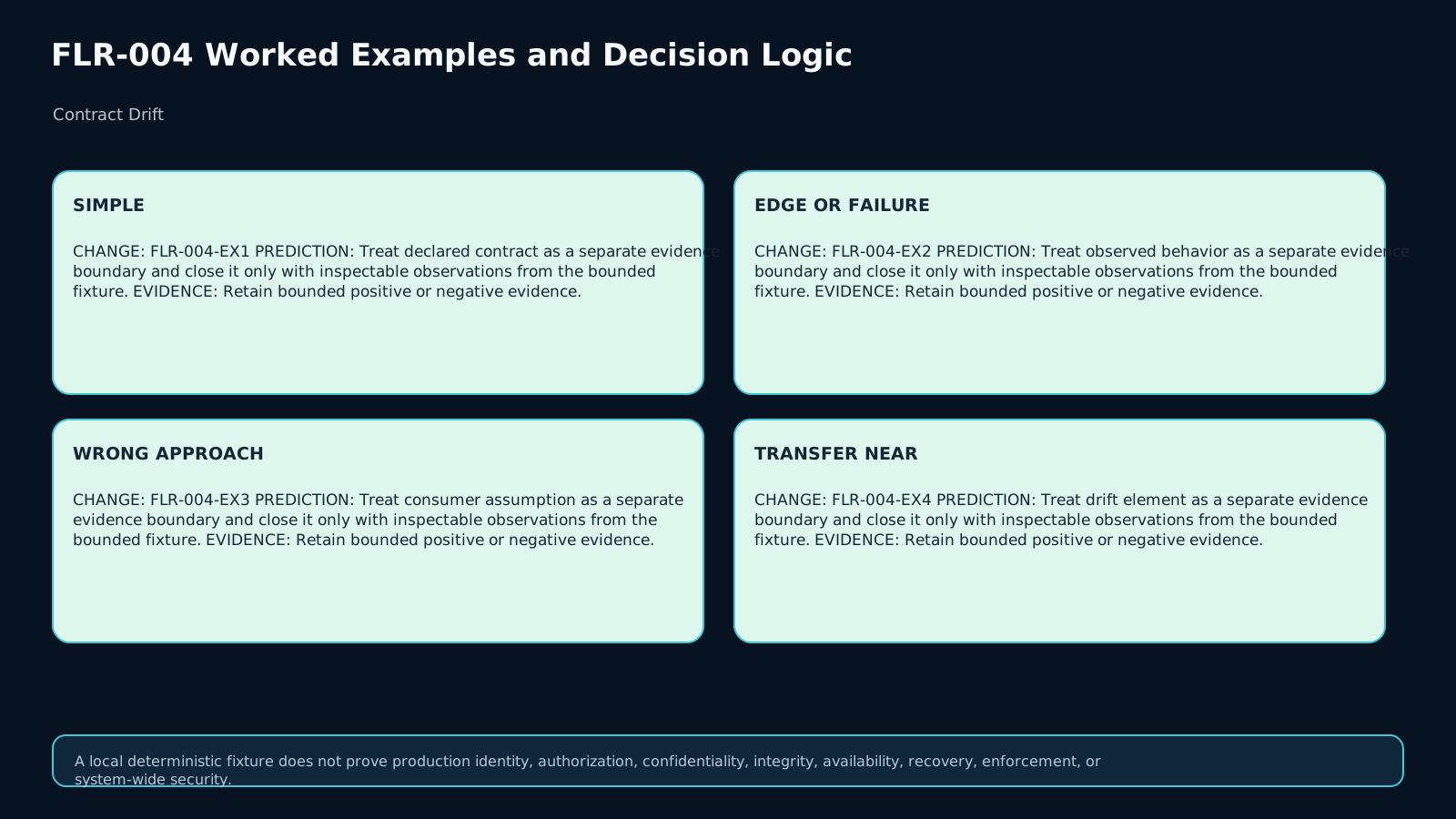
The lab is fully local, deterministic, and synthetic. Eight cases cover a healthy baseline, required-input break, ignored additive field, status-semantic break, stale-doc/runtime divergence, enum narrowing, incomplete evidence, and webhook transfer. The hidden evaluator checks eight dimensions per case for 64 assertions total.
15. Exit checklist and claim boundary
To exit, independently record declared contract, observed behavior, and consumer assumption; name the exact drift element; derive additive/breaking state from consumer evidence; avoid treating a green schema validator as runtime proof; separate stale docs from version drift; distinguish containment from repair; preserve OPEN when evidence is insufficient; and solve the webhook transfer from changed evidence. The synthetic fixture makes no conformity claim about a real API.
Assessment
There is no answer key in this lesson pack; answer it yourself and mark honestly. "Needs review" sends the lesson to your review queue.
FLR-004-AF1 formative
FLR-004-AF2 formative
FLR-004-AF3 formative
FLR-004-AS1 summative
FLR-004-AS2 transfer
Assessment rubric
| Dimension | Sufficient evidence | Blocking failure |
|---|---|---|
| Evidence layers | Declared contract, observed behavior, and consumer assumption are separate | Contract file treated as runtime proof |
| Drift element | Exact operation/field/status/enum/semantic element identified | Generic “API broke” label only |
| Compatibility judgment | Additive/breaking classification tied to consumer evidence | Every diff automatically labeled breaking |
| Repair boundary | Containment separated from compatibility/coordinated repair | Temporary containment presented as closure |
| Verification/transfer | Independent rerun and webhook transfer rebuild the decision | Green validator or copied REST answer treated as proof |
References & freshness
Case studies
Lesson visuals
Lab files
Use only the supplied deterministic synthetic fixtures. For each case, build API Contract Drift Record v1.
Keep declared contract, observed behavior, and consumer assumption separate. Do not treat a schema-valid OpenAPI file as proof that the synthetic implementation conforms. Do not call every diff breaking: consumer impact is required. Preserve UNKNOWN when evidence is incomplete.
The transfer case changes the interaction model from REST request/response to webhook callback. Rebuild the compatibility decision from callback evidence rather than copying the REST rules.
Lesson media & slides
Teaching files (download)