داده، SQL، قراردادها و ماشین حالت · فصل ۵ — JSON Schema، OpenAPI، AsyncAPI، Protobuf و gRPC · 72
Protobuf Compatibility and Message Versioning
Classify and test one Protobuf message evolution: preserve field-number identity, reserve deleted identifiers, distinguish binary wire-safe/compatible/unsafe changes, test old/new round trips, and state when ProtoJSON changes need a different compatibility judgment. میتواند «Protobuf Compatibility و Message Versioning» را برای یک domain محدود مدل کند و constraint، compatibility یا recovery evidence لازم را مشخص کند.
Lesson summary
Classify and test one Protobuf message evolution: preserve field-number identity, reserve deleted identifiers, distinguish binary wire-safe/compatible/unsafe changes, test old/new round trips, and state when ProtoJSON changes need a different compatibility judgment.
میتواند «Protobuf Compatibility و Message Versioning» را برای یک domain محدود مدل کند و constraint، compatibility یا recovery evidence لازم را مشخص کند.
This lesson produces
میتواند «Protobuf Compatibility و Message Versioning» را برای یک domain محدود مدل کند و constraint، compatibility یا recovery evidence لازم را مشخص کند.
Who it is for
Foundation
Worked baseline, explicit evidence table, local fixture and one guided failure probe.
Repair
Reduce to one broken contract/protocol assumption, observe it, repair it, then restore the full case.
Experienced
Compress introductory syntax; require independent compatibility/reliability decision, negative evidence and residual-limit statement.
Prerequisites
_Locale: en-US · Lesson: DAT-015 · Public order: 72_
Outcome and working artifact
This lesson produces a Protobuf Compatibility Change Record v1: a decision artifact that separates observations, assumptions, limits, and required evidence. The goal is a transferable model, not memorized tool names.
میتواند «Protobuf Compatibility و Message Versioning» را برای یک domain محدود مدل کند و constraint، compatibility یا recovery evidence لازم را مشخص کند.
Boundary model
A .proto file can compile while an evolution still damages old readers, new readers, stored messages, or ProtoJSON clients. In Protobuf, field numbers are wire identities. Compatibility therefore requires a directional old/new test, reservation of deleted identifiers, and separate judgment for binary and JSON representations.
Keep three labels throughout the work: observed, bounded inference, and needs verification. When evidence is unavailable, record unknown. A product name or a passing happy path is not a substitute for evidence.
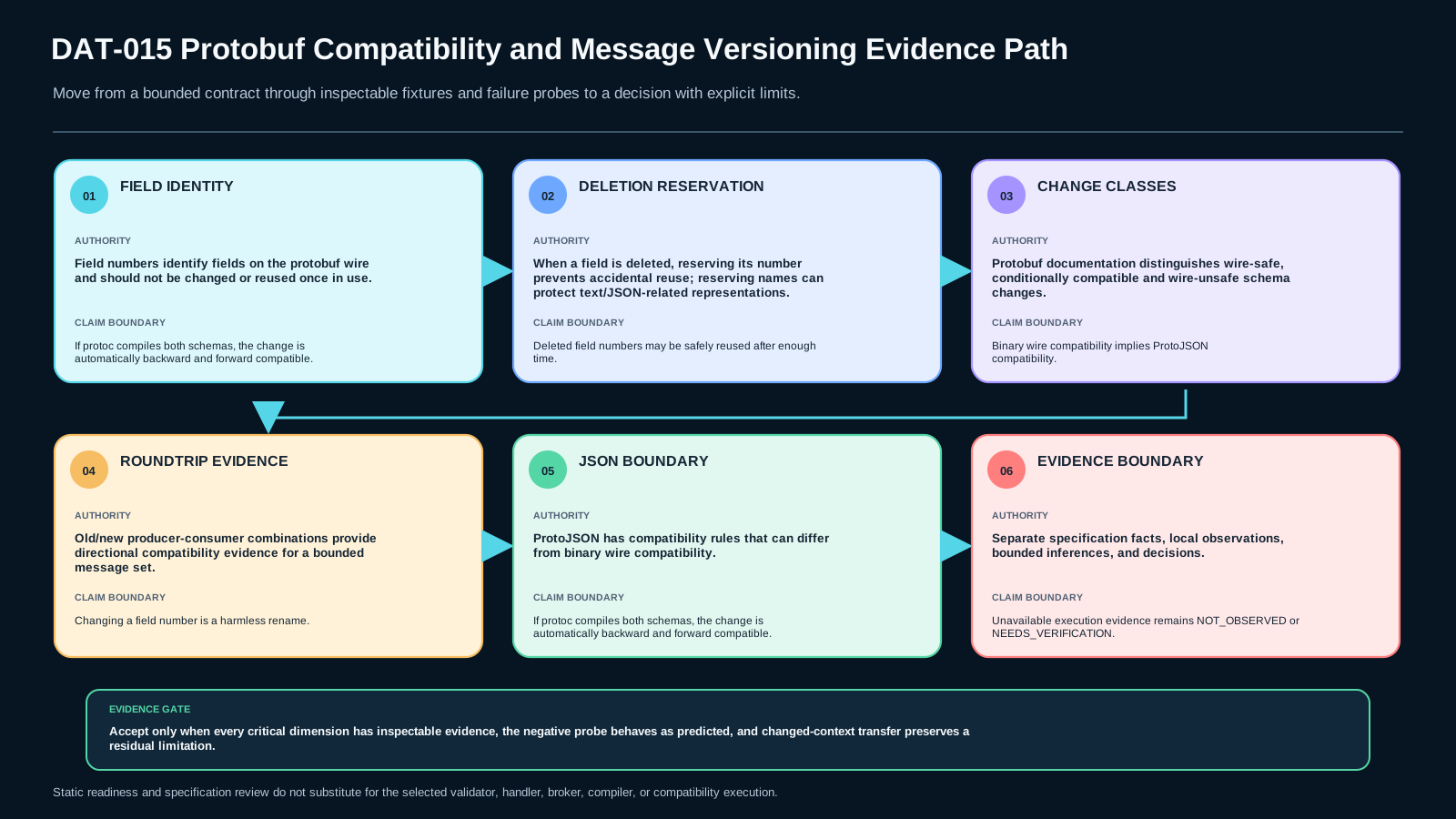
1. Field numbers are identities
A field name can change without changing binary identity, but changing or reusing a number changes how bytes are interpreted. Treat numbers as durable contract assets.
2. Reserve what you delete
When a field is removed, reserve its number and usually its name where relevant. This prevents a future author from accidentally reusing an identity that old data still carries.
3. Compatibility is directional
Test old writer→new reader and new writer→old reader separately. Unknown fields and default behavior can make one direction acceptable while another loses information.
4. Type changes need wire and value analysis
Some types share a wire encoding but are not automatically safe for every value. Golden boundary messages are needed, especially for narrowing or signedness changes.
5. ProtoJSON is a different boundary
JSON field names and representation rules create risks not visible in binary wire tests. If JSON is persisted or exchanged, classify it independently.
Five-step method
- Inventory every existing field number, type, cardinality, oneof membership, and JSON name.
- Describe the proposed diff and classify additions, deletions, renames, number changes, and type changes separately.
- Run old-writer/new-reader and new-writer/old-reader tests with representative and boundary messages.
- Reserve deleted numbers and names, then run a deliberate reuse mutation that must fail review.
- Repeat the judgment for ProtoJSON when JSON storage or exchange exists; record data-loss and residual limits.
Worked case
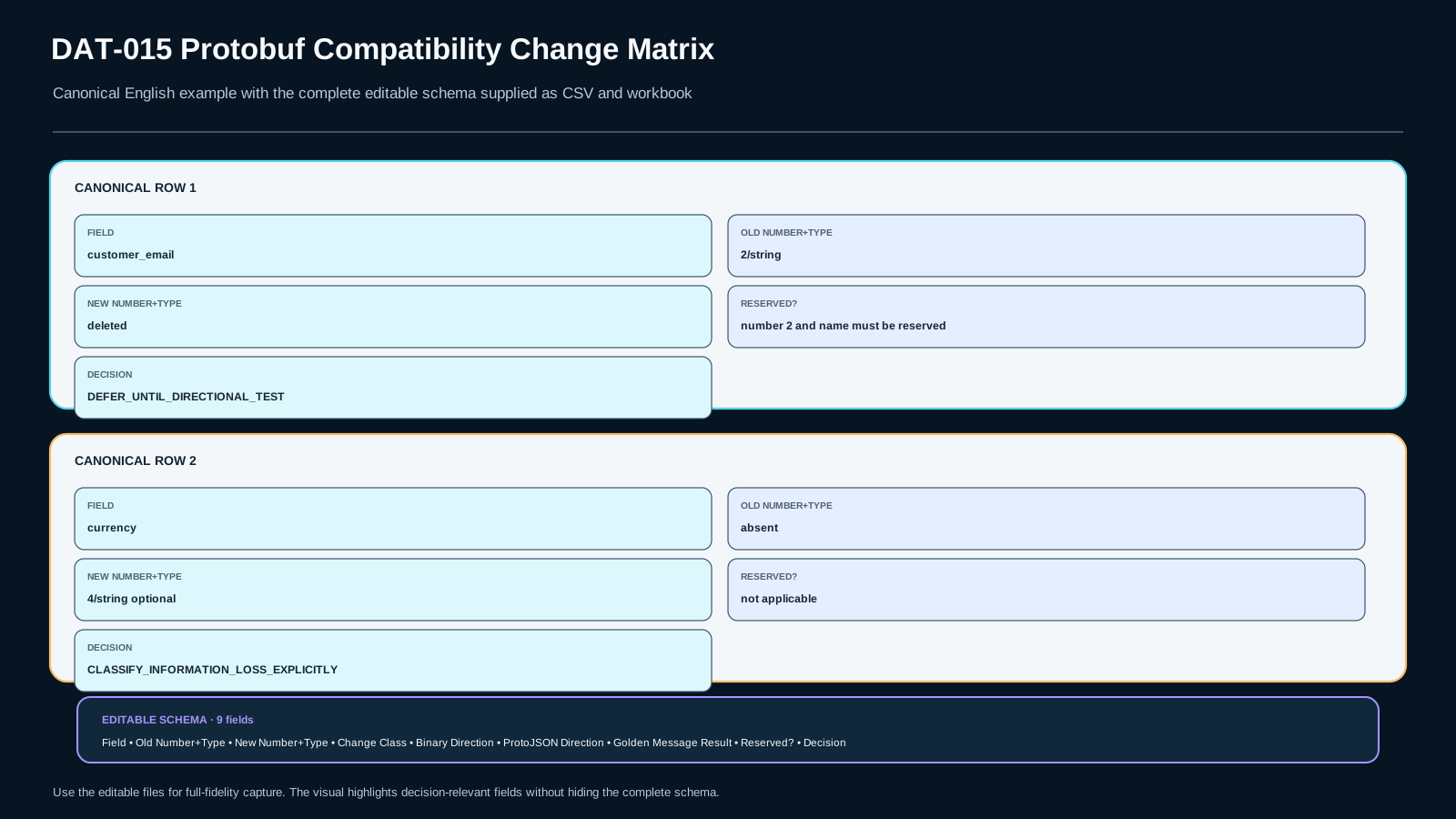
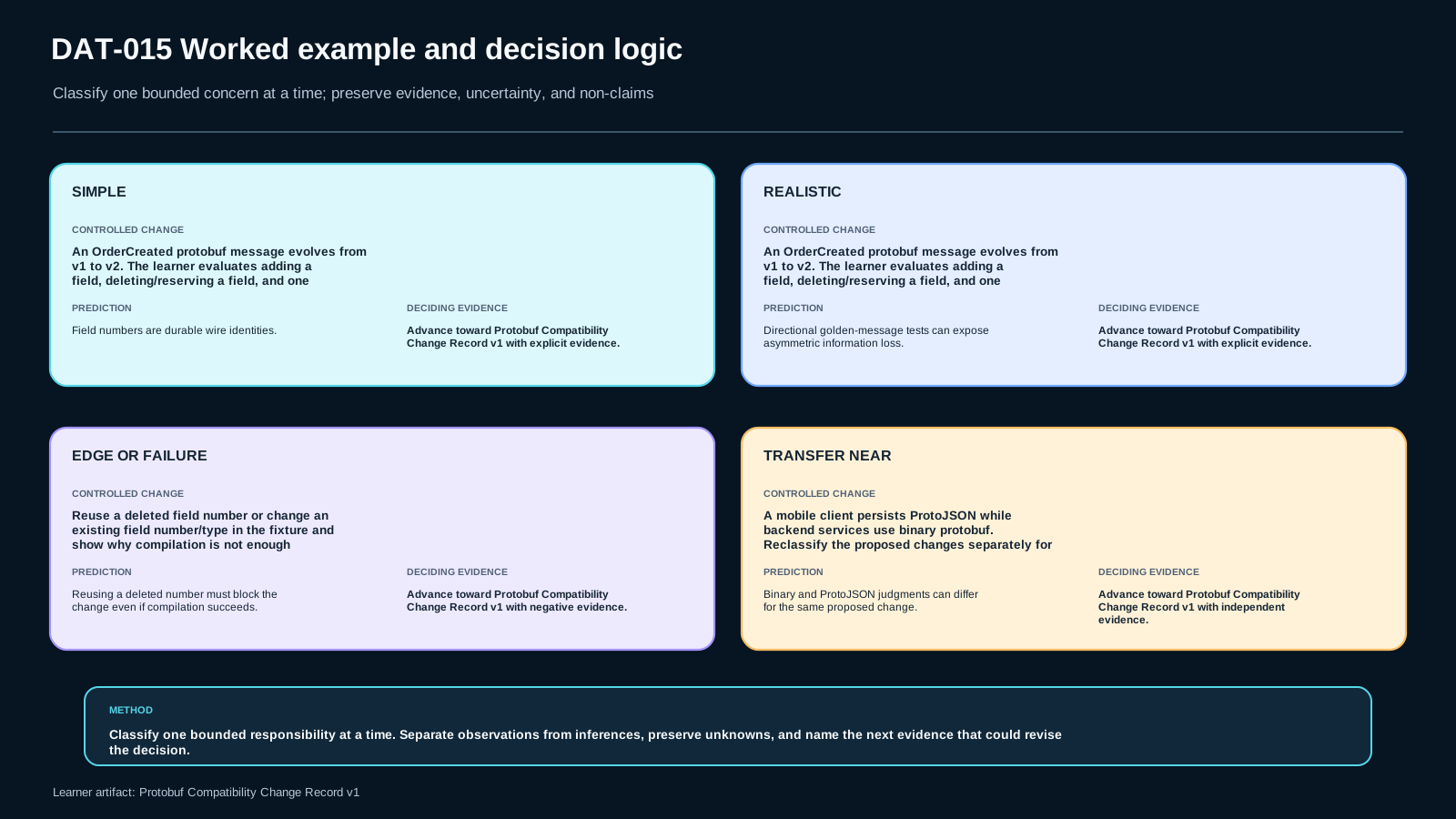
OrderCreated v1 has order_id = 1, customer_email = 2, and total_cents = 3. Version 2 adds optional currency = 4 and removes email. The safe candidate reserves number 2 and its name. Golden binary tests run in both directions; the old reader ignores field 4, so currency information is not preserved in that direction and the record says so. A mutation reuses number 2 for customer_phone and is rejected even though both schemas compile. ProtoJSON clients are reviewed separately because field-name changes can break persisted JSON.
Decision and evidence matrix
| Concern | Boundary or owner | Evidence | Decision or limitation | |
|---|---|---|---|---|
| order_id | 1/string | 1/string | Identity preserved | Accept |
| customer_email | 2/string | deleted + reserved | Old bytes remain unambiguous | Accept with retention note |
| currency | absent | 4/string optional | Old reader ignores field | Directionally compatible; information loss noted |
| customer_phone mutation | absent | 2/string | Deleted number reused | Reject |
| ProtoJSON rename | customerEmail | buyerEmail | Persisted JSON key changes | Separate migration required |
Failure probes and repair
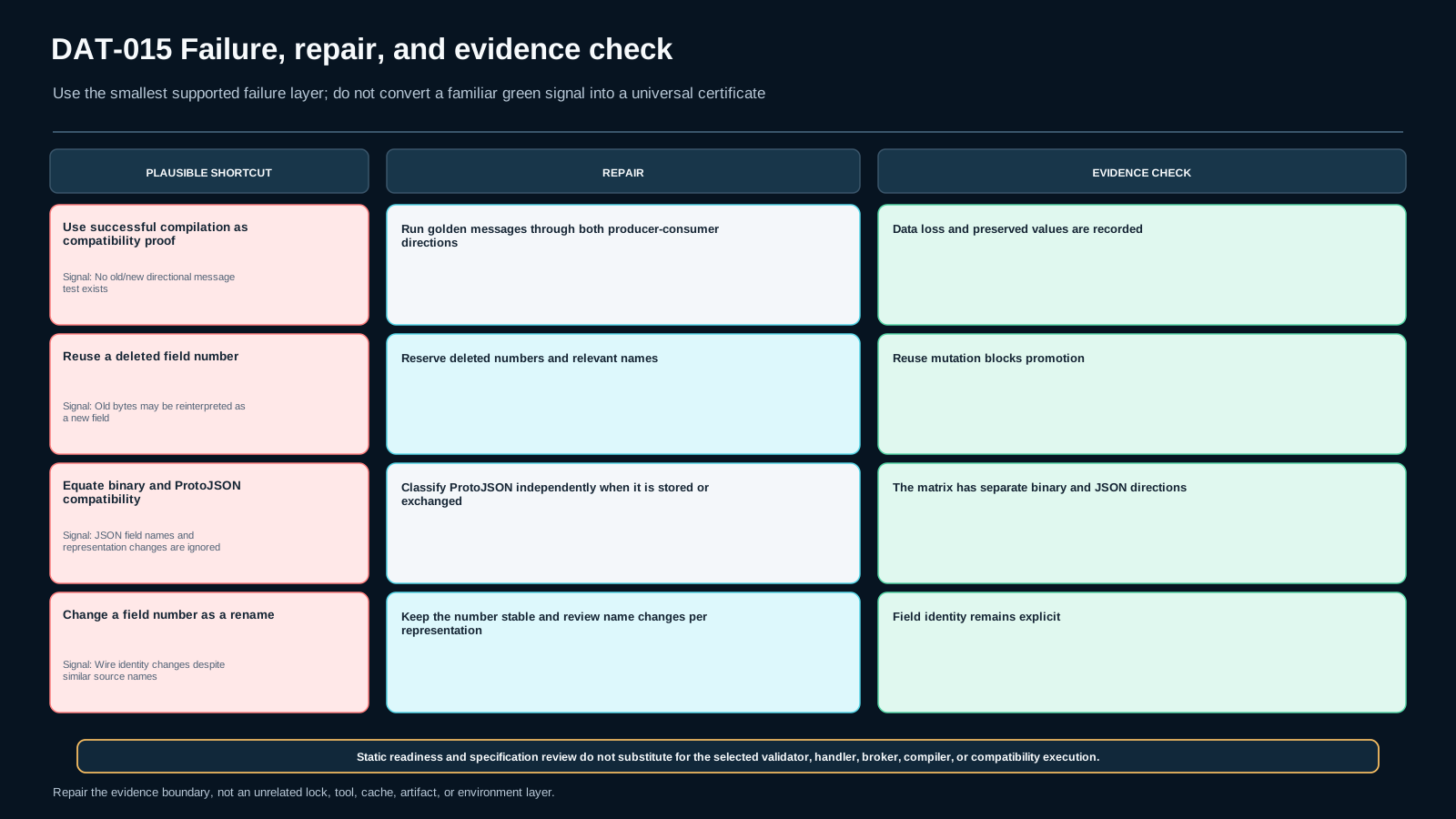
- If protoc compiles both schemas, the change is automatically backward and forward compatible.
- Deleted field numbers may be safely reused after enough time.
- Binary wire compatibility implies ProtoJSON compatibility.
- Changing a field number is a harmless rename.
For each statement, narrow the claim, create a counterexample, and name the observation that could confirm or reject it.
Transfer challenge
Change the scenario so that one assumption in the worked case no longer holds. Rebuild the Protobuf Compatibility Change Record v1 without copying the earlier decision, then explain what changed in the input and what stayed stable in the decision rule.
What this does not prove
This lesson does not claim certification, production guarantees, or coverage of every implementation. Its conclusion is valid only within the scenario boundary, dated sources, and recorded observations.
Self-check
- [ ] Did I separate responsibilities from framework or tool names?
- [ ] Did I state at least one failure probe and its predicted observable?
- [ ] Are fact, inference, and design choice visibly separated?
- [ ] Did I record non-claims and missing evidence?
- [ ] Did I complete transfer in a changed context without a prepared answer?
Sources and freshness boundary
Sources were reviewed for the frozen Bible as of 2026-09-19. A review_due date triggers a versioned requalification; it does not authorize silent in-place edits.
- PROTO3-GUIDE — Official field-number, deletion/reservation and message-update compatibility guidance. (https://protobuf.dev/programming-guides/proto3/; review: 2026-10-17)
- PROTOJSON — Official ProtoJSON format and compatibility considerations. (https://protobuf.dev/programming-guides/json/; review: 2026-10-17)
Assessment
There is no answer key in this lesson pack; answer it yourself and mark honestly. "Needs review" sends the lesson to your review queue.
DAT-015-S1 retrieval
DAT-015-S2 application
DAT-015-S3 diagnosis
DAT-015-S4 decision
DAT-015-S5 transfer
Assessment rubric
| Dimension | Critical | Sufficient evidence |
|---|---|---|
| contract/protocol correctness | yes | Explanation preserves version/dialect, compatibility/reliability and evidence semantics. |
| evidence quality | yes | Positive, negative and change/repair observations are traceable and separated from inference. |
| scope discipline | yes | Adjacent outcomes and unsupported tool/runtime generalizations are deferred. |
| transfer independence | yes | Changed-context task is solved without decisive scaffold. |
A submission passes only when every critical dimension is sufficient and the learner states missing evidence honestly. AI suggestions are not observed evidence; the learner remains accountable for the final bounded judgment.
References & freshness
Case studies
Lab files
Build Protobuf Compatibility Change Record v1 from the safe local fixture. First state a prediction. Then record the baseline, run or simulate the declared failure probes against the fixture, and preserve both positive and negative observations. Complete the transfer case without copying the worked lesson decision.
The starter intentionally does not choose the final classification or risk decision. Edit evaluate_record.py and the evidence template. Run python3 ../run_checks.py from this directory's parent to verify the environment and file shape; those checks do not grade your substantive decision.
Safety boundary: No production system/data, no external account/service dependency, and all failure probes must be bounded and deterministic.
Lesson media & slides
Teaching files (download)