مهندسی سامانههای هوش مصنوعی · فصل ۲ — Model Selection، Serving، Cost Governor و Workflow · 138
Ollama Adapter
Specify and test an Ollama adapter that maps the canonical gateway contract to the current Ollama native or compatibility surface, preserves model/runtime provenance, usage and terminal/error states, declares unsupported capability mappings, and proves conformance with deterministic fixtures without making business logic Ollama-specific. میتواند «Ollama Adapter» را در یک workflow AI محدود طراحی کند و validation، authority، cost یا failure controls مرتبط را مشخص کند.
Lesson summary
Specify and test an Ollama adapter that maps the canonical gateway contract to the current Ollama native or compatibility surface, preserves model/runtime provenance, usage and terminal/error states, declares unsupported capability mappings, and proves conformance with deterministic fixtures without making business logic Ollama-specific.
میتواند «Ollama Adapter» را در یک workflow AI محدود طراحی کند و validation، authority، cost یا failure controls مرتبط را مشخص کند.
This lesson produces
میتواند «Ollama Adapter» را در یک workflow AI محدود طراحی کند و validation، authority، cost یا failure controls مرتبط را مشخص کند.
Who it is for
Foundation
Use a guided lesson-specific evidence matrix and one worked negative case.
Repair
Re-run only the failed owned dimension with a smaller deterministic synthetic fixture.
Experienced
Start from mixed current-tool and synthetic product evidence; require explicit trade-offs and provenance.
Prerequisites
1. The real problem: changing the base URL is not a production adapter
A provider-neutral gateway can use Ollama safely only when a bounded adapter maps the canonical contract to actual Ollama semantics. One successful OpenAI-compatible call proves a happy path, not complete field support, usage preservation, stream termination, error behavior, provenance, or required capabilities.
2. Keep the domain/provider boundary intact
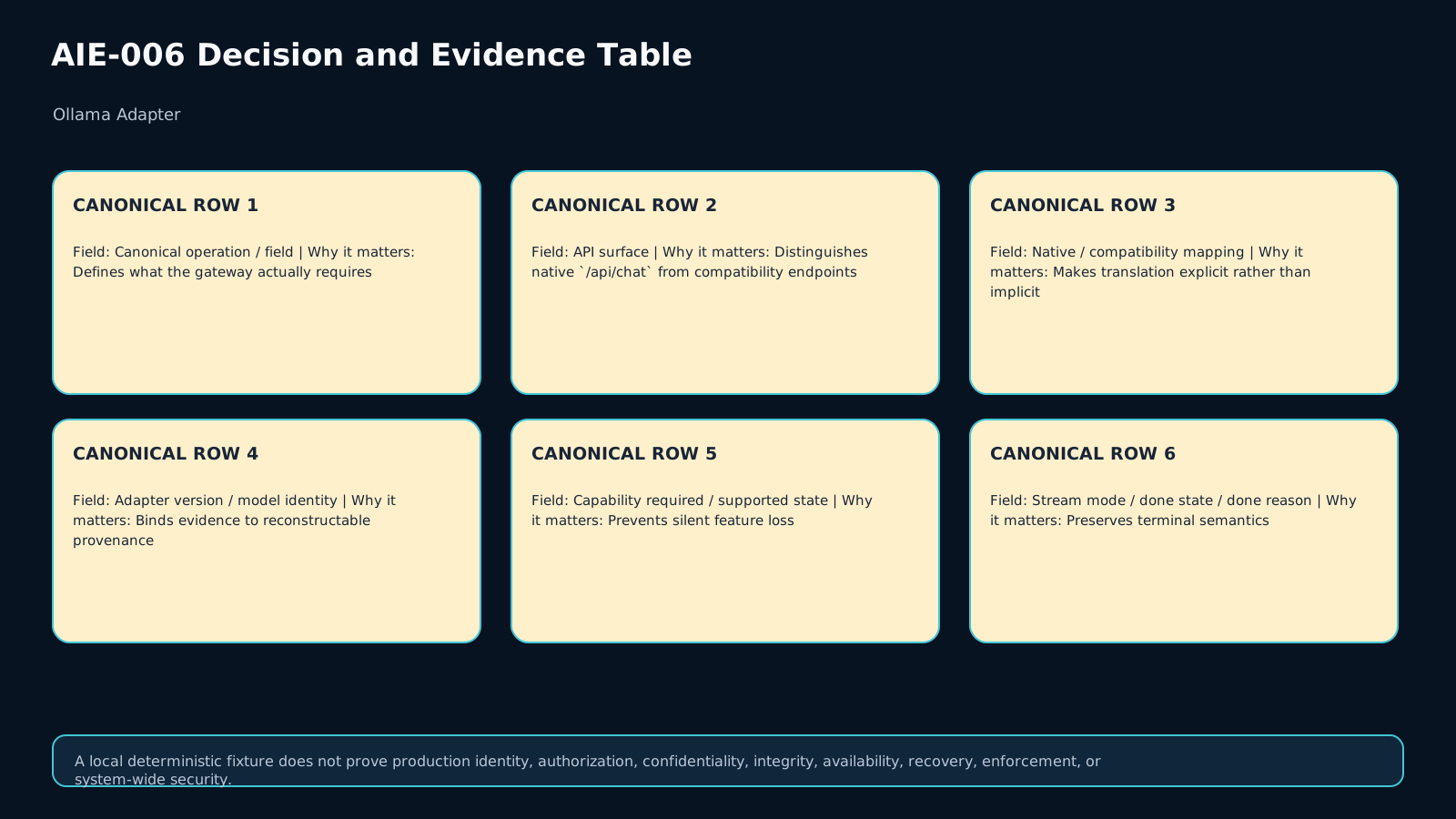
Domain code should not make business decisions from Ollama-specific fields such as done_reason, prompt_eval_count, or native error shapes. The adapter accepts a canonical request, checks capability, selects a native or compatibility mapping, and returns normalized state while preserving raw evidence separately for audit.
3. Model the native /api/chat surface explicitly
The current native chat contract can accept fields such as model, messages, tools, format, options, stream, think, and keep_alive. Map only fields supported by evidence for the recorded adapter/runtime context, and do not confuse a documented API field with support by every model.
4. Treat OpenAI compatibility as partial
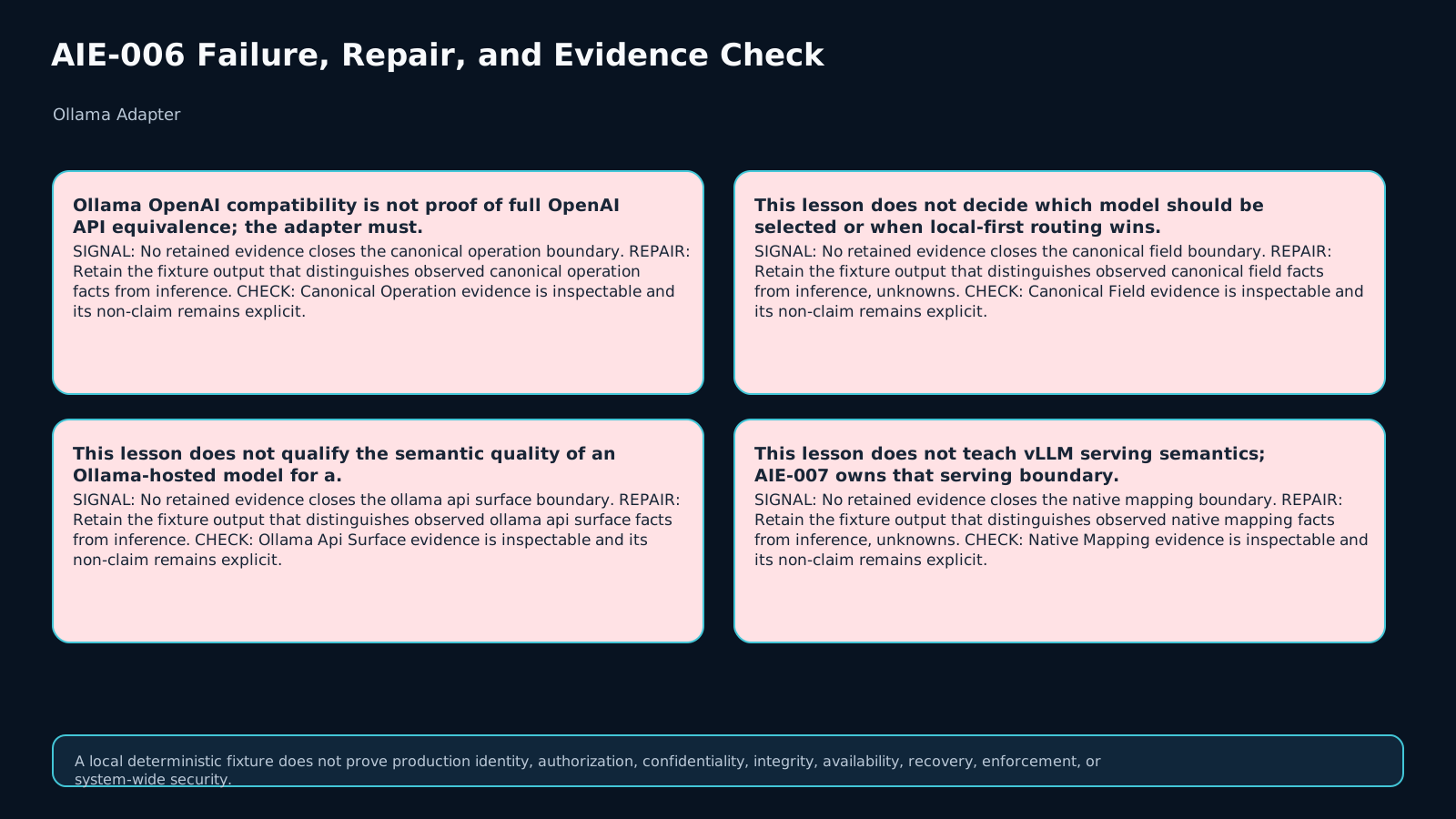
Ollama documents OpenAI-compatible endpoints such as chat completions and responses, while explicitly describing compatibility with parts of the OpenAI API. Mapping therefore remains operation-by-operation and field-by-field rather than assuming full behavioral equivalence.
5. Run the capability map before the endpoint call
For each canonical requirement, record whether the adapter/runtime/model fixture is SUPPORTED, UNSUPPORTED, or UNKNOWN. Unsupported or unknown requirements must not become success through silent field dropping or prompt rewriting; routing receives the typed state.
6. Non-stream and stream have different terminal contracts
For non-stream responses, HTTP status and body can normally be evaluated together. In a stream, valid content chunks may arrive before an error object. The adapter must preserve partial-output provenance, mark the terminal result failed, and prevent downstream code from treating incomplete output as success.
7. Do not invent an HTTP error after streaming starts
Once a response stream has begun, its HTTP status cannot be changed. If an NDJSON stream later contains an error object, normalize the state to something like STREAM_FAILED_AFTER_PARTIAL while retaining the raw error and evidence about prior chunks.
8. Missing usage is not zero usage
A native response may expose prompt/eval token counts and timing metrics, while a compatibility path or another fixture may omit the same evidence. Preserve missing values as UNKNOWN or UNAVAILABLE; zero means a measured zero and is semantically different.
9. Model identity and adapter version are evidence
A mutable model name is insufficient for replay. The conformance record should retain reconstructable model identity, adapter version, API surface, and mapping version so a later reviewer can determine which contract produced the result.
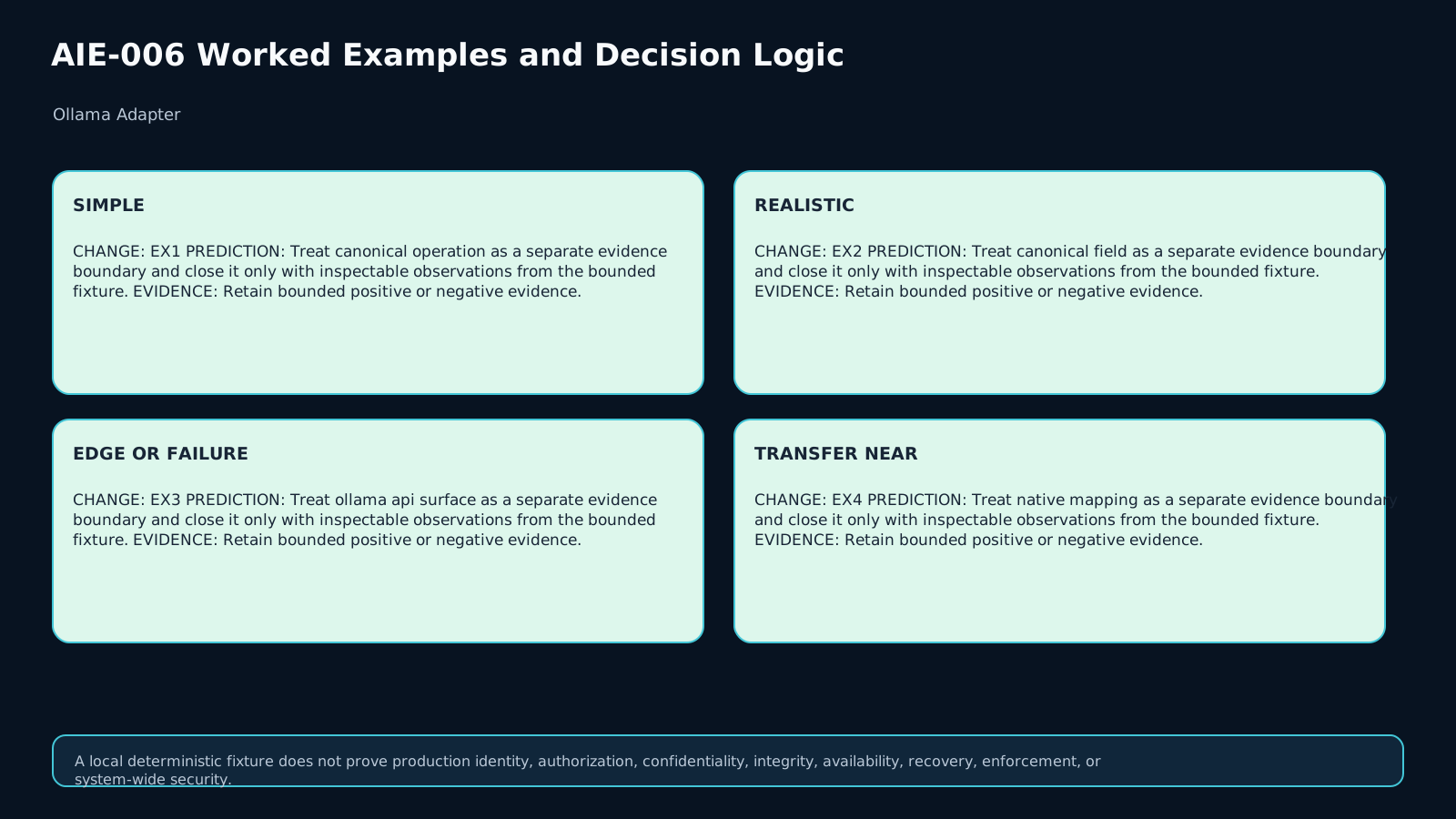
10. Worked example: a valid native response
Suppose canonical chat maps to native /api/chat, the fixture supports JSON-schema output and non-streaming, model identity and adapter version are present, and a clean terminal response includes valid usage/timing evidence. The adapter may issue PASS, but only for that mapping and declared capability set.
11. Worked failure: missing model 404
A 404 should normalize to a state such as MODEL_NOT_FOUND while retaining HTTP status and the raw error payload. The adapter must not reinterpret it as retry success, empty completion, or a model-selection decision; model choice belongs to another lesson boundary.
12. Lab: eight deterministic fixtures
The lab covers native success, compatibility with missing usage, a mid-stream error, an unsupported capability, missing-model 404, incomplete provenance, an unmapped format requirement, and transfer with a new capability. The goal is to implement a state machine, not memorize documentation prose.
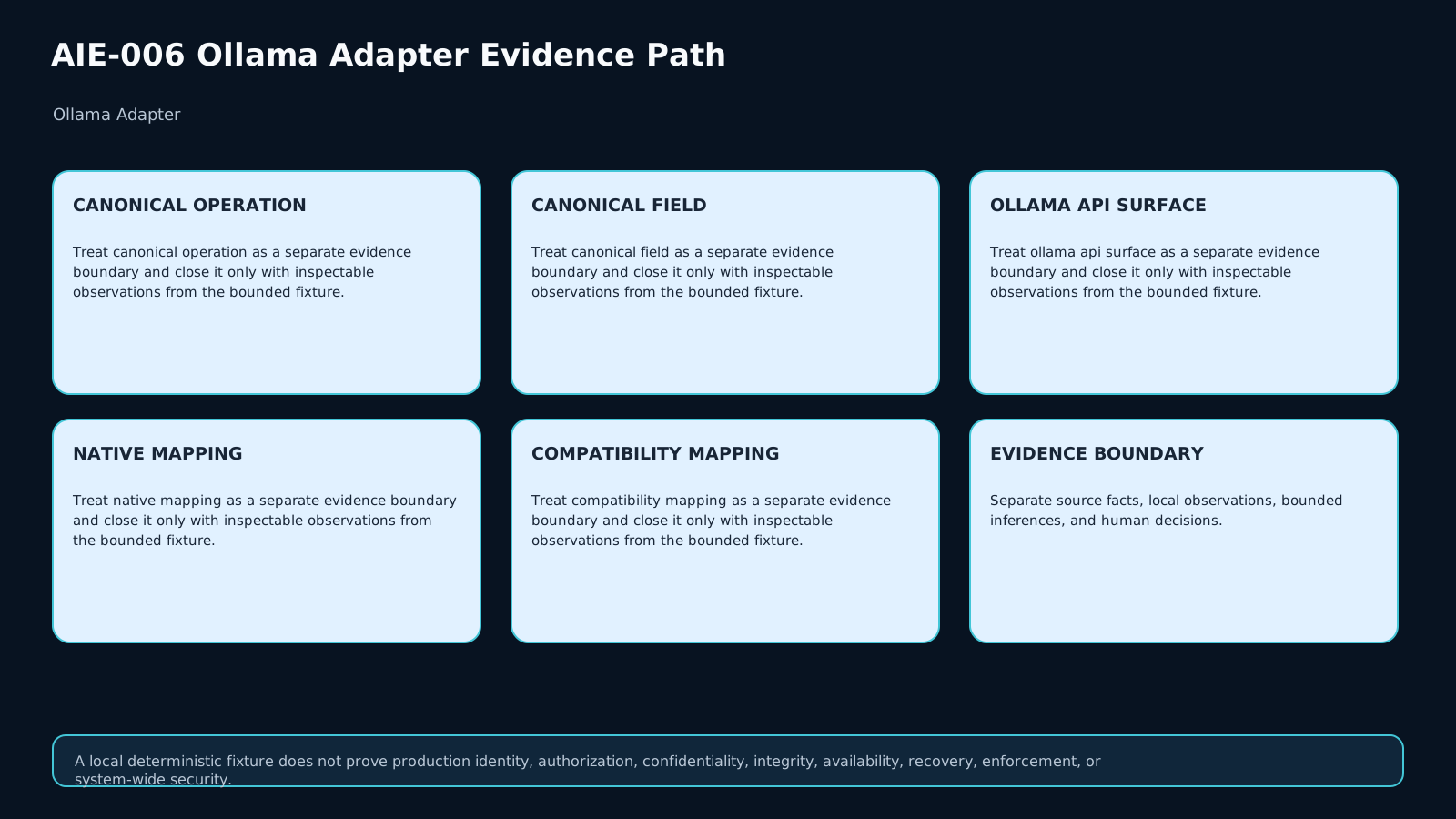
13. Decision order: provenance → mapping → capability → terminal/error → usage
First establish which model/adapter/surface is being evaluated. Then verify mapping and capability. Only then evaluate terminal/error state and usage completeness. Convenience or the presence of generated text cannot override an earlier hard gate.
14. Separate conformance evidence from product qualification
This lesson proves that the adapter maps its owned contract and preserves negative states. It does not prove that the hosted model is qualified for a task/locale/risk slice or that local-first routing should choose it. Those decisions require evidence from their owning lessons.
15. Exit checklist and transfer
Before exit, verify explicit field mappings, a versioned capability map, preservation of raw plus normalized errors, no success after mid-stream failure, no zero-filling of missing usage, complete provenance, and UNSUPPORTED for a newly required capability without a mapping. For transfer, add a new requirement and rebuild the decision from evidence.
Assessment
There is no answer key in this lesson pack; answer it yourself and mark honestly. "Needs review" sends the lesson to your review queue.
Q1 retrieval
Why is changing an OpenAI client base URL to Ollama insufficient as a production adapter?
Q2 application
A canonical requirement has no declared mapping for the current Ollama model/runtime fixture. What state should routing receive?
Q3 diagnosis
A stream emits useful text and then an Ollama error object. Is the call successful?
Q4 evidence
A compatibility response omits native token/timing metrics. Should the adapter fill them with zero?
Q5 transfer
A new canonical capability is added after the old adapter passed. May the old PASS be reused automatically?
Assessment rubric
PASS requires exact adapter/model/API-surface provenance, explicit canonical-to-Ollama mappings, a versioned capability map, preservation of raw plus normalized terminal/error state, correct UNKNOWN/UNAVAILABLE handling for absent usage, and deterministic conformance evidence. Unsupported capabilities, missing decisive provenance, or failed terminal state must not be coerced into success.
References & freshness
Case studies
Lesson visuals
Lab files
Implement evaluate(case) in starter.py. Use only the supplied deterministic fixtures. Return these fields: provenance_state, mapping_state, capability_state, terminal_state, usage_state, error_state, final_decision, reason_class.
Decision discipline: provenance first; an undeclared mapping cannot pass; an unsupported/unknown required capability cannot be silently dropped; a mid-stream error is terminal failure even after partial content; missing optional usage remains unavailable rather than zero. Keep raw provider evidence separate from normalized domain state.
Lesson media & slides
Teaching files (download)