وب مدرن، رابط کاربری و تجربهی وب · فصل ۵ — Error Model، REST، Streaming و Webhook · 51
Server-Sent Events and Server-to-Client Streaming
Implement a bounded SSE endpoint and client with explicit event framing, IDs and reconnect/resume behavior, then verify disconnect and replay mutations without claiming exactly-once delivery. میتواند «SSE و Server-to-Client Streaming» را در یک feature محدود طراحی/پیادهسازی کند و correctness، accessibility یا failure behavior مرتبط را اثبات کند.
Lesson summary
Implement a bounded SSE endpoint and client with explicit event framing, IDs and reconnect/resume behavior, then verify disconnect and replay mutations without claiming exactly-once delivery.
میتواند «SSE و Server-to-Client Streaming» را در یک feature محدود طراحی/پیادهسازی کند و correctness، accessibility یا failure behavior مرتبط را اثبات کند.
This lesson produces
میتواند «SSE و Server-to-Client Streaming» را در یک feature محدود طراحی/پیادهسازی کند و correctness، accessibility یا failure behavior مرتبط را اثبات کند.
Who it is for
Foundation
Worked baseline, explicit evidence table, safe local fixture and one guided failure probe.
Repair
Reduce to one failing contract, observe evidence, repair, then restore full case.
Experienced
Skip syntax walkthrough; require independent implementation, mutation evidence and residual-risk statement.
Prerequisites
_Locale: en-US · Lesson: WEB-007 · Public order: 51_
Outcome and working artifact
This lesson produces a SSE Resume and Delivery Evidence Record v1: a decision artifact that separates observations, assumptions, limits, and required evidence. The goal is a transferable model, not memorized tool names.
میتواند «SSE و Server-to-Client Streaming» را در یک feature محدود طراحی/پیادهسازی کند و correctness، accessibility یا failure behavior مرتبط را اثبات کند.
Boundary model
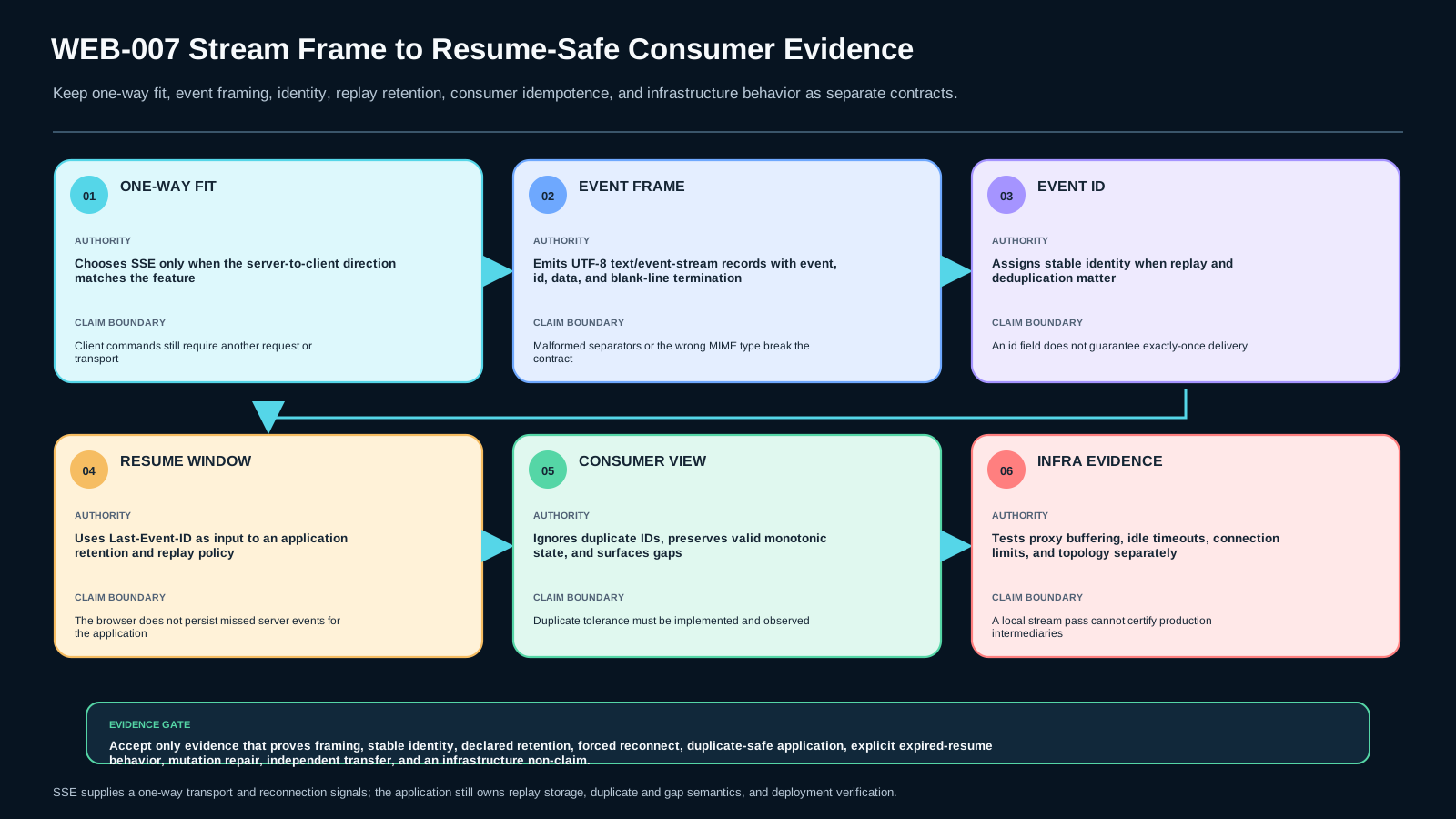
Server-Sent Events provide a browser-oriented, server-to-client event stream over HTTP. The simple API can hide the hard questions: event identity, reconnection, replay windows, duplicate handling, buffering intermediaries, cancellation, and user-interface state after a gap. This lesson treats SSE as at-least-repeatable evidence, not an exactly-once guarantee.
Keep three labels throughout the work: observed, bounded inference, and needs verification. When evidence is unavailable, record unknown. A product name or a passing happy path is not a substitute for evidence.
1. SSE is one-way
The server emits UTF-8 text events and the browser receives them. Client-to-server commands still need another HTTP request or another transport.
2. Framing is part of the contract
Fields such as event, id, data, and optional retry are line-based; a blank line terminates one event. Multi-line data and comments must be handled deliberately.
3. Event IDs support a resume protocol, not storage
The client can expose the last received ID during reconnection. The server still needs a retention and replay policy; Last-Event-ID does not create that policy automatically.
4. Duplicates and gaps are application concerns
Reconnect races can replay an event or miss data outside the retention window. A consumer view should be idempotent by stable event ID and should surface an unrecoverable gap.
5. Infrastructure can change observable behavior
Proxy buffering, connection limits, idle timeouts, compression, and deployment topology can affect latency and longevity. A local pass does not prove production behavior.
Five-step method
- Define named event types, a stable event ID, data schema, heartbeat rule, and termination behavior.
- Define the retention window and the response when the requested resume ID is too old or unknown.
- Make the client reducer idempotent: ignore an already-applied ID and preserve monotonic progress where the domain requires it.
- Force disconnect, duplicate replay, stale resume, malformed frame, and slow-consumer probes.
- Record local evidence separately from deployment assumptions about buffering, timeouts, and connection capacity.
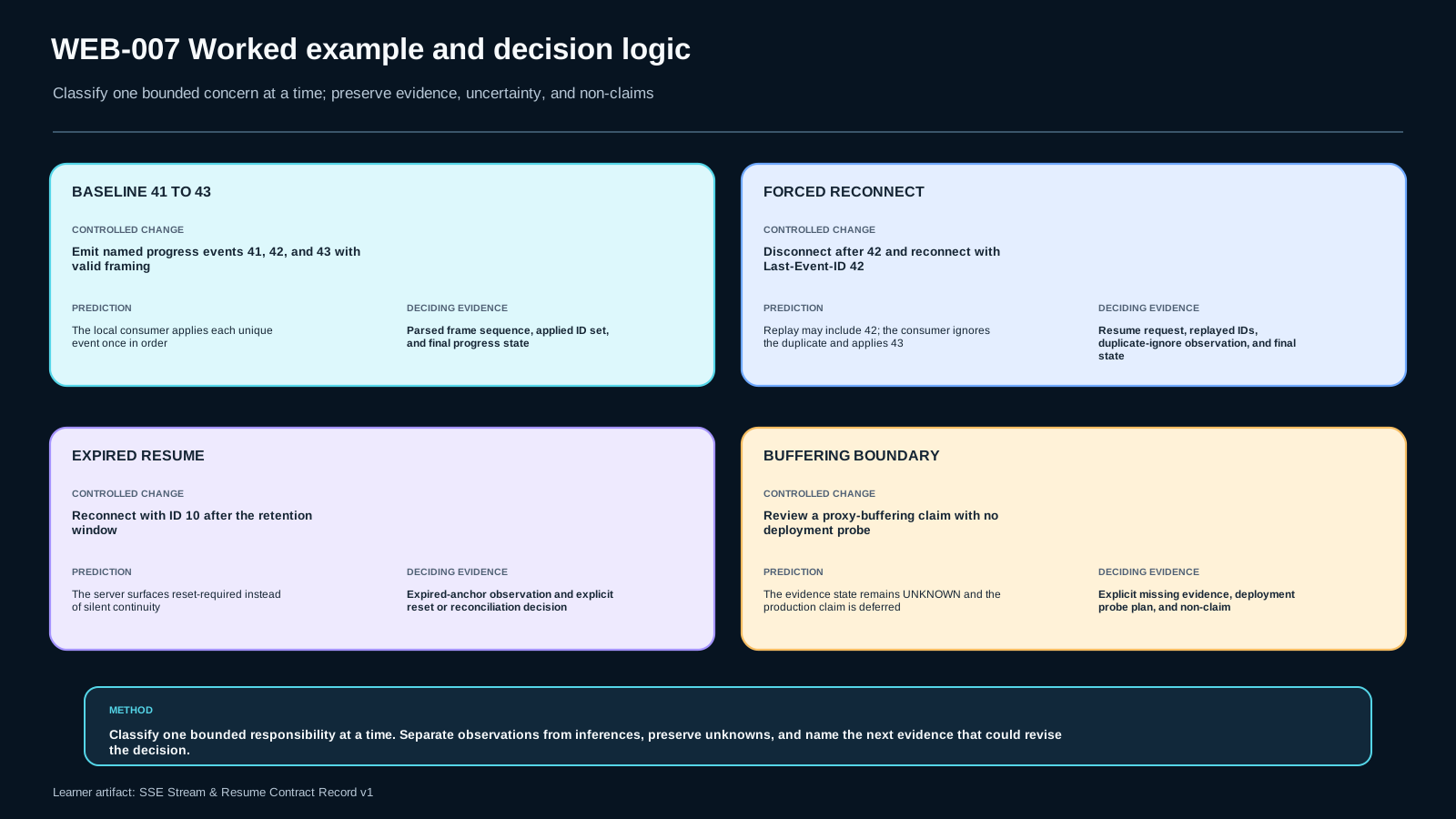
Worked case
A job emits progress events 41, 42, and 43. The client applies 41 and 42, disconnects, and reconnects with 42. The server replays 42 and 43. The UI ignores the duplicate 42 by ID and applies 43. A second probe reconnects with ID 10 after the replay window has expired; the server returns an explicit reset-required event rather than pretending continuity. This proves the local policy only; it does not prove that a production proxy will avoid buffering.
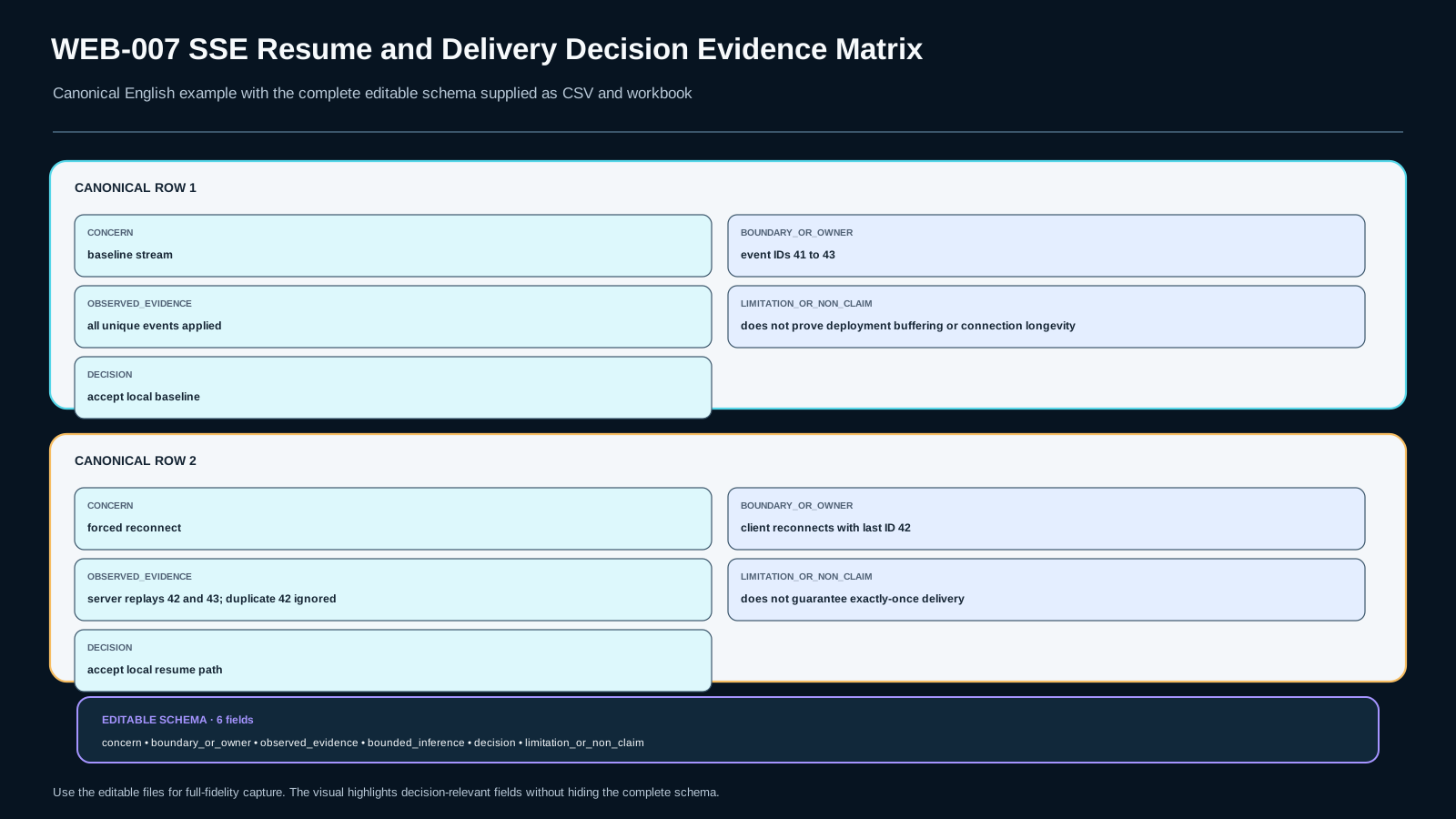
Decision and evidence matrix
| Concern | Boundary or owner | Evidence | Decision or limitation |
|---|---|---|---|
| Baseline stream | IDs 41→43 | All unique events applied | Local framing and reducer pass |
| Forced reconnect | Replay starts at 42 | Duplicate 42 ignored | Idempotence observed |
| Expired resume | ID outside retention | Reset-required surfaced | No silent gap |
| Buffered proxy | Not exercised locally | Unknown | Deployment probe required |
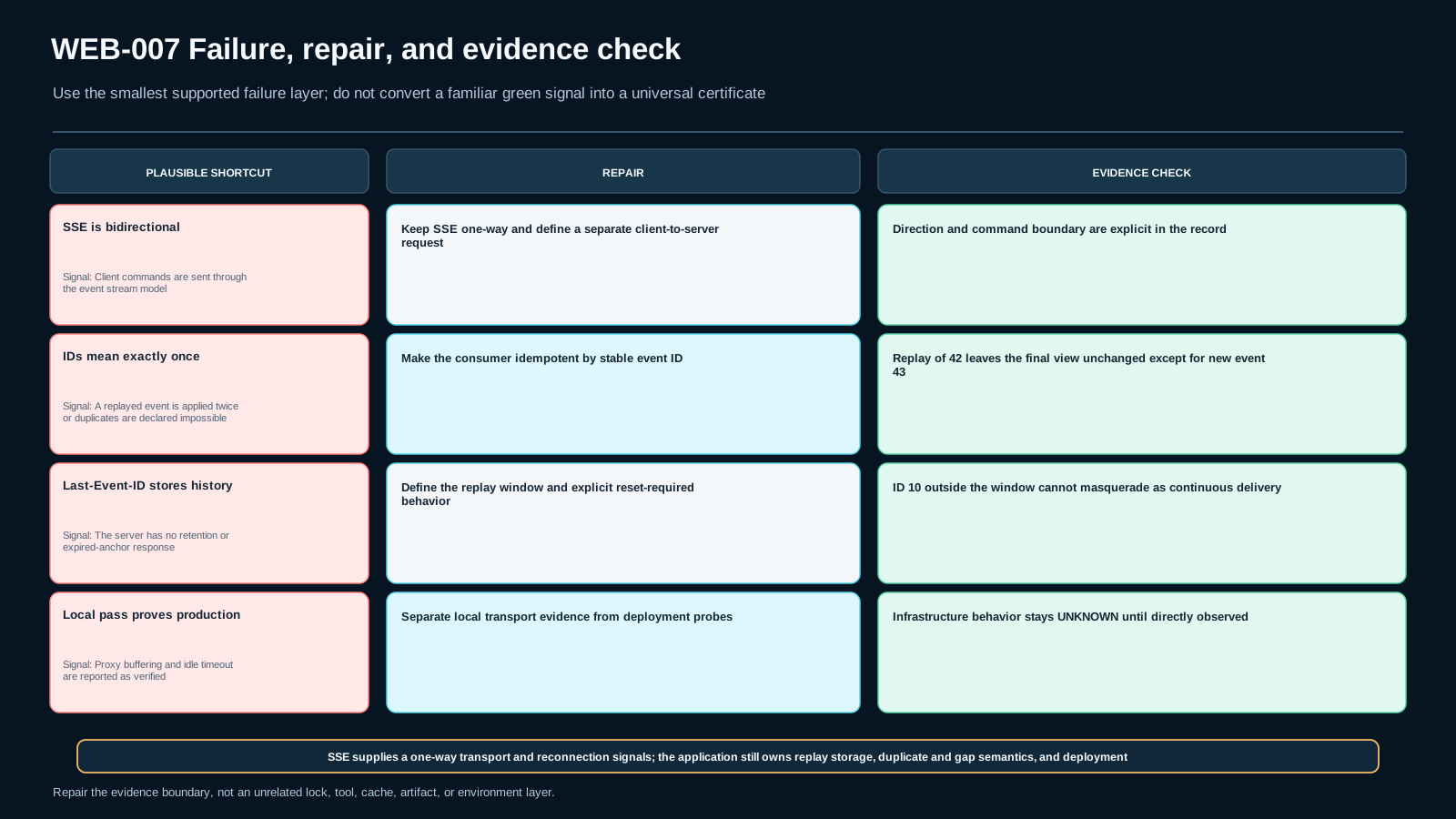
Failure probes and repair
- SSE is bidirectional like WebSocket.
- EventSource plus id fields guarantees exactly-once delivery.
- Last-Event-ID makes the server persist missed events automatically.
- A local stream test proves proxies will not buffer or time out the connection.
- SSE is always preferable to polling or WebSocket.
For each statement, narrow the claim, create a counterexample, and name the observation that could confirm or reject it.
Transfer challenge
Change the scenario so that one assumption in the worked case no longer holds. Rebuild the SSE Resume and Delivery Evidence Record v1 without copying the earlier decision, then explain what changed in the input and what stayed stable in the decision rule.
What this does not prove
This lesson does not claim certification, production guarantees, or coverage of every implementation. Its conclusion is valid only within the scenario boundary, dated sources, and recorded observations.
Self-check
- [ ] Did I separate responsibilities from framework or tool names?
- [ ] Did I state at least one failure probe and its predicted observable?
- [ ] Are fact, inference, and design choice visibly separated?
- [ ] Did I record non-claims and missing evidence?
- [ ] Did I complete transfer in a changed context without a prepared answer?
Sources and freshness boundary
Sources were reviewed for the frozen Bible as of 2026-09-19. A review_due date triggers a versioned requalification; it does not authorize silent in-place edits.
- S-WHATWG-SSE — WHATWG HTML defines EventSource, text/event-stream framing and Last-Event-ID behavior. (https://html.spec.whatwg.org/dev/server-sent-events.html; review: 2026-10-17)
- S-MDN-SSE — MDN documents data/id/retry fields and browser reconnection behavior as implementation guidance. (https://developer.mozilla.org/en-US/docs/Web/API/Server-sent_events/Using_server-sent_events; review: 2026-10-17)
Assessment
There is no answer key in this lesson pack; answer it yourself and mark honestly. "Needs review" sends the lesson to your review queue.
WEB-007-S1 retrieval
WEB-007-S2 application
WEB-007-S3 diagnosis
WEB-007-S4 decision
WEB-007-S5 transfer
Assessment rubric
| Dimension | Critical | Sufficient evidence |
|---|---|---|
| contract correctness | yes | Implementation and explanation preserve the owned semantic/behavioral contract. |
| evidence quality | yes | Observed evidence, mutation and repair are traceable and do not rely on appearance alone. |
| scope discipline | yes | Adjacent lesson outcomes and unsupported generalizations are explicitly deferred. |
| transfer independence | yes | Changed-context task is solved without decisive scaffold. |
A submission passes only when every critical dimension is sufficient and the learner states missing evidence honestly. AI suggestions are not observed evidence; the learner remains accountable for the final bounded judgment.
References & freshness
Case studies
Lab files
Build SSE Resume and Delivery Evidence Record v1 from the safe local fixture. First state a prediction. Then record the baseline, run or simulate the declared failure probes against the fixture, and preserve both positive and negative observations. Complete the transfer case without copying the worked lesson decision.
The starter intentionally does not choose the final classification or risk decision. Edit evaluate_record.py and the evidence template. Run python3 ../run_checks.py from this directory's parent to verify the environment and file shape; those checks do not grade your substantive decision.
Safety boundary: Local non-destructive fixture only; no credentials, privileged host changes or required outbound network.
Lesson media & slides
Teaching files (download)