امنیت، هویت، استقرار و تابآوری · فصل ۳ — Retention، TLS، Supply Chain و Verification Baseline · 93
Use OWASP ASVS and NIST SSDF as a Verification Baseline
Build a version-pinned, evidence-traceable verification baseline that uses OWASP ASVS for bounded application-control verification and NIST SSDF for secure-development practices without treating the two standards as interchangeable or as automatic certification. میتواند برای «OWASP ASVS و NIST SSDF بهعنوان Verification Baseline» threat/trust boundary، کنترل و evidence را در یک سناریوی محدود تعریف و justify کند.
OWASP ASVS و NIST SSDF بهعنوان Verification Baseline — fa-IR
Lesson summary
Build a version-pinned, evidence-traceable verification baseline that uses OWASP ASVS for bounded application-control verification and NIST SSDF for secure-development practices without treating the two standards as interchangeable or as automatic certification.
میتواند برای «OWASP ASVS و NIST SSDF بهعنوان Verification Baseline» threat/trust boundary، کنترل و evidence را در یک سناریوی محدود تعریف و justify کند.
This lesson produces
میتواند برای «OWASP ASVS و NIST SSDF بهعنوان Verification Baseline» threat/trust boundary، کنترل و evidence را در یک سناریوی محدود تعریف و justify کند.
Who it is for
Foundation
Worked baseline, explicit evidence table, local fixture and one guided failure probe.
Repair
Reduce to one broken contract/protocol assumption, observe it, repair it, then restore the full case.
Experienced
Compress introductory syntax; require independent compatibility/reliability decision, negative evidence and residual-limit statement.
Prerequisites
_Locale: en-US · Lesson: SEC-016 · Public order: 93_
Outcome and working artifact
This lesson produces a Security Verification Baseline Traceability Record v1: a decision artifact that separates observations, assumptions, limits, and required evidence. The goal is a transferable model, not memorized tool names.
میتواند برای «OWASP ASVS و NIST SSDF بهعنوان Verification Baseline» threat/trust boundary، کنترل و evidence را در یک سناریوی محدود تعریف و justify کند.
Boundary model
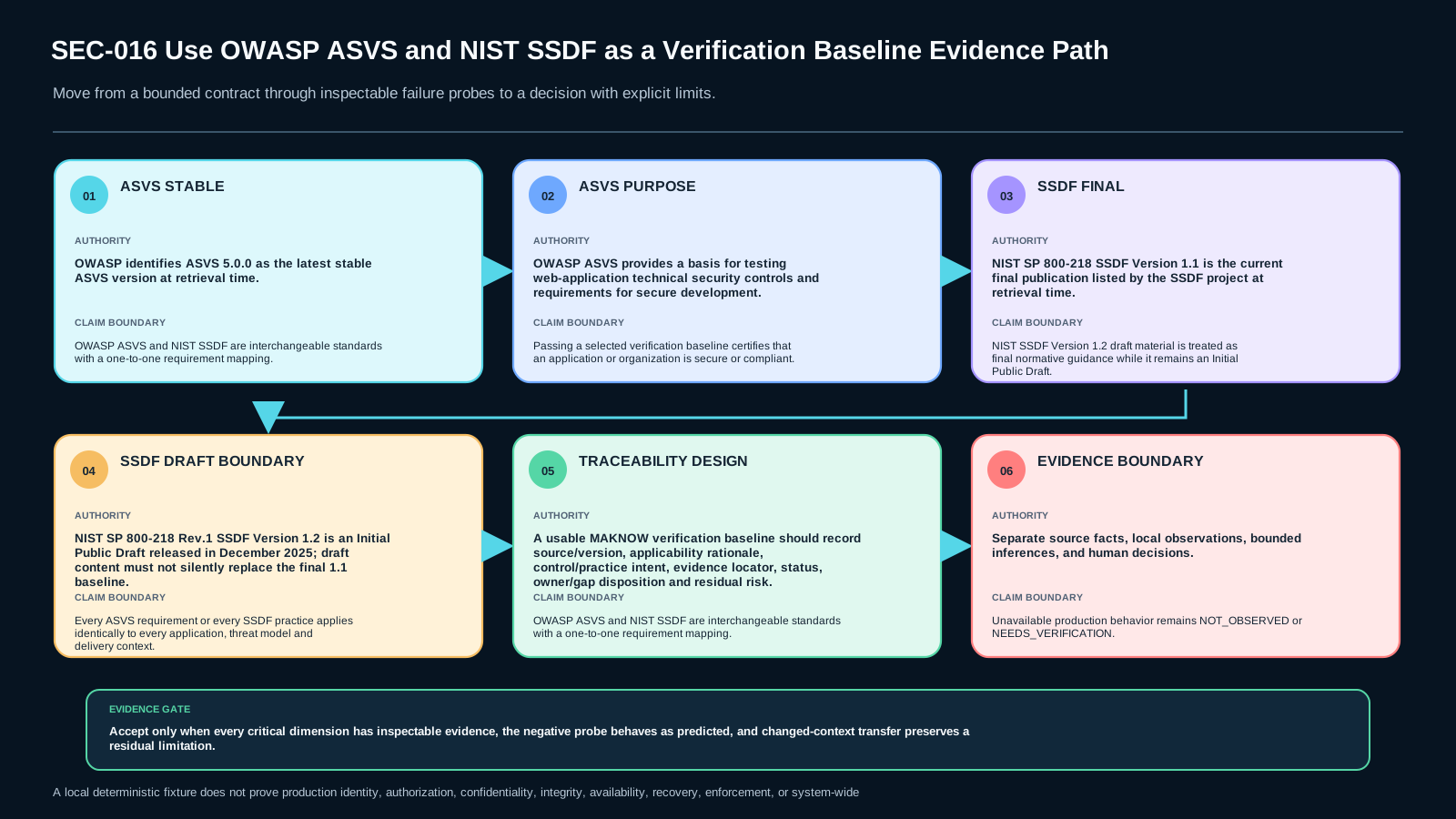
OWASP ASVS and NIST SSDF are useful together only when their different scopes stay visible. ASVS supplies application-security verification requirements; SSDF organizes secure-software development practices. They are not interchangeable checklists and do not create certification by themselves. A defensible baseline pins source version and status, records applicability, links evidence, leaves unsupported rows open, and preserves residual risk.
Keep three labels throughout the work: observed, bounded inference, and needs verification. When evidence is unavailable, record unknown. A product name or a passing happy path is not a substitute for evidence.
1. Pin the source and status
A requirement identifier without its ASVS version is unstable evidence. SSDF final and draft material must be labeled accurately; awareness of a draft is not permission to present it as final authority.
2. Keep scopes distinct
ASVS rows ask whether bounded application controls are verified. SSDF rows ask whether secure-development practices are performed. A useful crosswalk links evidence without pretending a one-to-one mapping.
3. Applicability needs a reason
PASS, FAIL, OPEN, and NOT_APPLICABLE are decisions. N/A without a threat, architecture, or process rationale is not a closed row.
4. Evidence must be locatable and build-bound
A row should name the exact test, review, artifact, or process record and the release/build it supports. A generic green dashboard or old report is insufficient.
5. Baseline completion is not certification
A selected set can support a release decision within a declared threat and product boundary. It does not prove the application or organization is universally secure or compliant.
Five-step method
- Freeze the synthetic service boundary, threat summary, release identity, and evidence date.
- Record ASVS version and selected requirement references; record SSDF publication version and status separately.
- For each row, write applicability rationale before assigning PASS, FAIL, OPEN, or N/A.
- Attach a precise evidence locator and verify that it concerns the same build and intended behavior.
- Mutate version, publication status, evidence locator, and N/A rationale; the gate must fail closed and preserve the gap.
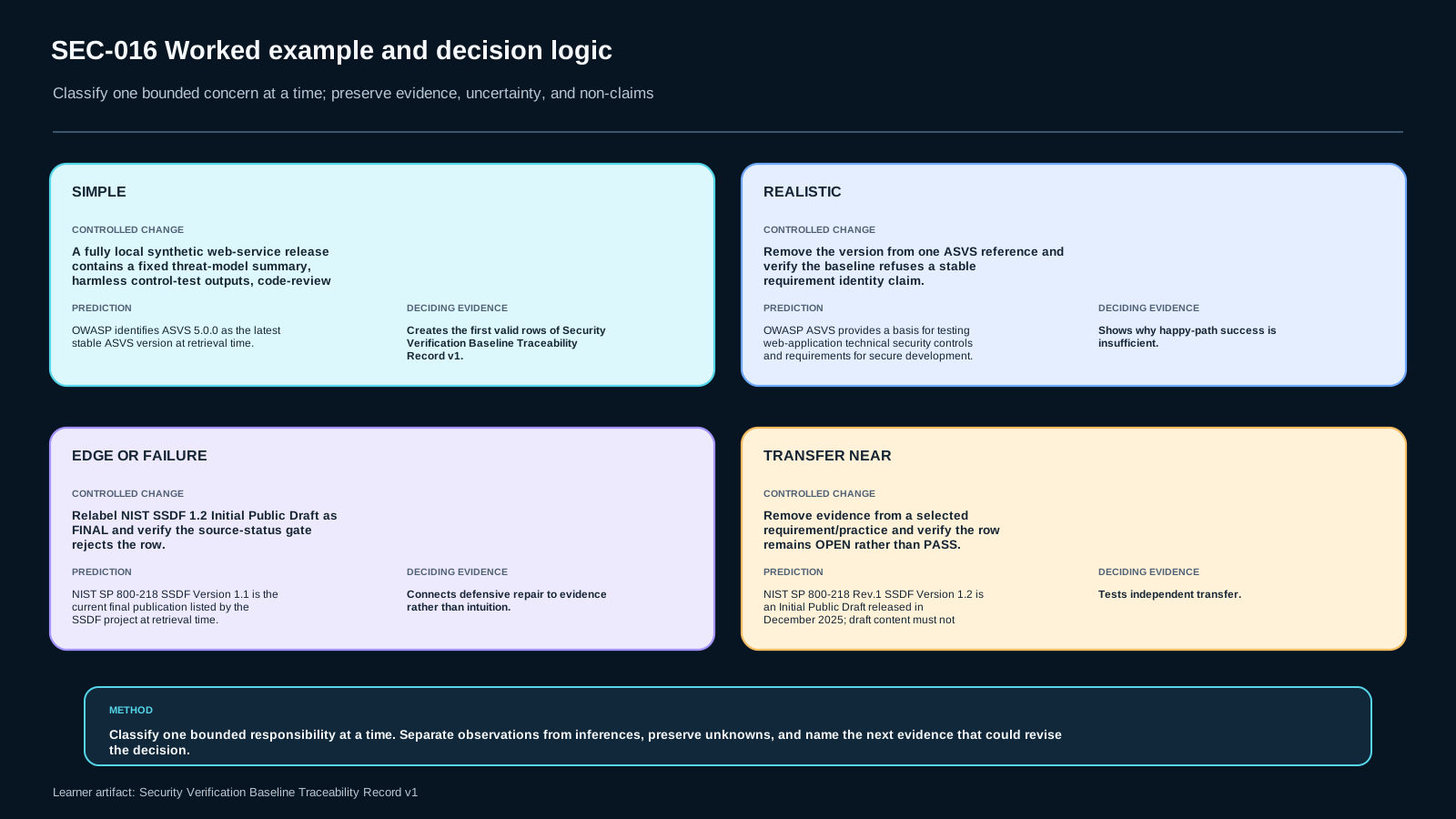
Worked case
A synthetic account service selects two ASVS 5.0.0 verification references and two SSDF 1.1 practices. One ASVS row points to a build-bound authentication test and passes. A second has no evidence and remains OPEN. An SSDF practice points to a review record. A draft-awareness row notes SSDF 1.2 material as draft and cannot silently replace the final baseline. Mutations remove the ASVS version, relabel the draft as final, delete an evidence locator, and mark a row N/A without rationale; each mutation is rejected without converting missing evidence into a pass.
Decision and evidence matrix
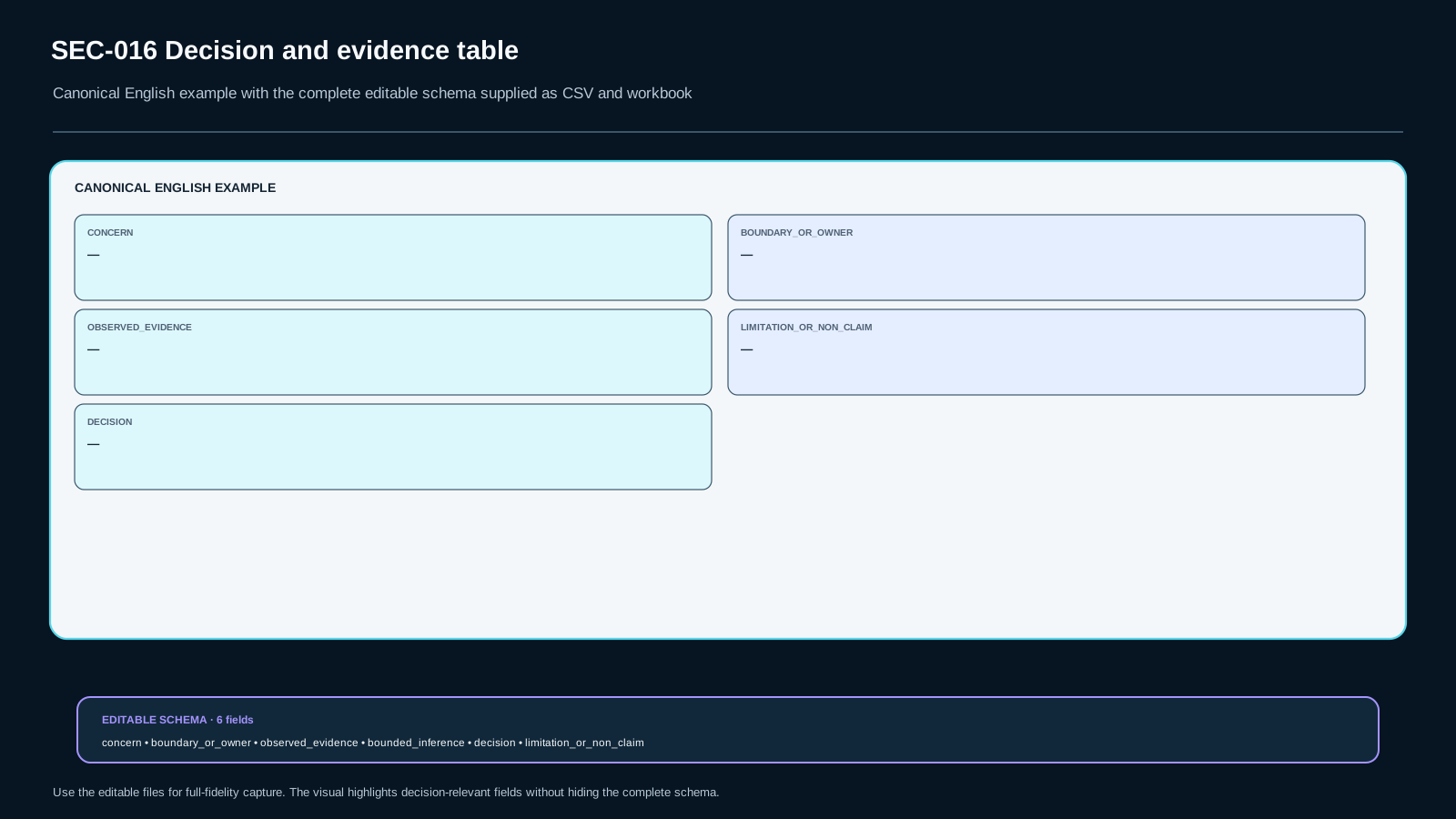
| Concern | Boundary or owner | Evidence | Decision or limitation |
|---|---|---|---|
| ASVS 5.0.0 control | Applicable | Build-bound auth test | PASS within selected boundary |
| ASVS 5.0.0 control | Applicable | No evidence | OPEN |
| SSDF 1.1 practice | Applicable | Review/process record | PASS for process evidence only |
| SSDF 1.2 draft awareness | Not final authority | Publication-status record | INFORMATIONAL |
| N/A row | Different threat boundary | Written rationale | N/A with residual note |
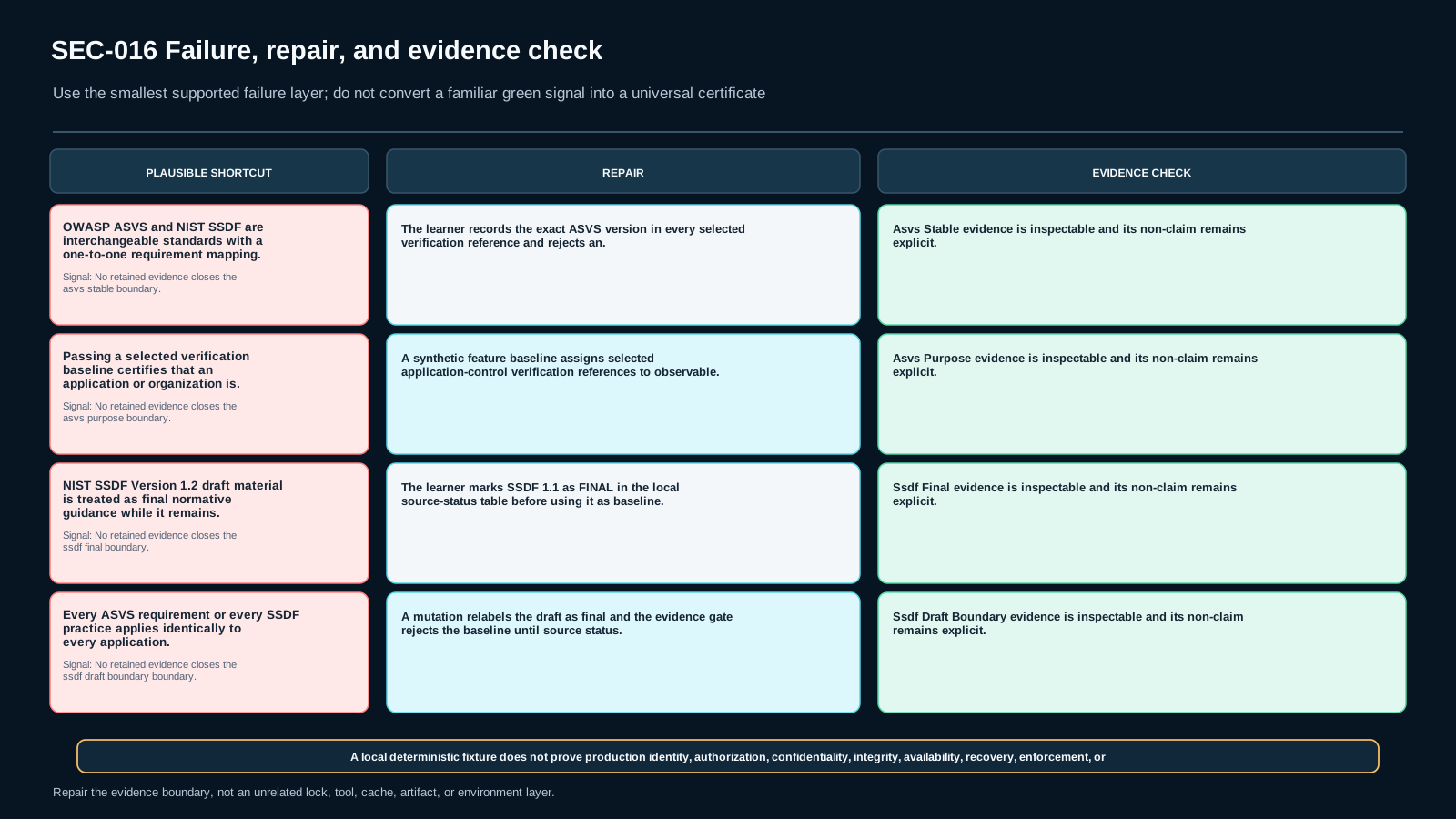
Failure probes and repair
- OWASP ASVS and NIST SSDF are interchangeable standards with a one-to-one requirement mapping.
- Passing a selected verification baseline certifies that an application or organization is secure or compliant.
- NIST SSDF Version 1.2 draft material is treated as final normative guidance while it remains an Initial Public Draft.
- Every ASVS requirement or every SSDF practice applies identically to every application, threat model and delivery context.
For each statement, narrow the claim, create a counterexample, and name the observation that could confirm or reject it.
Transfer challenge
Change the scenario so that one assumption in the worked case no longer holds. Rebuild the Security Verification Baseline Traceability Record v1 without copying the earlier decision, then explain what changed in the input and what stayed stable in the decision rule.
What this does not prove
This lesson does not claim certification, production guarantees, or coverage of every implementation. Its conclusion is valid only within the scenario boundary, dated sources, and recorded observations.
Self-check
- [ ] Did I separate responsibilities from framework or tool names?
- [ ] Did I state at least one failure probe and its predicted observable?
- [ ] Are fact, inference, and design choice visibly separated?
- [ ] Did I record non-claims and missing evidence?
- [ ] Did I complete transfer in a changed context without a prepared answer?
Sources and freshness boundary
Sources were reviewed for the frozen Bible as of 2026-09-19. A review_due date triggers a versioned requalification; it does not authorize silent in-place edits.
- OWASP-ASVS — Used for ASVS purpose, current stable version 5.0.0, and guidance to version-pin requirement identifiers. (https://owasp.org/www-project-application-security-verification-standard/; review: 2026-10-02)
- NIST-SSDF-11 — Used for final SSDF Version 1.1 scope as high-level secure software development practices. (https://csrc.nist.gov/pubs/sp/800/218/final; review: 2026-10-02)
- NIST-SSDF-12-IPD — Used only to record that SSDF Version 1.2 is an Initial Public Draft, not final authority, at retrieval time. (https://csrc.nist.gov/pubs/sp/800/218/r1/ipd; review: 2026-10-02)
- NIST-SSDF-PUBS — Used to distinguish the project publication status: 1.1 final and 1.2 draft at retrieval time. (https://csrc.nist.gov/projects/ssdf/publications; review: 2026-10-02)
Assessment
There is no answer key in this lesson pack; answer it yourself and mark honestly. "Needs review" sends the lesson to your review queue.
SEC-016-S1 retrieval
SEC-016-S2 application
SEC-016-S3 diagnosis
SEC-016-S4 decision
SEC-016-S5 transfer
Assessment rubric
| Dimension | Critical | Sufficient evidence |
|---|---|---|
| bounded security model correctness | yes | Explanation preserves the owned trust/control boundary and declared assumptions. |
| evidence quality | yes | Positive and negative observations are traceable and separated from inference. |
| scope discipline | yes | Adjacent security outcomes and unsupported assurance claims are deferred. |
| transfer independence | yes | Changed-context task is solved without decisive scaffold. |
A submission passes only when every critical dimension is sufficient and the learner states missing evidence honestly. AI suggestions are not observed evidence; the learner remains accountable for the final bounded judgment.
References & freshness
Case studies
Lab files
Build Security Verification Baseline Traceability Record v1 from the safe local fixture. First state a prediction. Then record the baseline, run or simulate the declared failure probes against the fixture, and preserve both positive and negative observations. Complete the transfer case without copying the worked lesson decision.
The starter intentionally does not choose the final classification or risk decision. Edit evaluate_record.py and the evidence template. Run python3 ../run_checks.py from this directory's parent to verify the environment and file shape; those checks do not grade your substantive decision.
Safety boundary: Synthetic defensive environment only; no real credentials, production systems, external targets, exploitation, vulnerability scanning or covert access.
Lesson media & slides
Teaching files (download)